Rules of Nations: The Dice Game
Summary
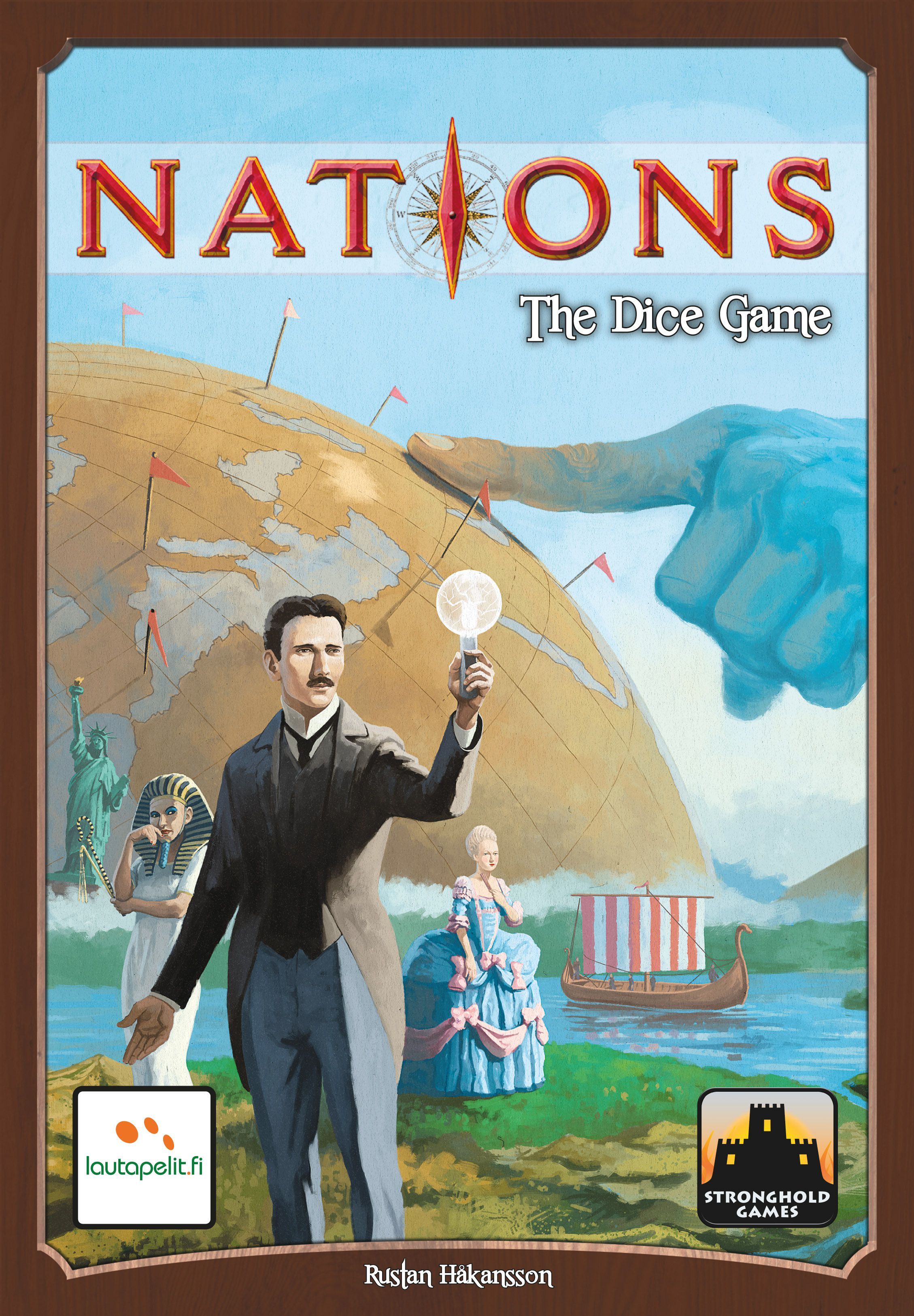
Nations: The Dice Game is a dice-based game of building a nation through four rounds of history. Players roll and spend dice and chits to buy tiles, build wonders, hire advisors, and fight for books, food and war. The player with the most victory points at the end of round four wins.
Setup
Sort the progress tiles into stacks by age (15 per age) and the event tiles into stacks by age (3 per age), then shuffle them into eight stacks. Shuffle the player order cards and deal one to each player. Give each player a player board, 5 white dice, one gold chit and one reroll chit, placed beside the board. Place a player marker for each player on 0 victory points and on the book track: player 1 starts on 1, player 2 on 2, player 3 on 3 and player 4 on 4. In a 2-player game, player 2 starts on 3 instead of 2.
A turn
At the start of each round, clear the old progress tiles and reveal new ones for the current age (age 1 in round 1, up to age 4 in round 4), filling 4 columns in a 4-player game and 3 otherwise. Replace the event tile, and return leftover tiles of the current age to the box. Move all chits and dice from the used area back beside your player board, turn your player order card face up, then roll all your dice before your first action.
Players then take one action each in player order, starting with player 1, until everyone has passed. Actions are:
- Reroll: move the reroll chit to the used area, then roll one or more unused dice.
- Buy tile: pay the cost in gold or strength shown by the row the tile is in (row 1 costs 1, row 2 costs 2, row 3 costs 3), moving dice and chits totalling at least that cost to the used area. Buildings, advisors, colonies and wonders are placed on your board as their rules describe.
- Build wonder: pay the cost in stone shown on your wonder under construction, then place the finished wonder beside your board.
You may trade dice at any time: two unused dice can be used in place of one gold, strength or food, but not for books or strength in that way, and chits cannot be traded. A pass ends your actions for the round.
After everyone has passed, score books, then famine, then set the new player order, then score war.
Books: in reverse player order, players may use book dice and chits, moving their book marker one step per book used. Each player then gains 1 gold for every other player with fewer total books (2 in solo and 2-player games).
Famine: in reverse player order, players may spend food to meet the event's requirement and gain the victory points shown.
Player order: the highest total of unused strength goes first, then the next highest and so on. Ties keep their previous relative order. Dice and chits are not moved for this.
War: in reverse player order, players may spend strength to meet the event's requirement and gain the victory points shown.
End of the game
After round four, each player adds the victory points shown on their wonders, colonies, buildings and advisors to their score. Wonders still under construction do not count. The game ends at that point.
Scoring
Victory points are tracked on the score board. Books, famine and war award victory points as described in the turn section, and final tile points are added at the end of the game. The player with the most victory points wins. Ties are broken by player order, with player 1 winning over player 2, and so on.
Variants
Solo game: you play against a shadow opponent that collects books and buys tiles. Both start with 1 book and only three columns of progress tiles are used. You are always player 1. When an event tile is revealed, roll one blue die per age number and give that many books to the opponent, ignoring wonder symbols. After each of your actions, roll the 4-sided die: on 1 to 3, remove the cheapest tile in column 1, 2 or 3 counting from the left; on 4, or if the column is empty, nothing happens. Score 2 victory points if you have more books than the opponent at the end of each round. Compare your final score with the Hall of Fame. For a harder game, reroll any 4s rolled for the opponent.
Changes
- Variants, by the rulebook draft, 23 November 2026 (shown now)
- Scoring, by the rulebook draft, 23 November 2026 (shown now)
- End of the game, by the rulebook draft, 23 November 2026 (shown now)
- A turn, by the rulebook draft, 23 November 2026 (shown now)
- Setup, by the rulebook draft, 23 November 2026 (shown now)
- Summary, by the rulebook draft, 23 November 2026 (shown now)