Rules of Navajo Wars
Summary
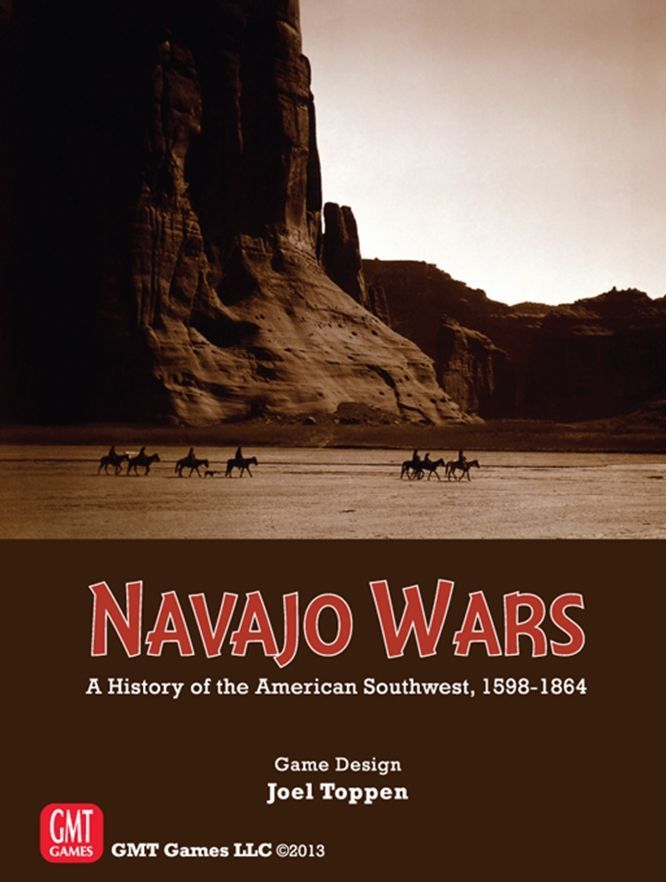
Navajo Wars is a solitaire game in which the player leads the Diné (Navajo) tribe through roughly 300 years of fighting for independence against colonial enemies, across the Spanish, Mexican and American periods. The player tracks Military Points, Culture Points and Enemy Morale on the General Records Track. The player wins at the end of a scenario by having more Military Points than Enemy Morale, or by driving Enemy Morale to zero; the player loses if both Military and Culture Points fall to zero.
Setup
Set up the game following the Playbook instructions for the chosen scenario. Each period can be played as a separate scenario of about 90 minutes, or the three periods can be played in sequence as a campaign.
A turn
Each turn is a card draw, resolved in this order:
- Card Draw: Draw and reveal the top card of the deck.
- Operations Segments (Operations cards only): The Enemy acts first, though the player may spend APs to Preempt and act first. The player then chooses exactly one of Planning, Take Actions, or Passage of Time, and the Enemy executes one operation using Enemy APs and Instruction counters.
- Major Event: Carry out the card's Major Event.
- Minor Event (Operations cards only): Carry out the card's Minor Event, such as Drought, Drought Recovery, an instruction swap, or Reset Cubes.
- Victory Check (Historical and Transitional Event cards only): Perform Good Medicine or a Victory Check.
- Discard Phase: Apply Fort penalties, check for automatic victory or defeat, discard the card unless it persists, reset Family Ferocity for Families without a man, and repeat if the scenario has not ended.
In Planning, the player gains APs from elders, may take Free Elder Actions, may buy Trade Goods, and may conduct Tribal Warfare or Tribal Diplomacy. In Take Actions, activated Families spend Movement Points on actions such as moving, raiding, planting and harvesting corn, and tribal council. In Passage of Time, the player adjusts population, returns and breeds animals, harvests corn, feeds population and animals, checks elders for death, and recovers land.
End of the game
The scenario ends on an automatic defeat, an automatic victory, or when the scenario's victory conditions are reached. Automatic defeat occurs when the player has zero Culture and zero Military Points. Automatic victory occurs during the Discard Phase when Enemy Morale is zero and no Family is in the same Area as a Fort; the player then rolls a die to determine a Major Victory or a reset of Enemy Morale. Transitional Event cards also end or change the game, such as the Kit Carson card, which leads to a final Tribal Raid sequence.
Scoring
Victory is decided by comparing Military Points with Enemy Morale at the end of a scenario, as set out in the scenario conditions. At a Victory Check, the player subtracts the Historical Event card's VP value from the total VP of Territories with Families, adding 1 Military Point if the result is positive or losing Military Points if it is negative. The player then subtracts Enemy Morale from Military Points, and Enemy Morale is reduced to zero. Next, Military Points rise by the number of men outside Fort Territories, up to a cap of 7, with Enemy Morale rising by the same number of boxes. Enemy Morale then rises by the number of Outposts, limited by the player's Military Points plus Outposts. Culture Points rise by the number of women outside Fort Territories, capped at 9, and lose 1 per Fort. Finally, the player may buy one Cultural Development card. When a point loss would take Military Points to zero, it converts to Culture Point losses, and vice versa. Ties are not separately addressed in the rulebook.
Variants
The rulebook describes a two-player game, with a Headman card and a Two Player Game option, both explained in the Playbook, and not covered in this rulebook. Playing the three periods as a campaign is also given as a longer challenge. The Playbook contains the individual scenarios.
Changes
- Variants, by the rulebook draft, 23 November 2026 (shown now)
- Scoring, by the rulebook draft, 23 November 2026 (shown now)
- End of the game, by the rulebook draft, 23 November 2026 (shown now)
- A turn, by the rulebook draft, 23 November 2026 (shown now)
- Setup, by the rulebook draft, 23 November 2026 (shown now)
- Summary, by the rulebook draft, 23 November 2026 (shown now)