Rules of Overboss: A Boss Monster Adventure
Summary
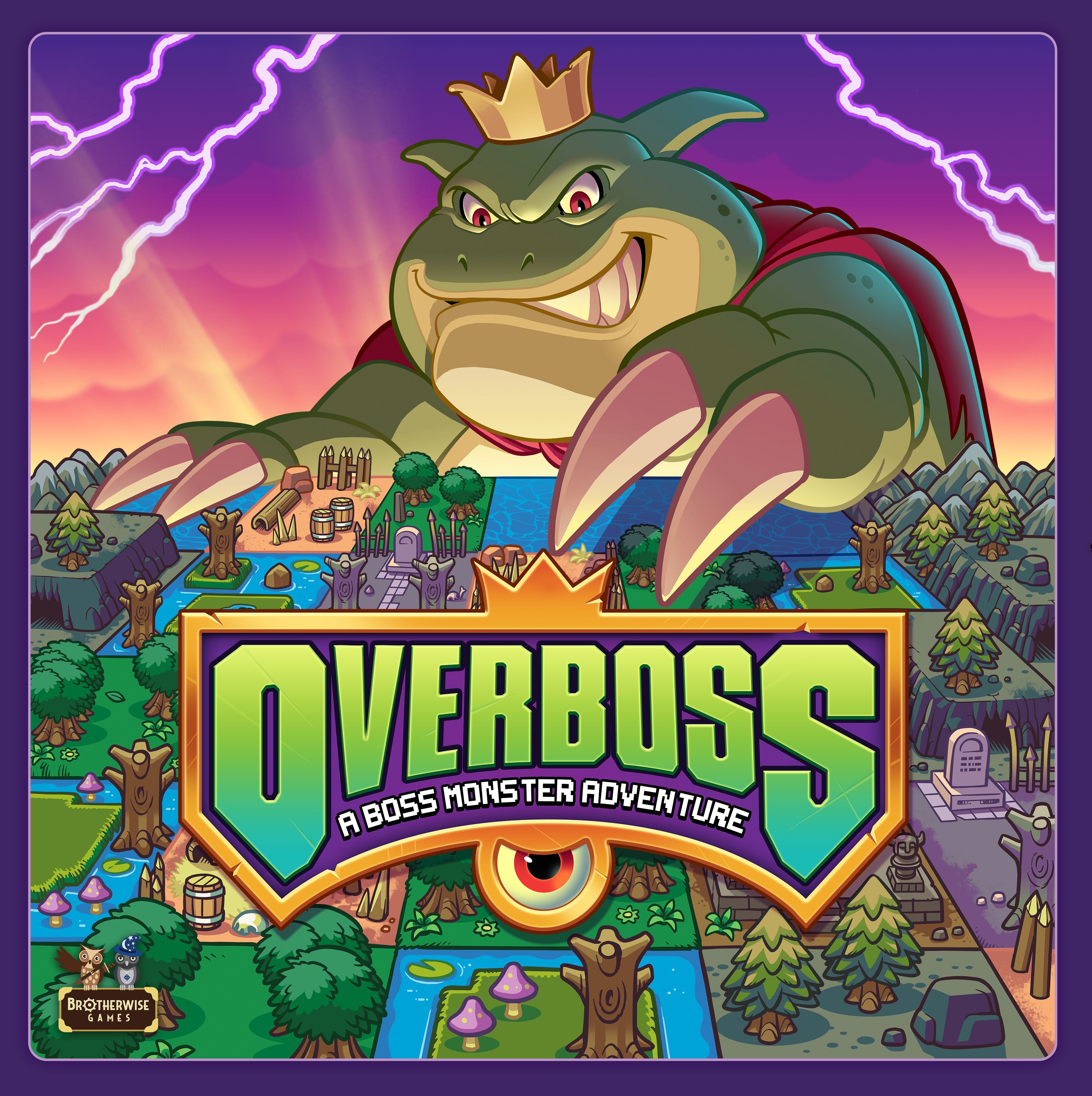
Overboss is a tile-placement game where each player builds a 3x4 map (or a larger 4x4 map) of terrain tiles and fills them with Monster, Miniboss, and other tokens. Players draft tile and token pairs from a shared market. The Boss with the highest Power score at the end of the game wins.
Setup
- Each player takes a player board and uses the 3x4 side for the classic game or the 4x4 side for a longer game.
- Choose 5 terrain types, either by picking them or by shuffling the terrain selection cards and drawing 5 at random. The rulebook suggests Forests, Caves, Graveyards, Swamps, and Camps for a first game.
- Take the 12 tiles of each chosen type, the 10 Monster tokens and 1 Crystal token for each type, all 8 Dungeon tiles, and the 6 Miniboss and 7 Portal tokens.
- Shuffle all tiles face down and set them near the play area as one or more stacks.
- Put all Monster and Crystal tokens, plus all Portal and Miniboss tokens, into the token bag.
- Draw four tiles and place them in the center of the table. Draw four tokens and place each one beside a tile to form four pairs. These pairs are the starting market.
A turn
Players take turns clockwise, starting with the first player, until every map is full.
On a turn, first draft one tile and token pair from the market. Then place the tile on an open square of your map. Next, place the token:
- Monster and Miniboss tokens go on an open terrain tile if one is available. Only one token may sit on a tile.
- Dungeon tiles cannot hold a token.
- If no open terrain tile is available for a Monster or Miniboss, put it in your lair. Your lair holds unused tokens without limit. A token in your lair can later be placed on a newly drafted tile in place of the new token, which then goes to the lair.
- Crystals and Portals always go to your lair.
At the end of your turn, refill the market so it has four tiles and four tokens again.
End of the game
The game ends once every player has completely filled their map with tiles. The round finishes with the last player, and then scoring begins.
Scoring
Power score comes from tiles and tokens.
Tiles:
- Forests: more Forests give more points, from 1 point for one Forest up to 15 points for five or more.
- Graveyards: each has a base value of 1 to 3. The Boss with the most Graveyards gets 5 bonus points and the Boss with the second most gets 2. Ties for first or second each receive that place's points.
- Camps: count unique Camps only, meaning Camps that share a flag color count once. Points rise from 1 for one unique Camp to 16 for four or more.
- Caves: 1 base point, plus 2 more if the Cave borders a mountainous map edge, for a maximum of 3.
- Swamps: 1 base point, plus 1 for bordering a watery map edge and 1 for being next to another Swamp, for a maximum of 3.
- Dungeons: 1 base point, plus 1 for each different terrain type bordering it, for a maximum of 5 when all four sides differ.
- Deserts: scored by connected group size. Groups of 1 score 0, 2 score 2, 3 score 6, 4 score 12, and 5 or more score 20.
- Cloud Islands: 7 points minus 1 for each non-Cloud Island tile type on your map, including Dungeons.
- Castles: 2 base points, plus 2 more if a vampire is on it, for a maximum of 4 points.
- Volcanoes are worth 4 points each. Summoning Circles are worth 1 point each.
Tokens:
- Bands: a straight line of 2, 3, or 4 identical Monsters scores 2, 5, or 7 points. One Monster may count in both a horizontal and a vertical band.
- Minibosses on a terrain tile are worth 2 points. They do not count toward bands.
- Matching Monsters (on the terrain type that shares their icon) are worth 1 point each.
- Crystals score 1 point per tile of their type on your map.
- Portals are worth no points.
The Boss with the highest total wins. Ties are broken first by the higher tile score, then by the most Matching Monsters. If still tied, the tied Bosses share the win.
Variants
Big Board: uses the 4x4 map, adds four more rounds, and is for up to four players. Your lair is the area beside your board.
Boss cards: deal two Boss cards to each player and keep one. Each Boss has a reveal ability that may be used once per game during your turn, and a scoring objective counted at game end whether or not it was revealed.
Command cards: deal four Command cards near the market. A player may activate at most one Command per turn by completing the shown pattern of same-type tiles, where the tile just placed must complete it. Intimidate moves a tile on any map, Demolish destroys a tile on any map, and Overthrow swaps two tiles on any maps.
Solo mode: High Score Mode plays one full game with any Boss, the Dungeons, and any 5 terrain types, aiming for the highest score. Campaign Mode runs six levels with a difficulty setting that provides hearts, which each track one game played. It uses Schemes and Side Quests to earn Soul Gems and a final title. Solo play earns bonus points for collecting Graveyards.
Changes
- Variants, by the rulebook draft, 23 November 2026 (shown now)
- Scoring, by the rulebook draft, 23 November 2026 (shown now)
- End of the game, by the rulebook draft, 23 November 2026 (shown now)
- A turn, by the rulebook draft, 23 November 2026 (shown now)
- Setup, by the rulebook draft, 23 November 2026 (shown now)
- Summary, by the rulebook draft, 23 November 2026 (shown now)