Rules of Panic on Wall Street!
Summary
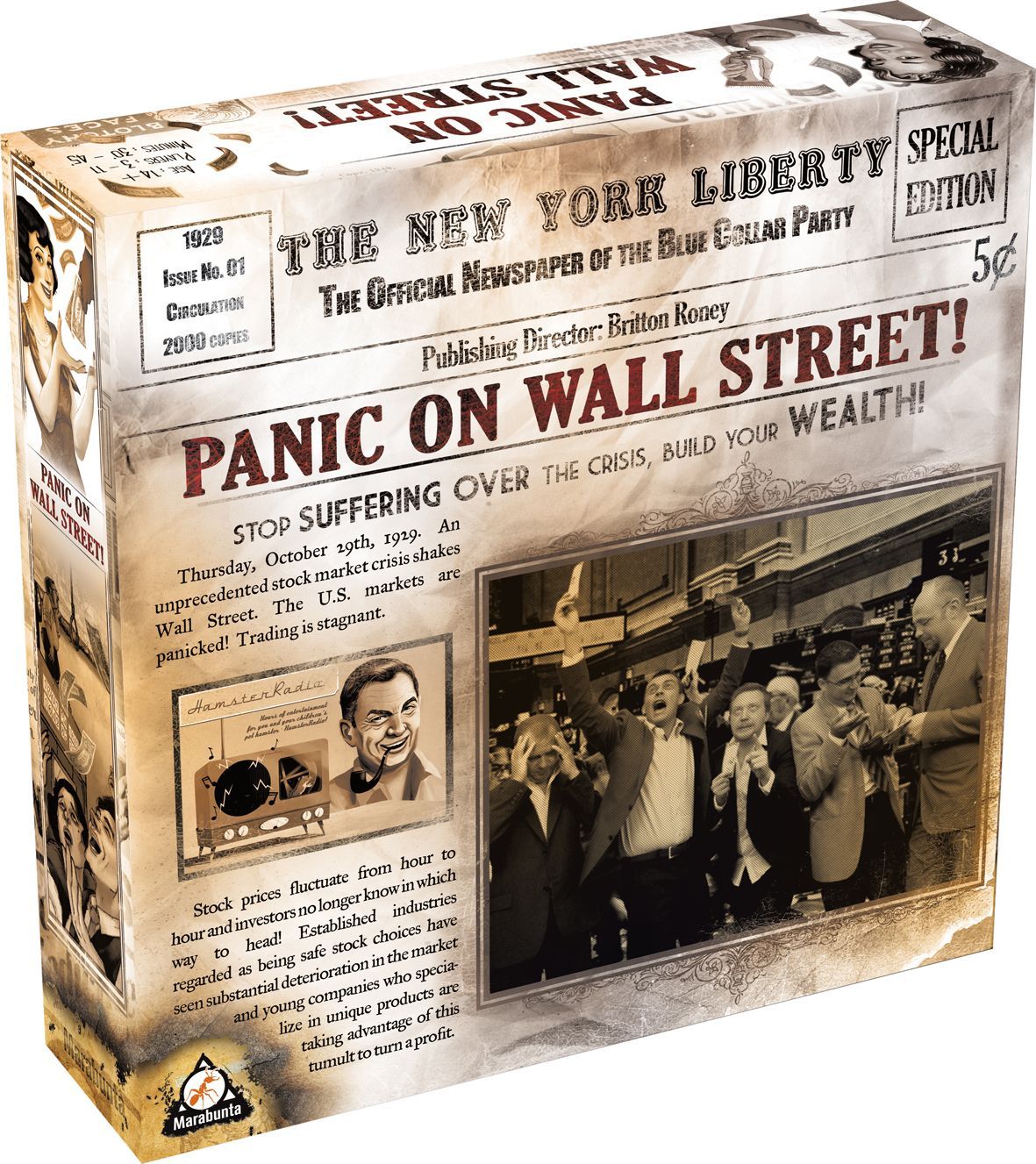
Panic on Wall Street! is a game of trading shares in companies over five months. Managers sell company shares to investors, who hope the share values rise. After five rounds, the manager and the investor who have accumulated the most money are each declared winners.
Setup
- Place the market board in the center, put the four colored indicators on their "start" spaces, and make a bank from the money.
- Each player rolls the red die. The highest rollers become managers and the rest become investors. The number of each depends on player count: 3-4 players see the variant; 5 players have 2 managers and 3 investors; 6 players have 3 and 3; 7 players have 3 and 4; 8 players have 4 and 4; 9 players have 4 and 5; 10 players have 5 and 5; 11 players have 5 and 6.
- Each player takes $120,000 from the bank.
- Each investor takes a bag of bank tokens.
- Shuffle the companies and deal 3 to each manager. If a manager is dealt a "2x" company, discard it and draw another. Put the rest face down as the company reserve.
- Managers arrange their companies as they like.
A turn
Each month is one turn and has five phases.
- Negotiation: Flip the timer for two minutes. Any investor may negotiate with any manager. A manager accepts an offer by writing the agreed price on a company and placing an investor's token on it. Deals can be renegotiated or withdrawn until time runs out. A company with its token on the "closed" side cannot be renegotiated that month. Deals without both a token and a written price do not count.
- Investor income: Roll the dice and move each color's indicator by the rolled amount, stopping at the ends of the scale. Each investor then collects or pays the value on the board for each company they hold of that color. A "2x" company doubles this income or loss, but not the purchase price or management costs.
- Manager income: Each manager collects the purchase price from each investor for their companies. If an investor cannot pay, the manager may force bankruptcy, which removes that investor, or agree informally to be paid later. Tokens stay in place until the next negotiation phase.
- Management costs: Each manager pays the bank $10,000 per company. A manager who cannot pay must sell companies to the bank at $5,000 each, returning them to the reserve. Any token on a sold company goes back to its investor.
- Company auction: A random investor is the auctioneer. They draw from the reserve a number of companies equal to twice the number of managers minus one, or all remaining companies if there are not enough. Each company is auctioned face up in turn. The winner pays the bank and adds the company to their portfolio. Companies no one bids on are removed from the game.
Scoring
The manager with the most money wins among managers. The investor with the most money wins among investors. There are therefore two winners in the standard game. The rulebook does not give a tie-break rule.
Variants
Three or four players: Each player is both a manager and an investor. During negotiation, a player may only buy shares in companies owned by other players. A player who goes bankrupt in the manager income phase can only continue as a manager, while a player who goes bankrupt in the management cost phase can only continue as an investor. In this variant there is only one winner, but the source text describing this is partly garbled.
Changes
- Variants, by the rulebook draft, 23 November 2026 (shown now)
- Scoring, by the rulebook draft, 23 November 2026 (shown now)
- A turn, by the rulebook draft, 23 November 2026 (shown now)
- Setup, by the rulebook draft, 23 November 2026 (shown now)
- Summary, by the rulebook draft, 23 November 2026 (shown now)