Rules of Power Grid: Factory Manager
Summary
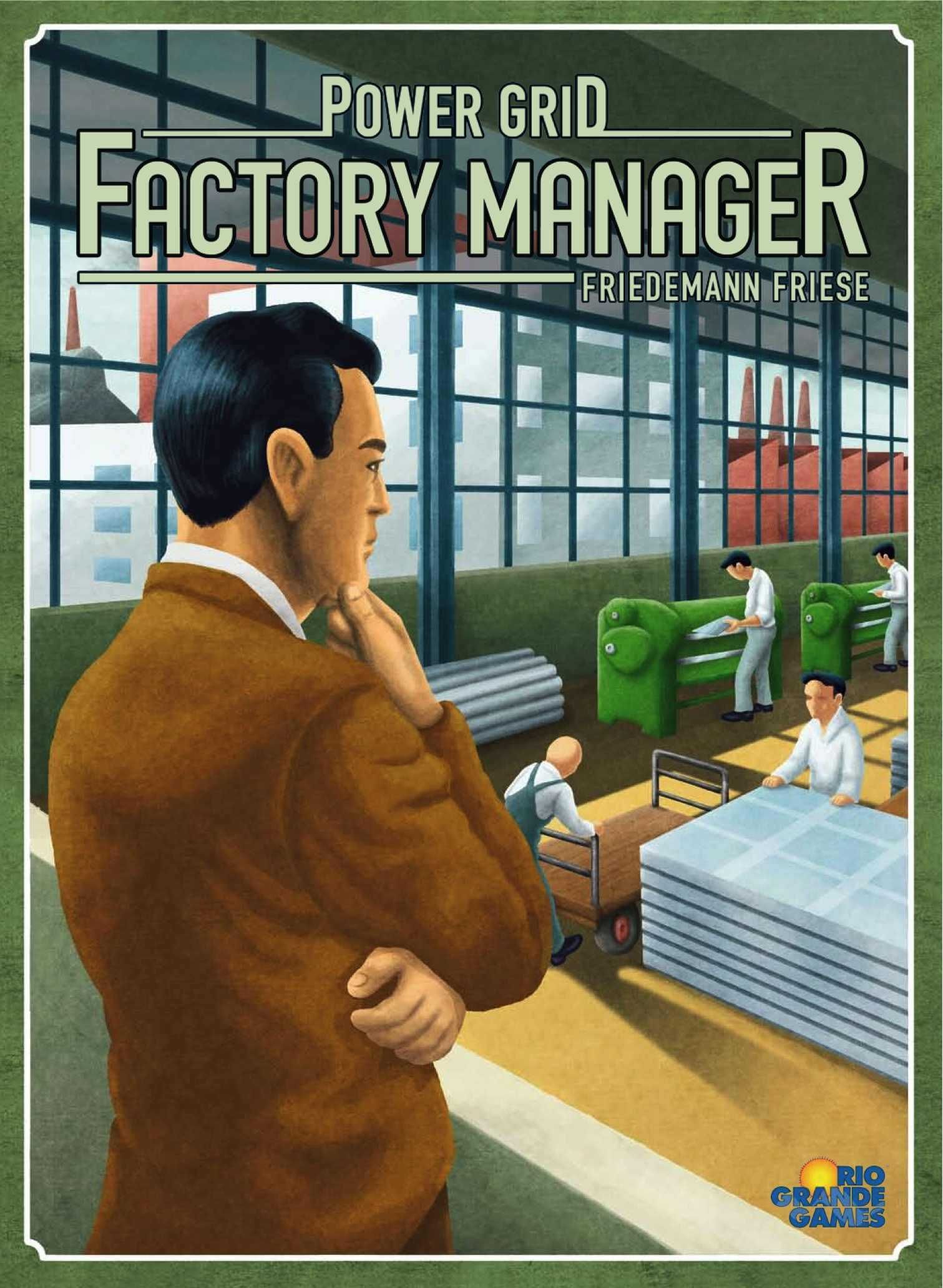
Factory Manager is a game for entrepreneurs, each running a factory over five rounds. Players bid for turn order, buy factory tiles from a shared market, and manage workers and energy costs to earn as much money as possible. After five rounds, the player with the most money wins.
Setup
- Each player picks a color and takes 7 workers, 3 markers, a factory board, and 18 Elektro.
- Each player takes a factory tile set (A to E, shown by the letter on the back). Place 3 storage tiles and 2 machine tiles on the first five spaces of the factory floor. Return unused sets to the box.
- Put each player's markers on the starting track spaces: production 2, storage 3, energy consumption 4.
- Each machine needs 2 workers, so place 4 workers in the canteen. Place the other 3 workers beside the factory.
- Put the remaining money, shut-down markers, and seasonal workers in the middle of the table.
- Remove unused player order tiles. Shuffle the rest and give one to each player at random. Shuffle the draw stack tiles and place them face down.
- Use the factory tiles marked with the matching player count on the back, and arrange them for the market as described in the supplement.
- Shuffle the six X tiles, remove 3 at random, and place the other 3 face up in the market.
- Shuffle the energy price tiles, remove 3 at random, and place the rest face down as a draw stack. Set the energy price marker to 1.
- First game only: set one "0" energy price tile aside, shuffle the other seven, remove 3, then put the "0" on top of the remaining four as the draw stack.
A turn
The game lasts five rounds, each with five phases.
- Auction the player order: Players bid in reverse player order using available workers to win new player order tiles. A winner places the bid workers on the tile, where they stay until the end of the round. A player must always keep at least one available worker. Once a player wins, he cannot bid again this round. The last player gets the remaining tile for free, and may optionally offer workers.
- Prepare the market: In turn order, each player chooses one factory tile from the market for each available worker, taking the cheapest tile in each column. He cannot choose fewer tiles than his available workers. The last player adds extra tiles to the market, based on the player count, and may add fewer or none.
- Buy, place, tear down, and hire: Starting with the lowest player order tile, each player uses workers to either buy a market tile and place it on his factory floor, or tear down a placed tile. A player with a player order tile numbered 4 to 12 gets a discount on purchases. The first ten factory spaces are free, while the last two cost 10 Elektro the first time they are used. Bought tiles can be stored beside the factory for later placement. Control and optimization tiles can only be used with matching tiles, and each player may have only one of each. After all actions, a player may hire up to two seasonal workers at 7 Elektro each, minus any player order discount. Retained seasonal workers must be paid for again. At the end of the phase, unbought market tiles return to the storage board.
- Bureaucracy and new energy price: Players return workers to the area beside the factory, then recalculate production, storage, and energy consumption from their tiles. Energy consumption has a minimum of 1. Players place workers in the canteen to run their machines. Machines or robots may be shut down temporarily if workers are short or if there are more robots than machines. Shut-down tiles do not use energy, but their values are not counted on the scales. Finally, draw the top energy price tile and move the marker by the number shown (0 to 2 spaces).
- Income: Each player's earnings equal the lower of his production and storage values. Subtract the energy consumption multiplied by the energy price. The result is taken from the bank. In the fifth round, all income is doubled.
End of the game
The game ends after five rounds. The player with the most money then wins.
Scoring
Money is the score. The richest player after the fifth round wins. Income from the final round is doubled before the comparison. If players tie on money, the player with the higher income in the last turn wins.
Variants
The rulebook gives a beginner setup for the first game only. Set aside one "0" energy price tile, shuffle the other seven, remove three, then place the "0" on top of the four remaining tiles. This keeps the energy price from rising at the end of the first round. Experienced players use the normal setup. The rulebook also recommends that new players use no more than four players, since the player order mechanism grows harder with more players.
Changes
- Variants, by the rulebook draft, 23 November 2026 (shown now)
- Scoring, by the rulebook draft, 23 November 2026 (shown now)
- End of the game, by the rulebook draft, 23 November 2026 (shown now)
- A turn, by the rulebook draft, 23 November 2026 (shown now)
- Setup, by the rulebook draft, 23 November 2026 (shown now)
- Summary, by the rulebook draft, 23 November 2026 (shown now)