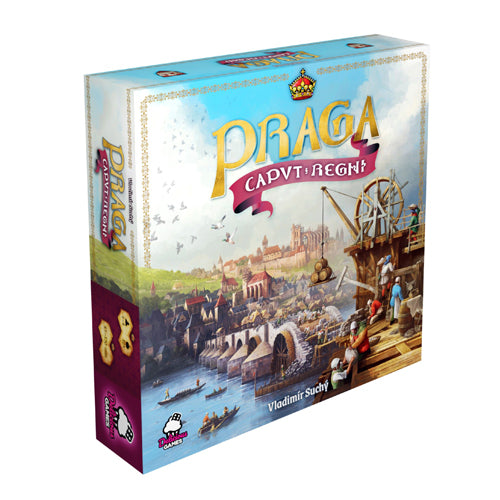
Rules of Praga Caput Regni
Summary
Heart of the Empire is a game where players are wealthy citizens funding building projects in medieval Prague to win favor with King Charles IV. Each turn you pick an action tile from the action crane and carry out actions, building up wealth, walls, technologies and academic standing. The player who has most impressed the king by the end, with the most points, wins.
Setup
Assemble the board as shown on the enclosed parchment, including the action crane, player boards, Charles Bridge, and the Hunger Wall and Cathedral (the 3D pieces are optional). Turn the crane wheel so its white arrow points to the icon for your player count, then place the six action tiles in the first six empty slots starting from the first red slot at the top, so they fill only the red and green zones and never the blue zone. Place one turn-counting cube on the wheel in the space shown for your player count, and place the other turn-counting cube on the platform space matching your player count. Each player chooses a color and takes a player board, that color's pieces, and an action board, and places the markers on their tracks as shown. The starting player is whoever was most recently in Prague, or can be chosen at random.
A turn
On your turn, first choose one action tile from the crane. Then perform the action shown on that tile, and optionally one extra action, which you can buy for two gold windows or for one gold window and one silver window. Actions can be taken in any order. Finally, rotate the crane and return your action tile to the start of the red zone. Tiles in the red zone cost you the price shown on the board, which you must pay before you take the tile. Tiles in the green zone are free of extra cost. Tiles in the blue zone give you the points shown on the board. The wheel bonus is yours to take, but you may delay it until later in your turn. Actions include managing gold mines or quarries, upgrading an action, constructing walls or buildings, constructing the King's Road, and paying for technologies or the Charles University track. When you refresh a hex tile row, you may pay one gold or stone, once per turn. Halfway through the game, when the platform cube crosses the Era I to Era II line, the Era I tiles are replaced by Era II tiles. In a two-player game, this happens a few turns later, when the wheel's arrow reaches the final red-zone space marked by the star.
End of the game
The game ends when the platform cube moves off the platform onto the hourglass at the end. At that point each player has taken exactly 16 turns. Players then move on to final scoring.
Scoring
Final scoring happens in order. First, unresolved plazas that were not enclosed during play pay out to every player with a claim on them. Next, points are scored for your technology advances, using your height on the Charles University track, from 0 to 3 points per advance. Then you score points for your row on the Hunger Wall and on the Cathedral. Next, you score points for your red and blue corner bonus tokens, multiplying each column's value by the number of tokens you have. After that, you count your built walls: 4 points for exactly 3 walls, 10 points for 4 or 5 walls, and 18 points for 6 or more. Then you use any final-scoring abilities you have claimed from Charles Bridge, the Cathedral, or the seals. Finally, you score points for your leftover eggs, based on the number you have. The player with the most points wins. A tie is broken in favor of the player who started later, so the player to the starting player's right wins all ties.
Variants
Solo play: set up as for two players and take the first turn. After each of your turns, simulate the opponent's turn by choosing the action tile farthest ahead, the one closest to the blue zone, then return it to the crane using the usual rules. The rulebook says a score above 140 is a good result. Alternative actions: use the B sides of the action tiles for a less symmetrical set of actions, but do not mix A and B sides, and some or all King's Road non-egg effects can be replaced with the tiles marked with Roman numerals. Different tiers: the Hunger Wall and the Cathedral can each use A tiers, B tiers, or the original tiers, but each project must use one consistent set.
Changes
- Variants, by the rulebook draft, 22 November 2026 (shown now)
- Scoring, by the rulebook draft, 22 November 2026 (shown now)
- End of the game, by the rulebook draft, 22 November 2026 (shown now)
- A turn, by the rulebook draft, 22 November 2026 (shown now)
- Setup, by the rulebook draft, 22 November 2026 (shown now)
- Summary, by the rulebook draft, 22 November 2026 (shown now)