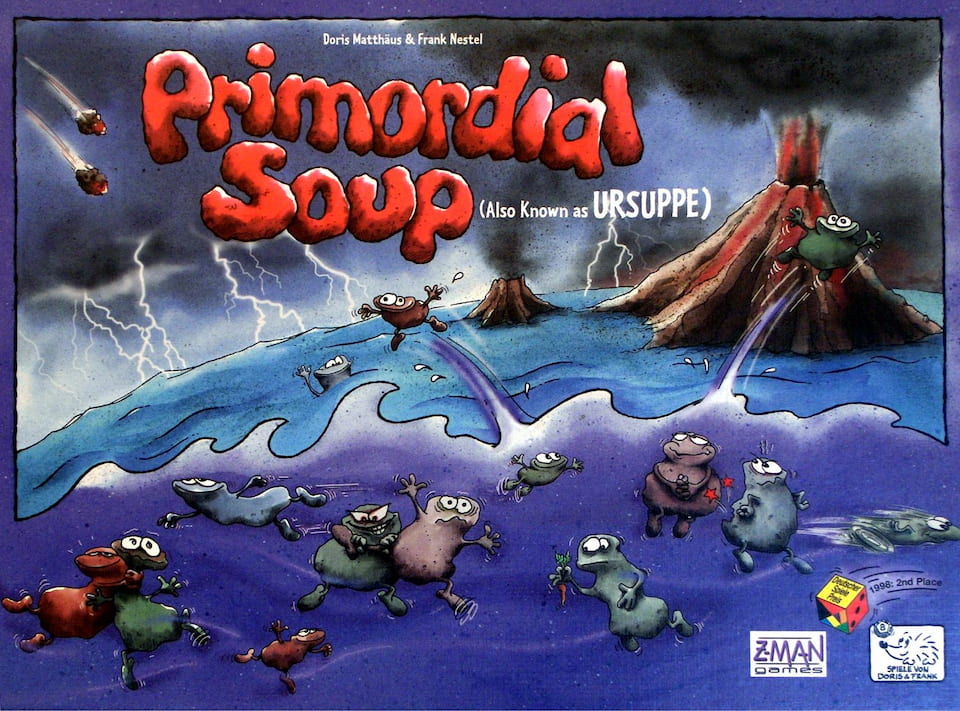
Rules of Primordial Soup
Summary
Each player controls a tribe of amoebas in the early history of life, where they feed, multiply and move. Players spend Biological Points (BP) to buy Genes that give their amoebas extra capabilities. The more living amoebas and the stronger their capabilities, the further a player's Score Marker advances on the Scoring Ladder. The player furthest along when the game ends wins.
Setup
Place the board open in the center of the table. Each player takes one color of amoebas, a reference booklet and 4 BP (small BP are worth 1, large BP are worth 5). Put two Foodstuff cubes of each in-play color on every space of the board and keep the rest nearby. Set aside the unused colors.
Shuffle the Environment Cards, place one face up on the Compass and put the rest face down. With three players, use only the Gene Cards marked with a 3.
Each player rolls two dice. The highest roller places a Score Marker on one of the spaces numbered 1 to 4 (1 to 3 with three players), and the others choose in descending roll order. Only one marker may occupy a space.
In Ascending Order (starting with the player on space 1), each player places one amoeba on an empty space and gives it one Damage Point (DP). With three players these amoebas get no DP. Then in Descending Order, each player places a second amoeba on an empty space without a DP. No space may hold more than one amoeba at the end of setup. Amoebas may be chosen in any order, not only by number.
A turn
A round has six phases, carried out in order.
1. Movement and Feeding (Ascending Order). The player deals with each of their amoebas on the board in numerical order, 1 to 7. Each amoeba either:
- drifts one space in the direction shown on the face-up Environment Card, or
- moves under its own power by paying 1 BP and rolling a die. Rolls 1 to 4 give a compass direction, 5 means no movement and 6 gives a free choice of direction. A move into an obstacle is cancelled.
Obstacles are the board edge and the Compass island. Amoebas do not block each other. An amoeba stays put if drift is blocked or the drift is zero.
After moving or drifting, the amoeba feeds. It eats three cubes per turn, never of its own color. With four players it eats one cube of each other color; with three players it eats two cubes of one color and one of another, the player choosing which. If it finds enough, it replaces the eaten cubes with two cubes of its own color, limited by the supply. If it cannot, it starves and receives one DP.
- Environment and Gene Defects (Descending Order). Replace the Environment Card. There are no Gene Defects in round 1. Otherwise, add the Mutation Points on your Genes. If the total exceeds the Ozone Layer Thickness, pay the difference by giving up Genes (counted at their Mutation Points) and/or BP (1 each). Excess points given up are lost. Returned Genes can be bought again.
- New Genes (Descending Order). Each player in turn may buy one Gene they can afford. No player may hold a duplicate. Gene effects apply to all of that player's amoebas at once and override the standard rules.
- Cell Division (Descending Order). Each player gains 10 BP and adds any saved BP. At 6 BP per amoeba, new amoebas with no DP may be placed on empty spaces that are orthogonally adjacent to an amoeba of the same color. A newly placed amoeba can support further placements.
- Deaths (all players). Amoebas with 2 or more DP die and are removed. Each death is replaced by two cubes of each in-play color. Dead amoebas can be placed again later.
- Scoring (Descending Order). Advance each Score Marker by the Advance Table (see Scoring).
If a player has no amoebas on the board, they may place one free on any space. With only one amoeba on the board, they may place a second anywhere but must still pay the normal cost.
Scoring
Each Score Marker advances according to the Advance Table, based on two counts:
- Live amoebas on the board: 0 to 2 gives 0 spaces, 3 gives 1, 4 gives 2, 5 gives 4, 6 gives 5, 7 gives 6.
- Gene cards: 0 to 2 gives 0 spaces, 3 gives 1, 4 gives 2, 5 gives 3, 6 or more gives 4.
Advanced Genes (PERSISTENCE, MOVEMENT II, AGGRESSION, ARMOR) count as two cards. RAY PROTECTION does not count.
A marker that would land on an occupied space leapfrogs it, so each space holds at most one marker. Markers advance in Descending Order.
The rulebook gives no tie-breaking rule. It only says the player whose marker is furthest along wins.
Variants
- Three players: only Gene Cards marked with a 3 are used, the starting spaces are numbered 1 to 3, the first amoebas get no DP, and the feeding rule changes to two cubes of one color and one of another.
- Shortened game: the players may agree to declare an earlier Finish Zone, which ends the game sooner.
The rulebook describes no other official variants.
Changes
- Variants, by the rulebook draft, 23 November 2026 (shown now)
- Scoring, by the rulebook draft, 23 November 2026 (shown now)
- A turn, by the rulebook draft, 23 November 2026 (shown now)
- Setup, by the rulebook draft, 23 November 2026 (shown now)
- Summary, by the rulebook draft, 23 November 2026 (shown now)