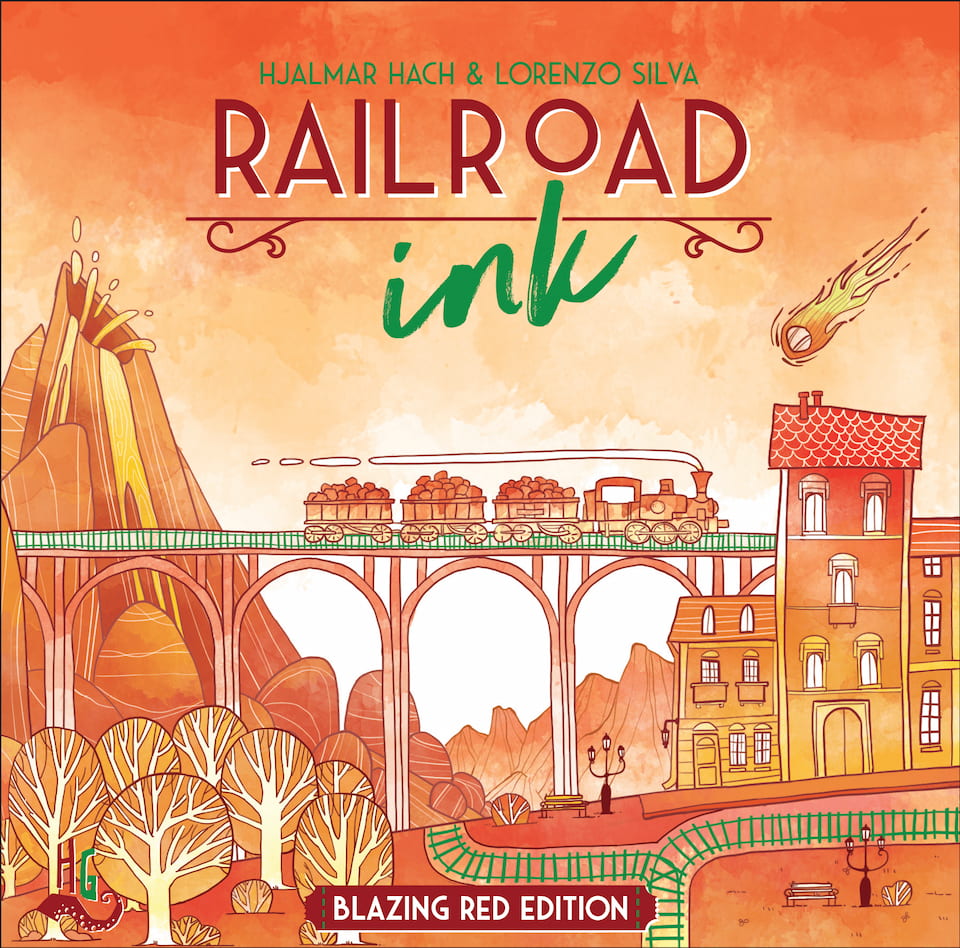
Rules of Railroad Ink: Blazing Red Edition
Summary
In Railroad Ink, players share the same dice rolls over 7 rounds and draw the shown routes on their own boards to connect Exits into Networks. Points come mainly from connected Exits, plus bonuses for your longest Railway, longest Highway and Central Spaces. The player with the most points after deducting Errors wins.
A turn
At the start of each round, roll the Route dice once and leave them visible to everyone. All players then draw the shown routes on their own boards at the same time. You may rotate or reverse each die pattern as you like.
Drawing rules:
- Each new route must touch an Exit or an existing route on at least one side. If it cannot be connected, it cannot be drawn.
- Draw all 4 routes shown, if possible, and each shown route only once.
- Railways and Highways cannot connect directly. Use a Station to join them.
Special Routes: the top part of each board lists 6 Special Routes that do not appear on the dice. You may use one per round, in addition to the dice routes. Each may be used only once per game, and you may use at most 3 in the whole game. Mark off each one after using it.
When everyone has finished drawing, write the round number in the white box of each space you drew on this round. Never erase routes from earlier rounds. Then roll the dice for the next round.
End of the game
The game ends after the 7th round. Then each player checks for Errors: every route end that does not connect to another route or to the board edge counts as an Error, and each one is marked on the board.
Scoring
Score each part and record it on the Scoring Table:
- Networks: each group of Exits linked by one Network is worth points based on how many Exits it connects, as shown in the Network Values on your board.
- Longest Railway and Longest Highway: 1 point per space in your single longest unbroken chain of that route type. Loops and branches do not count, and Stations do not break a Highway. If two chains tie for longest, only one counts.
- Central Spaces: 1 point for each of the 9 central spaces that has anything drawn on it.
- Errors: lose 1 point per Error.
- Expansion points: if using an Expansion, add them to the expansion space on your scoring board.
Add everything up. The player with the most points wins. If tied, the player with fewer Error marks wins. If still tied, the victory is shared.
Variants
The rulebook gives two optional Expansions. Use only one at a time. When using one, roll its dice together with the 4 Route dice each round. Both Expansions play 6 rounds instead of 7.
Meteor Expansion: each round a Meteor hits one space, which becomes a Crater and erases any route in it. Use the two Meteor dice to find the target, counting from the last hit space (from the Central Space in round 1). The Meteor bounces off board edges and skips over existing Craters. You may erase a Crater to draw a route there. At the end, gain 2 points for each route with an open end leading into a Crater. Open ends at Craters are not Errors.
Lava Expansion: draw a Volcano in the Central Space at the start. Each round you must draw at least one Lava die connected to existing Lava. You may start a new Volcano in a space not adjacent to existing Lava. If you have no room, you must open a new Volcano or erase a route to make room. Open Lava sides count as Errors. At the end, gain 5 points for each closed Lava lake and 1 point per space of your largest Lava lake, even if it is open.
Changes
- Variants, by the rulebook draft, 22 November 2026 (shown now)
- Scoring, by the rulebook draft, 22 November 2026 (shown now)
- End of the game, by the rulebook draft, 22 November 2026 (shown now)
- A turn, by the rulebook draft, 22 November 2026 (shown now)
- Summary, by the rulebook draft, 22 November 2026 (shown now)