Rules of Railways of the World
Summary
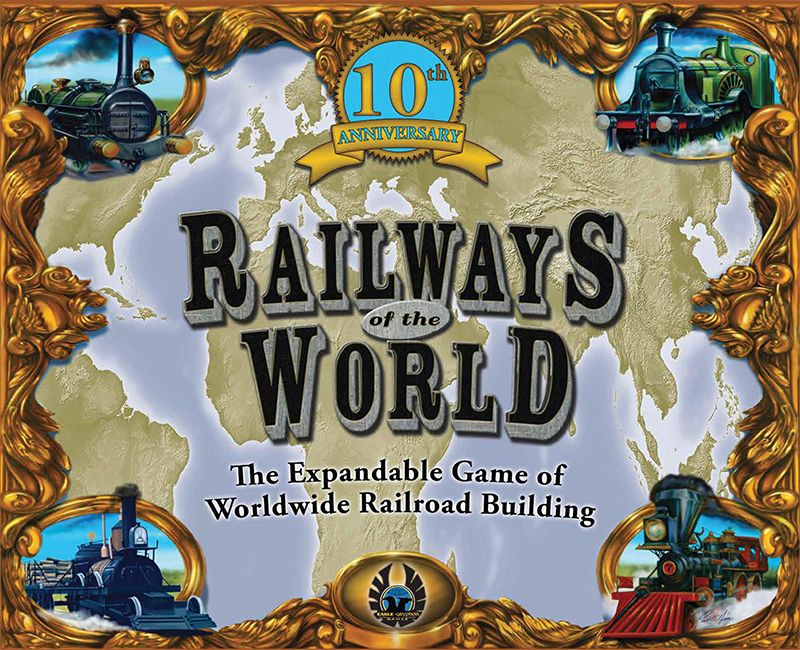
Railways of the World is a railroad game in which players build track between cities, deliver colored goods cubes to matching-colored cities, and earn income points for each link their cubes travel along. The player with the most victory points when the game ends wins. This reference follows the base game rules, with notes on the expansions and variants in the compendium.
Setup
- Place goods cubes in the bag, then draw and place cubes in each city equal to the number printed on it. In 2 or 3 player games, place one fewer cube per city, but never fewer than one.
- Place New City tiles face up by the map, track tiles beside it, bonds sorted by value, and the money as a bank.
- Set aside the empty city markers the map and player count require and return the rest to the box.
- Remove the three start Railroad Operations cards and place them face up. Shuffle the rest and reveal two cards per player.
- Place a spare empty city marker on the first Round space of the round track.
- Each player is dealt two Baron cards, keeps one face down, and returns the other unseen.
- Each player picks a color, takes that color's locomotives, places a level 1 engine card in front of them, and puts their income marker on the 0 space of the income track.
- Players start with no money and get it by issuing bonds.
A turn
A turn has three phases.
- First player auction: Starting with the youngest player on the first turn, then the previous first player, bidding moves clockwise. Each bid must beat the last, with a minimum opening bid of $1,000. A player who passes cannot re-enter. The high bidder becomes first player, takes the First Player marker, and pays the bank. If everyone passes, the player to the left of the previous first player becomes first player.
2. Player actions: There are three rounds. In each round, every player may take one action, starting with the first player and moving clockwise. Passing is allowed. Choose one action each round:
- Build track: Lay tiles that connect a city to an incomplete link you own, or start a new link from a city. You may lay up to 4 tiles, and you must stop once you reach another city. Cost per tile is $2,000 for open terrain, $3,000 for water, $4,000 for mountains, plus $4,000 when crossing a ridge. Redirecting track costs the terrain price again. Crossover track may be placed over existing track, including your own, but it does not connect to it.
- Urbanize: Pay $10,000 to place an unused New City tile on a gray city and add two random cubes from the bag to any cubes already there. If the city was empty, remove its empty city marker.
- Upgrade engine: Replace your engine card with the next level, paying the cost shown on the new card. You may upgrade only one level per action. The maximum level is 8.
- Deliver one goods cube: Move a cube along complete links to a city of the same color, up to your engine level in links. A cube cannot pass through the same city or link twice, and it must stop at the first matching city it reaches. You earn 1 income point for each complete link traveled, but you must own the first link. If the last cube leaves a city, place an empty city marker there.
- Take a Railroad Operations card: Claim one available card. Symbols mark how each card works: green circle cards are awarded to the first player to meet their goal; purple diamond cards can be used once per turn; red X cards are used immediately and discarded; hand cards are kept until used; cards with no symbol stay face up for the rest of the game.
Bonds: At any time during your turn, you may issue bonds at $5,000 each, but only as many as you need. Issuing bonds is not an action, and bonds can never be paid off.
- Income and dividends: Each player collects income equal to the value on their income track marker. Then each player pays $1,000 per bond issued. If you cannot pay, you must issue more bonds, and those new bonds are not charged dividends until the next income phase. Remove all incomplete links, return the round marker to the start, and reveal one more Railroad Operations card before the next auction.
End of the game
The game ends once the last empty city marker is placed on the map. The number needed depends on the map and player count. Finish the current turn, then play one more full turn, with every player taking three actions. After that, the game is over and final scoring takes place.
Scoring
Each bond a player holds costs them 1 victory point. Each point on the income track is worth 1 victory point, and the track marker's position is counted at the end. If a player's score passes 100, the marker returns to the start of the track and 100 is added to their final score.
Baron cards are revealed at the end. Players who meet their card's requirement earn its points. If players tie for a Baron requirement, no bonus is awarded.
The player with the most victory points wins. A tie is broken by the most track links, and if still tied, by the most money.
Variants
- Cut-throat blocking: You may not redirect your final tile on an incomplete link, which allows more aggressive blocking.
- First player auction variant 1: On the first turn, the least experienced player goes first and the others receive $1,000, $2,000, and so on, by turn order. After that, the normal auction applies.
- First player auction variant 2: A player who passes pays half their bid, rounded up, and their position is set by the order they drop out. The winning bidder pays the full bid and goes first.
- Eastern U.S. two-player variant: Neither player may build west of the mountains until one player reaches 30 points.
- Service bounties: Lay out all bounties at the start. Only the first is active. When one is fulfilled, the next becomes active at the end of the following full turn.
- Alternate Baron selection: Keep two Baron cards and discard one after the first Major Line is completed.
- Shorter game: Lower the empty city markers by 2.
- Transcontinental game: Combine the Eastern and Western U.S. maps into two phases. Players may return bonds for victory point penalties between phases, and Eastern cities can no longer be urbanized after the Western phase begins. A Faster Game option removes unconnected cubes and depletes gray cities.
- Optional add-ons (any map): The Event Deck, Rotor Cities, Fuel Depots, Mines, Switch Tracks, and hotel markers can each be added to the game. Each has its own rules in the compendium.
Changes
- Variants, by the rulebook draft, 23 November 2026 (shown now)
- Scoring, by the rulebook draft, 23 November 2026 (shown now)
- End of the game, by the rulebook draft, 23 November 2026 (shown now)
- A turn, by the rulebook draft, 23 November 2026 (shown now)
- Setup, by the rulebook draft, 23 November 2026 (shown now)
- Summary, by the rulebook draft, 23 November 2026 (shown now)