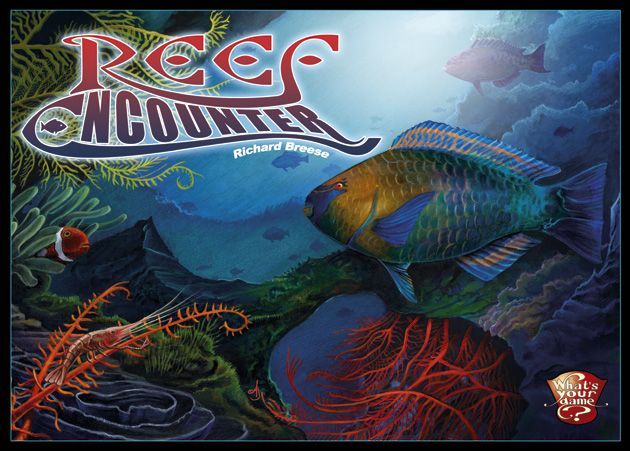
Rules of Reef Encounter
Summary
Reef Encounter is a game for two to four players in which you grow corals on reef boards, then feed them to your parrotfish. Points come from the polyps your parrotfish has eaten, counted at the end. The game usually ends once the coral hierarchy is settled or a parrotfish has eaten four corals.
Setup
Randomly choose a number of reef boards equal to the number of players and place them in the centre. Put one starting polyp on each of the five start spaces of each board, matching the coral type shown there.
Place the open-sea board, then five bonus polyps (one per colour) beside it. Put the remaining polyps in the bag. Set the alga cylinders and larva cubes beside the open-sea board.
Flip one coral tile to decide orientation. If its starfish shows, all ten coral tiles go on the open-sea board showing the starfish; if not, none do. Keep the double coral at the top.
Put a larva cube of matching colour on each of the five large coloured spaces. Draw a polyp from the bag, note its colour, and return it. That colour's space gets the first group of polyps. Draw and place 3, 3, 3, 2 and 1 polyps on the next spaces clockwise.
Each player takes a screen, four shrimps and a turn card in their colour, and keeps the shrimps behind the screen. Clockwise from the start player, each draws unseen polyps into their hand: with 2, 3 or 4 players the start player gets 6 and later players get more (second 9, 7 or 7; third 9 or 8; fourth 9). Each player then secretly puts one polyp into their parrotfish and takes two larva cubes, showing their colours. The start player is the one who most recently went swimming.
A turn
On a turn, a player may do the following actions:
- Eat one coral with the parrotfish (this comes first if used).
- Play a larva cube and up to four polyps of that colour from behind the screen, plus any consumed polyps of that colour.
- Play a second larva cube and polyps the same way.
- Introduce a new shrimp onto a coral that has no shrimp.
- Move a shrimp at any time between actions 1 and 9, even mid-action.
- Exchange a consumed polyp for a larva cube of the same colour.
- Exchange a consumed polyp for an alga cylinder, which must be played at once.
- Exchange a larva cube for a polyp of the same colour.
- Do nothing.
- Collect a larva cube and the polyps on its space from the open-sea board, then refill the space. This always ends the turn.
Actions 1, 2, 3, 4 and 10 are used at most once per turn. Actions 2 to 8 may be done in any order between actions 1 and 10. Each action must finish before the next starts, except action 5.
Polyps must join orthogonally to a same-colour coral. A polyp may not join two same-colour corals if both have a shrimp. Placing a polyp next to an empty extra-growth space automatically adds a free polyp of the right colour, which does not count toward the four-polyp limit.
A coral at least two polyps large may attack an adjacent weaker coral by placing a polyp on an unprotected polyp of that coral. The defeated polyp goes in front of the attacker's screen. Which coral is stronger is shown on the coral tiles.
At the start of a turn, the parrotfish may eat a coral of at least five polyps that is protected by its owner's shrimp. The first four polyps go back in the bag and the rest go into the parrotfish. If it is the player's first eaten coral, the shrimp goes on a shrimp space on the open-sea board; otherwise the shrimp goes into the parrotfish. A coral cannot be eaten after the player has already acted that turn.
End of the game
The game ends immediately when any of these happens:
- All coral tiles are covered by alga cylinders.
- All four of one player's shrimps have been eaten.
- There is nowhere left to play a polyp.
- There are not enough polyps or larva cubes to refill the board.
A player cannot cover the last uncovered coral tile with an alga cylinder unless their parrotfish has eaten at least two polyps, counting the one from setup.
If the game ends by the first or second condition, every other player gets one more turn. On that turn the only action allowed is eating one coral, and five polyps go back in the bag instead of four.
Scoring
Score each player's parrotfish. Each polyp scores one point, plus one for each coral tile that shows that coral type duplicated at the top. Each polyp is therefore worth 1 to 5 points.
If players tie on score, compare in order:
- Consumed polyps still in front of the screen.
- Unplayed larva cubes.
- Unplayed polyp tiles.
- Polyps on the boards that form part of a coral protected by that player's shrimp.
If still equal, the players share the placing.
Variants
For a longer, more tactical game:
- No bonus tiles are used when filling the extra-growth spaces.
- When a coral is eaten, five polyps go in the bag instead of four, and at the end of the game six instead of five.
Changes
- Variants, by the rulebook draft, 23 November 2026 (shown now)
- Scoring, by the rulebook draft, 23 November 2026 (shown now)
- End of the game, by the rulebook draft, 23 November 2026 (shown now)
- A turn, by the rulebook draft, 23 November 2026 (shown now)
- Setup, by the rulebook draft, 23 November 2026 (shown now)
- Summary, by the rulebook draft, 23 November 2026 (shown now)