Rules of Relic
Summary
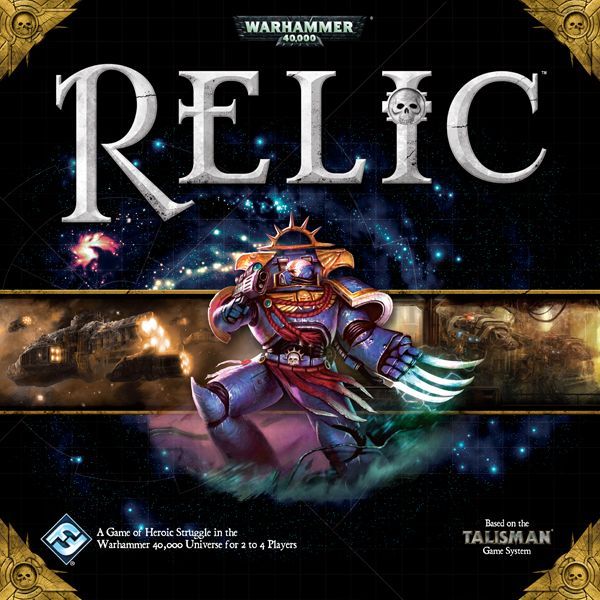
Relic is a game for two to four players, each controlling a Warhammer 40,000 character. Players move around the board, fight enemies, complete missions, gain levels and acquire relics. The first player to reach the centre scenario space and meet that scenario's victory condition wins.
Setup
- Place the game board in the centre of the play area.
- Choose a scenario sheet at random and place it on the scenario space. In a first game, use "The Mystery Beyond". One player reads it aloud.
- Sort the cards into their decks (Corruption, Mission, Power, Relic, the three Threat decks and Wargear). Shuffle each and place it facedown.
- Set the charge and influence tokens in supply piles.
- Deal two character sheets to each player. Each secretly picks one and returns the rest to the box.
- Each player picks a colour and takes the matching character board, base, tokens and level peg.
- Place your character piece on the starting space shown on your character sheet.
- Slide your character sheet into your board and put your level peg on "Start".
- Set your dials to the starting Strength, Willpower, Cunning and Life values.
- Take three influence tokens.
- Draw Power cards equal to your starting power limit and keep them hidden.
- Draw one Mission card and place it faceup. Carry out any immediate action it requires. The oldest player goes first, and turns pass clockwise.
A turn
Each turn has four phases in order.
- Movement: Roll one die and move your piece clockwise or anticlockwise exactly that many spaces. You must move and cannot stay put. Once you start moving you cannot reverse direction until your next turn. In the Inner tier you do not roll and instead move one space along the arrow.
- Exploration: Check the threat icons on your space. For each icon not already matched by a faceup Threat card of that colour, draw one card from the matching deck and place it on your space.
- Engagement: If Threat cards are on your space, resolve them in this order: events (then discard), battles with each enemy, encounters, then take any assets. If you lose a battle your engagement ends and you cannot resolve the rest. If there are no Threat cards, resolve the text box on your space instead.
- Experience: Spend trophies to gain levels, at six trophy points per level. Spend three completed missions to acquire a relic by revealing two Relic cards and keeping one. Draw a Mission card if you have no active mission. Discard any cards over your power or asset limit.
Battles: The battle form matches the enemy's attribute. The player to your left rolls for the enemy, then you roll. Add the roll, the attribute value and any bonuses to get your score and the enemy's score. Higher score wins. A win gives you the enemy as a trophy. A loss costs one Life. A tie gives no trophy and no Life loss, and your engagement ends.
End of the game
The game ends when a player wins by reaching the scenario space. To get there, a player must first hold at least one relic, which is gained by completing three missions. Relics let the player enter the Inner tier from the Guardian of the Rift space. Once on the scenario space, the player cannot move and must resolve the scenario's confrontation section during each Engagement phase.
A player who is corrupted and has no unused character sheets left is eliminated and loses. A player may also choose to lose instead of starting a new character after corruption. Eliminated players cannot affect the game further.
Scoring
The rulebook does not use a points total to decide the winner. The winner is the first player to meet the scenario's victory condition on the scenario space. If more than one player reaches that space, each resolves the confrontation during their own Engagement phase, and the first to fulfil the winning condition wins.
Trophy points are the only points counted. Each enemy taken as a trophy is worth its attribute value, and six trophy points buy one level.
For battle ties, the battle score is compared. A tie means no trophy, no Life lost, and the enemy stays on the space, ending the engagement.
Changes
- Scoring, by the rulebook draft, 23 November 2026 (shown now)
- End of the game, by the rulebook draft, 23 November 2026 (shown now)
- A turn, by the rulebook draft, 23 November 2026 (shown now)
- Setup, by the rulebook draft, 23 November 2026 (shown now)
- Summary, by the rulebook draft, 23 November 2026 (shown now)