Rules of Roads & Boats
Summary
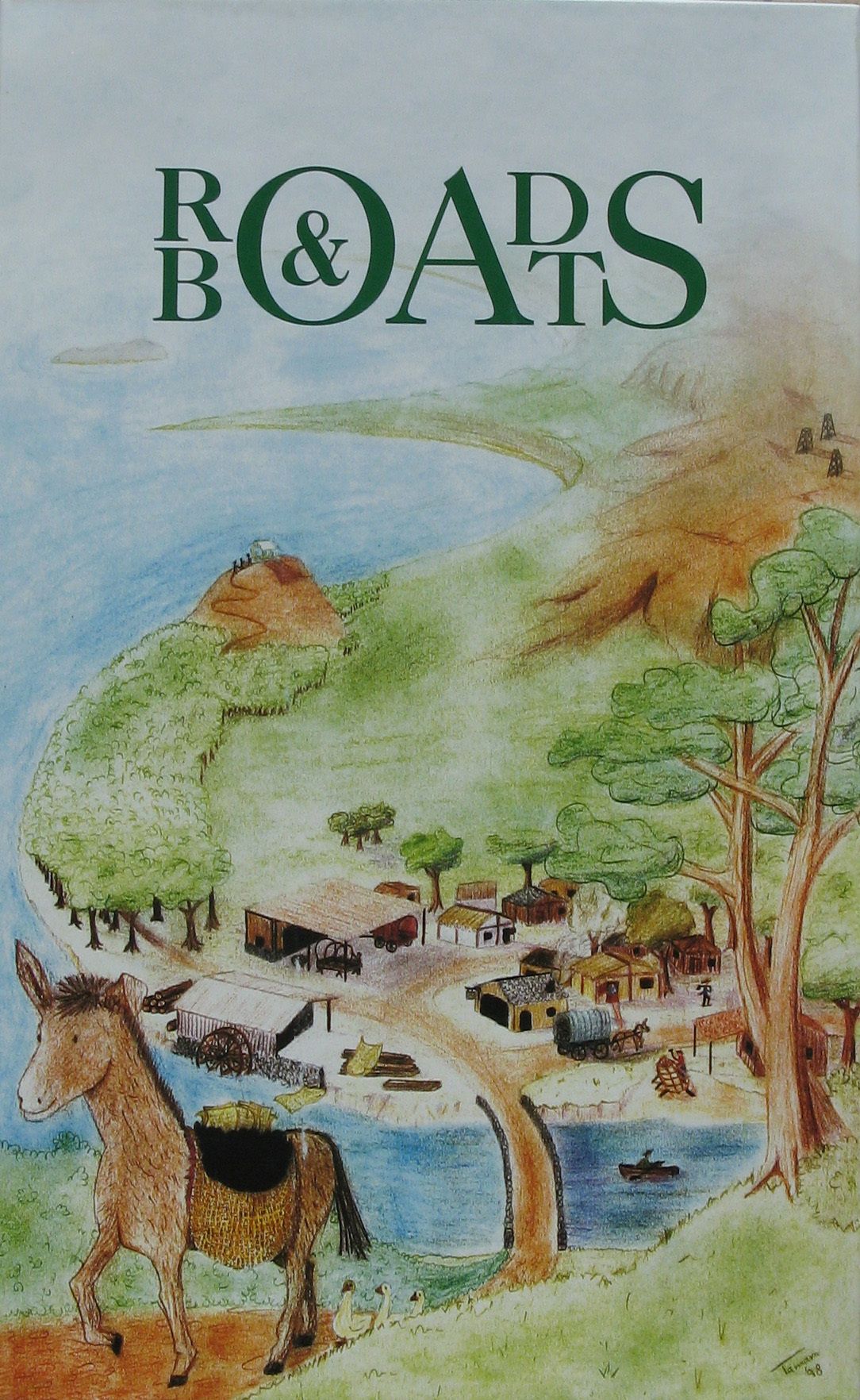
Roads & Boats is a game about logistics and transport rather than warfare or territory. Players build up a civilization over turns by moving goods with transporters and constructing buildings, roads, boats, walls and wonder bricks. The game ends when the wonder is completed, and the player with the most wealth points wins.
Setup
Build a map of hexagonal land and sea tiles, with rivers placed naturally, using about ten land tiles per player, or use a map from the scenario book. Cover the map with the plastic sheet and fix it in place. Determine the starting sequence by drawing praying figures from a cup and placing them on the temple row, with the first drawn closest to the temple and its sequence marker placed furthest left on the sequence chart. Players then choose starting land tiles in that order, keeping at least one empty tile between each starting tile and the nearest neighbour, and mark them with their home marker. Each player receives 3 donkeys, 5 sets of boards, 1 pile of stones and 2 geese on the starting tile. Each player takes a colour's transporters, walls, wonder bricks, home marker, research table and player aid, and covers each research table slot with a research marker. Place a glass stone on the phase chart and set up the wonder board next to the playing area.
A turn
Each turn has four phases played in order: (re-)production, movement, building and wonder construction. Players act simultaneously unless a conflict requires a playing sequence.
- Production: Primary producers (woodcutters, stone quarries, clay pits, oil rigs, mines) create goods each turn, and mines draw a random counter from their bag. Secondary producers (sawmills, stone factories, coal burners, papermills, mints, stock markets) turn input goods into output up to their capacity. Factories can also produce transporters, and research can be produced from two geese and one paper. Livestock pairs reproduce on empty pasture tiles. Goods from producers are placed on the tile or on a transporter.
- Movement: Each transporter may move once per turn. Land transporters move along roads, except donkeys, which can also cross roads-free tiles one step at a time. Donkeys move up to 2 tiles, wagons 3 and trucks 4, carrying up to 2, 3 and 6 goods. Goods may be moved by only one transporter per movement phase. Boats move on rivers and sea, may dock on a shore, and carry or move goods between transporters. Geese follow transporters that leave their tile.
- Building: Players may build buildings, roads, bridges, walls and mine shafts on tiles where they have a transporter, using goods from their own transporters or the tile. Only one building may stand on each tile, and buildings cannot be removed. Walls can be strengthened or demolished, and walls block other players' colours.
- Wonder: Players may buy wonder bricks using goods from their starting tile, which must also hold one of their transporters. The price of each additional brick rises within a turn. After all players have acted, a neutral brick is added.
End of the game
The game ends as soon as the wonder is completed, which happens when a brick covers the marker showing the number of players. The game also ends when the last neutral brick is placed, which is after 33 turns.
Scoring
The player with the most wealth points wins. Wealth points come from gold nuggets (10 points each), sets of coins (40 points) and stock bonds (120 points), but only if these items are on a transporter and not lying unattended on a tile. Each row of the wonder scores 10 points, divided evenly among the players' bricks on that row, with each total rounded down. The last row scores 10 points even if incomplete. Neutral white bricks do not affect scores. A table on the back cover gives row scores. In case of a tie, the tied player whose praying figure is closest to the temple wins.
Variants
The rulebook gives a scenario book with one-player rules and strategy hints, and suggests maps from the scenario book for inexperienced players. It also allows players to design their own map, with the amount of land and sea varied to change how interactive the game is. Beginners are advised to treat their first games as practice.
Changes
- Variants, by the rulebook draft, 23 November 2026 (shown now)
- Scoring, by the rulebook draft, 23 November 2026 (shown now)
- End of the game, by the rulebook draft, 23 November 2026 (shown now)
- A turn, by the rulebook draft, 23 November 2026 (shown now)
- Setup, by the rulebook draft, 23 November 2026 (shown now)
- Summary, by the rulebook draft, 23 November 2026 (shown now)