Rules of Runewars
Summary
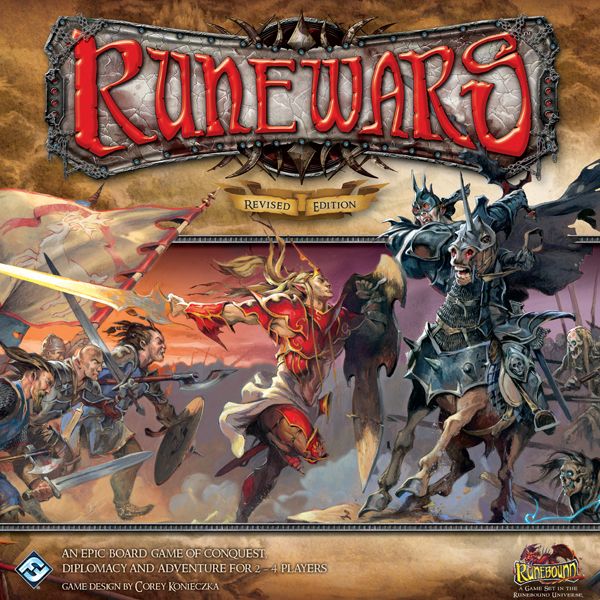
Runewars is a game for two to four players, each controlling a faction's army in the land of Terrinoth. Players spread their empire, conquer territory, recruit heroes, and gather dragon runes. The player who controls the most dragon runes at the end of seven game years wins, or a player holding six dragon runes can try to win sooner with a Victory card.
Setup
- Choose first player: Deal one Fate card to each player; the highest number goes first.
- Choose factions: In clockwise order from the first player, each player takes a faction's components, including faction sheet, figures, home realm tile, tokens, Victory card, and Order cards.
- Build game board: Follow the eight-step board setup (see below).
- Build Quest deck: Remove Quest cards for areas not on the board, then shuffle the rest with each player's Setup Quest cards.
- Set starting resources: Set each resource dial to the red number on the faction sheet.
- Place stronghold and starting forces: In clockwise order, place one stronghold in your home realm, then recruit and place starting units there.
- Receive starting hero: Deal each player one Hero card matching his alignment, and place the hero figure in his home realm.
- Place card decks: Shuffle each deck separately and place them by the board. Place the three Title cards faceup.
- Place markers and tokens: Put the battle marker, defeated hero markers, damage tokens, influence tokens and training tokens in piles, and place rune tokens faceup in separate dragon and false piles.
- Receive Tactics cards and influence: Each player takes the amounts shown on his faction sheet.
- Draw starting Quests: Each player draws two Quest cards.
- Draw Objective cards: Each player draws one Objective card matching his alignment and keeps it facedown.
Game board setup:
- Each player is dealt two faceup Setup Quest cards.
- Each player receives the map tiles named on those cards, assembling puzzle-fit pieces if needed.
- Starting with the first player, players place their map tiles so that at least two hexes touch two hexes of placed tiles. Mountain and water borders may not touch parallel borders.
- The first player places one home realm setup marker per player along the board edge, following spacing rules.
- Counterclockwise from the first player, each player secretly places one dragon rune and one false rune facedown in two areas he chooses.
- Clockwise from the player left of the first player, each player swaps a home realm setup marker for his home realm tile. If home realms touch, redo steps 4 to 6.
- Place neutral units in each area as its icon shows.
- Place one city token faceup on each city space; return unused tokens to the box.
A turn
Each game is played in seasons. The seven game years each have four seasons: spring, summer, fall, and winter. Each season has three steps:
- Resolve a Season card: The first player draws the top card of the matching Season deck. Resolve its primary ability first, then its secondary ability.
- Choose Order cards: Each player picks one Order card from his hand and places it facedown. This is his active Order card.
- Resolve Order cards: Reveal the chosen cards at once. Players resolve them in order from lowest number, with ties going to the player with more influence. Each card's primary ability resolves first. If the card is your highest-numbered Order card in play, you may also use its Supremacy Bonus.
Season secondary abilities:
- Spring: Remove all activation tokens, return used Order cards to hand, and stand all routed figures.
- Summer: A Quest Phase happens. Starting with the lowest Order card number, each player may move, heal, or train each hero, and may duel or attempt a quest after moving.
- Fall: Shuffle the Fate discard pile into the Fate deck. Each player then chooses to take two influence or draw one Tactics card.
- Winter: Each player's unit limit per area becomes his food dial value, and excess units are destroyed. Water borders are ignored this season.
Order cards:
- Strategize (1): Move units and heroes into adjacent friendly or empty areas.
- Mobilize (2): Activate an area and move units and heroes into it; starts battles or diplomacy.
- Conquer (3): Same primary ability as Mobilize, with a bonus against strongholds.
- Harvest (4): Set resource dials to match the resources of controlled areas.
- Recruit (5): Choose a resource and recruit units at friendly strongholds.
- Rally Support (6): Gain benefits from controlled cities.
- Acquire Power (7): Gain influence based on resource dials.
- Fortify (8): Build or repair strongholds and move rune tokens.
Battles and diplomacy happen when units enter areas with enemy or neutral units. Diplomacy costs one to six influence and draws Fate cards to decide whether neutral units ally. Battles run up to five rounds, and the highest total strength wins, with ties going to the defender.
End of the game
The game ends after winter of the seventh game year. A player can also win earlier by controlling six dragon rune areas and resolving his Victory card. To do so, he reveals six dragon runes and places his Victory card on the current Season deck; if he still has six runes when it resolves the following year, he wins. No Victory cards may be placed during the seventh year.
Scoring
At the end of the game, all rune tokens are flipped faceup. The player controlling the most dragon runes wins. Ties are broken by the most influence tokens, then by the highest starting influence.
Variants
Exploration Tokens variant: Players agree as a group before the game whether to use it. During setup, one exploration token is placed facedown in each non-home-realm area; areas next to a home realm get a "1" token, and other areas get a "2+" token. After a hero's move in the Quest Phase, the hero's player flips and resolves any token in the hero's area before dueling or questing. Tokens are events, which are discarded after use, or locations, which stay in play. Destructible locations can be discarded by a player controlling the area with at least six units.
Victory cards are described in the rulebook as a mandatory option, not a variant.
Changes
- Variants, by the rulebook draft, 23 November 2026 (shown now)
- Scoring, by the rulebook draft, 23 November 2026 (shown now)
- End of the game, by the rulebook draft, 23 November 2026 (shown now)
- A turn, by the rulebook draft, 23 November 2026 (shown now)
- Setup, by the rulebook draft, 23 November 2026 (shown now)
- Summary, by the rulebook draft, 23 November 2026 (shown now)