Rules of Samurai Spirit
Summary
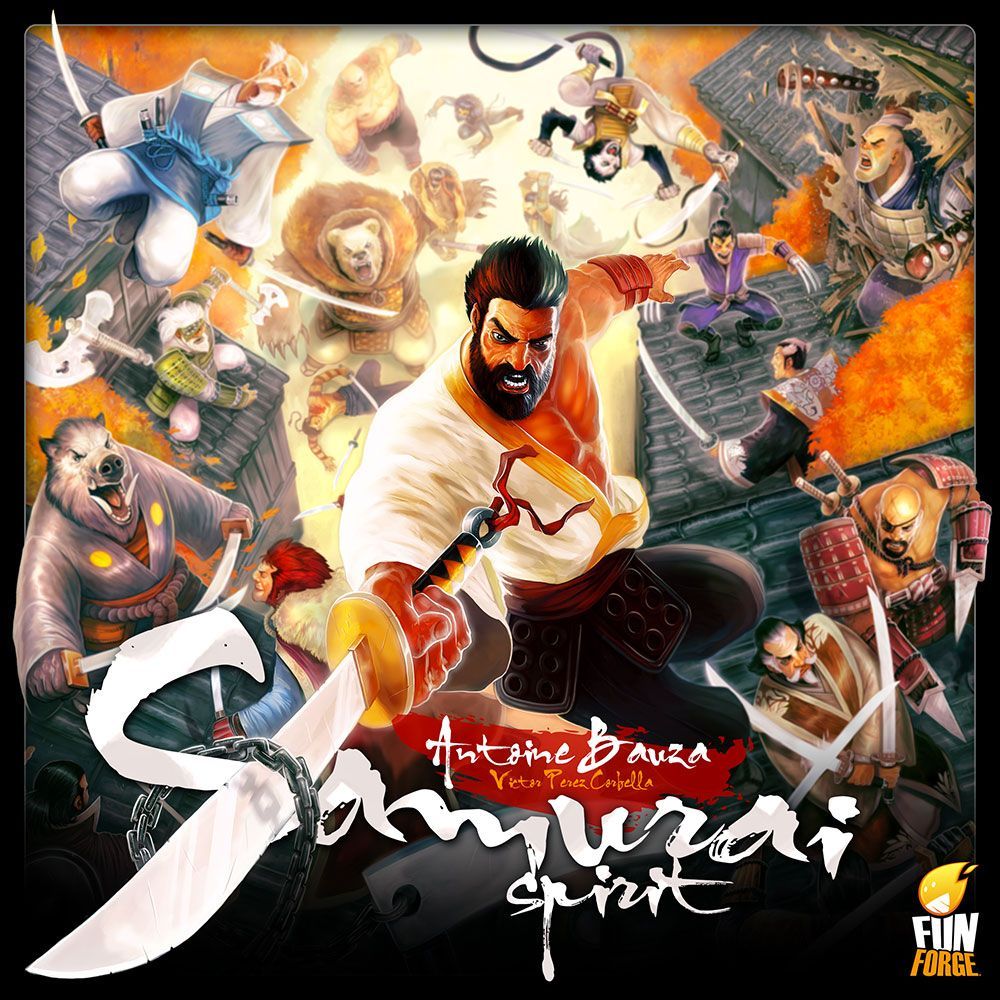
Samurai Spirit is a cooperative game in which the players are Samurai defending a village from raiders of the Oni-Musha clan. The players win together by finishing the third round with at least one Farmstead and at least one Family still in the village. They lose if a Samurai suffers a fourth wound, or if the village falls apart during a round.
Setup
Place the Village board in the centre. Put the 6 Farmsteads building-side-up on their spaces (3 left, 3 right) and the 3 Family tokens doll-side-up on their spaces.
Place a number of Barricades equal to the number of players + 2 on their spaces. Return the rest to the box.
Shuffle all Plunderer cards (values 1 to 4). Deal face down a number of them equal to players × 7 as the Raider stack, and return the others to the box unseen. Set aside the Lieutenant (5) and Boss (6) cards for later.
Each player takes a Samurai board, either chosen or random, and places it human-side-up. Put the Samurai meeple on space 0 of the battle track and the support token beside the board. A random player receives the Active Player marker and begins.
A turn
Players act clockwise. On your turn, follow these steps in order:
- Apply the battle penalty: If the last Raider card in your combat line (the cards to the right of your board) shows a penalty, you must apply it. If you cannot, you suffer a wound instead.
- Take exactly one action: Fight, Support, or Pass.
Fight: Turn over the top Raider card. Then either:
- Confront: Place it to the right of your board, overlapping so all values show, and move your meeple to the total of the combat line. If the total is below your Kiai value, nothing happens. If it equals your Kiai value, you may activate your Kiai. If it is above, remove one Barricade.
- Defend: Place it to the left of your board, but only if it shows a hat, farm, or doll symbol that you do not already have on your left. This does not move your meeple. Otherwise you must Confront. You can have at most three cards on the left.
Support: Give your support token to another Samurai. Then move the top Raider card, unseen, onto the Intruder stack. That Samurai uses your talent on his next turn and returns the token afterwards, whether or not he used it.
Pass: Leave your meeple where it is. You are out for the rest of the round: you receive no cards, get rid of none, and no longer suffer penalties. You must pass if your meeple is past your Kiai value.
Kiai activation: When your meeple lands exactly on your Kiai value, you may use the Kiai effect. Whether or not you do, remove the first card of your combat line to the discard pile and update your meeple.
Wounds: The first wound places a Wound token on your board. The second removes the token and flips your board to the animal side, keeping your cards and resetting the meeple to match the combat line. The third places a token on the animal side. The fourth means the Samurai dies and the game is lost.
End of the game
A round ends immediately when either the last card of the Raider stack has been drawn and played, or all players have passed. Any remaining Raider stack cards are then placed on top of the Intruder stack.
Then, in order:
1. Each Samurai without a hat card on his left sustains a wound.
2. Each Samurai without a farm card on his left removes one Farmstead. On Hard or Heroic, its penalty applies.
3. Each Samurai without a doll card on his left removes a random Family token. Then the bonus applies for each Family still in the village.
4. Reveal Intruder cards one at a time. For each with flames at the bottom right, remove a Barricade; if none remain, destroy a Farmstead instead (applying its penalty on Hard or Heroic). Then place the top Intruder card on the discard pile.
If at least one Farmstead and one Family remain after round one or two, the next round begins: all cards are gathered, meeples return to 0, and one random Lieutenant (round two) or Boss (round three) per player is shuffled into the Plunderers. The last active player passes the Active Player marker to the player on his left. If the round ends with no Farmstead or no Family left, the game is lost.
Scoring
If the players win, they score:
- 1 point per Farmstead remaining (maximum 6)
- 1 point per Family remaining (maximum 3)
- 1 point if no Samurai has a wound, whether human or animal
The score is then marked with a difficulty grade: Easy has no addition, Normal adds one +, Hard adds two ++, and Heroic adds three +++. The rulebook does not state a tie-break rule.
Variants
Difficulty levels:
- Easy: players + 3 Barricades, Farmstead penalties not applied, 6 Plunderers per player, and in later rounds Lieutenants or Bosses equal to players minus 1.
- Normal: players + 2 Barricades, Farmstead penalties not applied, 7 Plunderers per player, one Lieutenant or Boss per player in later rounds.
- Hard: players + 1 Barricades, Farmstead penalties applied, otherwise as Normal.
- Heroic: players Barricades, Farmstead penalties applied, no Family bonus (families are still set up and must be saved), otherwise as Normal.
Two-player game: Place the 5 support tokens of the absent Samurai face up beside the village. At the start of your turn, before applying your penalty, you may use any of these tokens. Its effect adds to your talent for the round. Each token works once per game. During setup, make sure the family symbol appears at least twice among the 14 Plunderers kept, redrawing if not.
Solo game: Take two Samurai (or three) and play with the two-player rules.
Talents: Using a talent is always optional.
- Heihachi: Passes an even-valued drawn card to a neighbour, who must Fight it.
- Daisuke: Passes an odd-valued drawn card to a neighbour, who must Fight it.
- Gorobei: Ignores penalties on even-valued cards.
- Kanbei: Ignores penalties on odd-valued cards.
- Kikuchiyo: May Fight a second time in the same turn.
- Kyuzo: May discard a drawn card whose value matches a card in his combat line.
- Katsushiro: May place a drawn card under the Raider stack and draw again, keeping the new card.
Changes
- Variants, by the rulebook draft, 23 November 2026 (shown now)
- Scoring, by the rulebook draft, 23 November 2026 (shown now)
- End of the game, by the rulebook draft, 23 November 2026 (shown now)
- A turn, by the rulebook draft, 23 November 2026 (shown now)
- Setup, by the rulebook draft, 23 November 2026 (shown now)
- Summary, by the rulebook draft, 23 November 2026 (shown now)