Rules of Shinkansen: Zero Kei
Summary
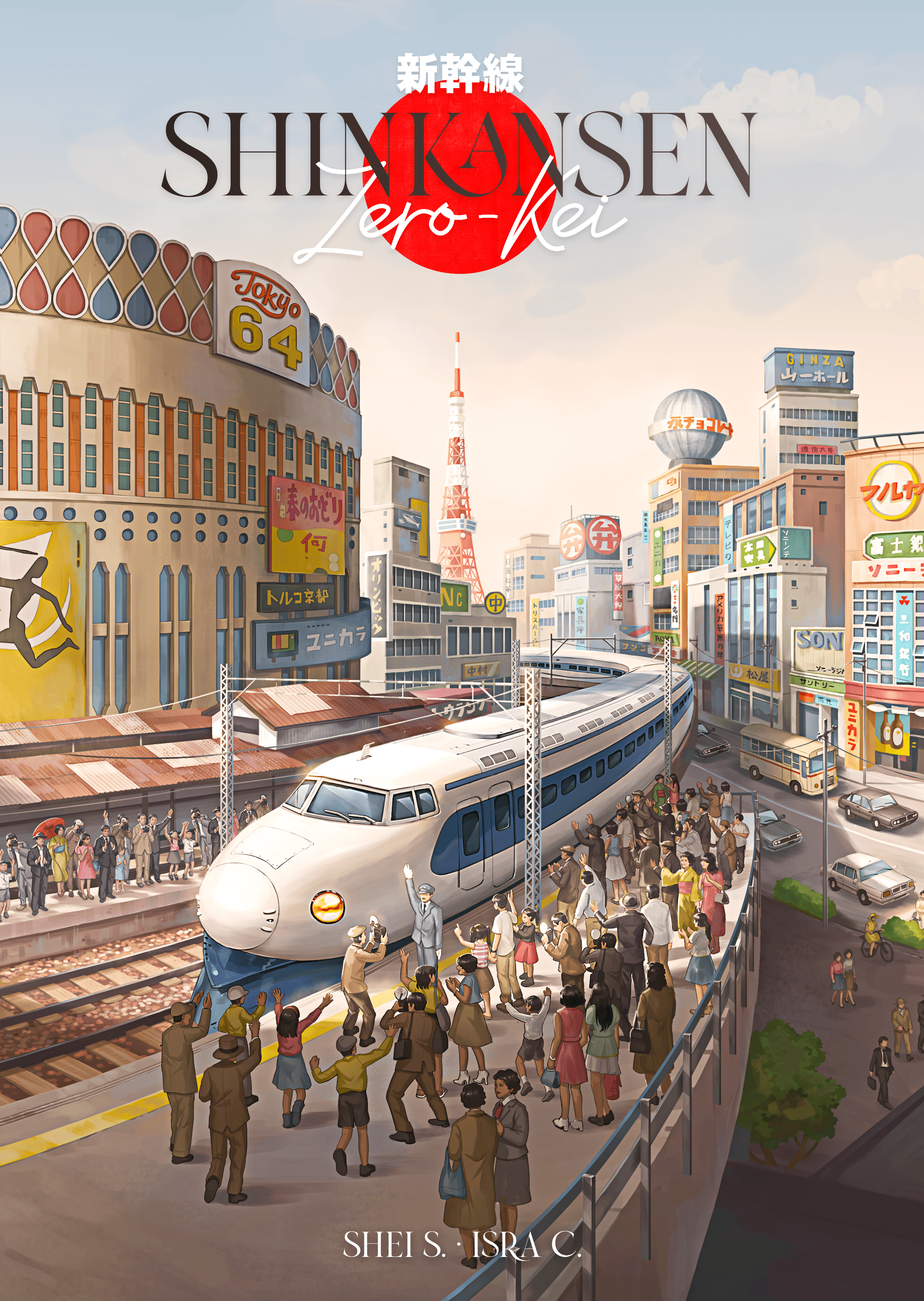
Shinkansen Zero-Kei is a game in which players build a bullet train over five rounds, one round for each year of construction of the Tōkaidō line. Each Carriage Card added to your train grants actions or abilities, and connecting the cities on your cards in the correct order earns victory points. The player with the most victory points after the fifth round wins.
Setup
Place the board in the centre and the Turn Order Tile beside it, matching the player count. Put the 12 Stations in the unbuilt area by colour, and place the Station Value Counters on the starting space of their marker. Shuffle the Olympic Venue Tokens, reveal 3 at random on the venue spaces, and set the rest aside. Place a Construction Token on each city's station space. Each player takes the 7 Flame Cauldrons of their colour, and the Turn Order Tokens are placed randomly on the Turn Order Tile. Stack the Score Counters on the zero space in turn order, with the first player on top. Engine Cards are dealt from last player to first, each player takes a Tail-Carriage Card beside it as their starting train. Shuffle the three Event Card decks separately and place one card of the correct type in each of the five spaces at the top of the board. Each player receives Yen equal to the total shown on those five Event Cards. Place the Track Cost Counter on the space matching the first Event Card, and set out the Action Tokens and Used Card Tokens. Shuffle the Carriage Cards into a face-down draw deck beside the Turn Order Tile, leaving space for a discard pile. Return unused components to the box.
A turn
Each round has three phases.
Phase 1, prepare the round: Flip the previous round's Event Card, and the first face-up card from the left becomes the current Event Card. Set the Track Cost Counter to the space shown on it. Each player collects Yen for their Flame Cauldrons in the Olympic Venues. Then draw as many Carriage Cards as the number of players plus two and lay them in a row beside the Turn Order Tile.
Phase 2, purchase new Carriages: In turn order, each player places their Turn Order Token on one available Carriage Card and pays its cost. If a card's city already has a Station, add the increase shown on the card. If you cannot pay in Yen, the shortfall is paid in victory points at one VP per Yen, and you cannot choose a card you cannot afford. Then advance the Station Value Counter or Counters shown on the card. Remaining cards in the row go to the discard pile.
Phase 3, add the new Carriage and actions: Players take turns in order of how close their token is to the Turn Order Tile, nearest first. Add the purchased card to your train, just left of your Tail-Carriage. Then place your token on a free space of the Turn Order Tile and take that space's reward. Finally, take the number of actions the current Event Card allows, using Action Tokens to mark each used card. Each card can be used once unless stated otherwise. Unused actions give 1 Yen each. Using another player's Engine pays 2 Yen to its owner, and any action cost is added to that. Actions include Income, Prepare Ground, Lay Track, Build Station, Buy Card from the discard pile, Participate in an Olympic Venue, and Repeat Action for 1 Yen. Pass the Action Tokens to the next player afterward.
End of the game
After all players finish their actions in a round, apply any end-of-round effect on the current Event Card. If the fifth round has not been played, prepare the next round. The game ends once the last player completes their turn in the fifth round, and then final scoring begins. Station Value Counters are placed on the Station Score Spaces, with the most advanced counter on the 6 VP space, the second on 3 VP, and the last on 1 VP. A counter that is higher on a shared space counts as more advanced.
Scoring
Final scoring is done in this order:
- Cities: A city with a Laid Track and a Station of the most advanced counter's colour earns 6 VP, second place earns 3 VP and third place earns 1 VP. A city with a Laid Track but no Station earns nothing. A city without a Laid Track costs -3 VP. Each card a player holds for a city scores that city separately.
- Olympic Venues: Each venue is scored separately. The player with the most Flame Cauldrons there scores the venue's city as above, and ties give all tied players the score.
- Connected Cities: Starting from the Engine, find the longest run of consecutive city numbers on your cards in ascending order. Cities without a Laid Track break the run. Each city in the longest run (minimum two) earns 3 VP.
- Leftover items: -3 VP for each Flame Cauldron still in your play area, 1 VP for every 3 Yen left, and 1 VP for each Track left on your Engine Card.
The highest total wins. A tie is broken by the player with the most Flame Cauldrons in their play area, and if still tied, the victory is shared.
Variants
Solitary mode: Play against an automated opponent named Hideo. Set up as a two-player game, with Hideo's Turn Order Token on space 2 and his components on one side. Hideo never pays money, and any Yen he gains is converted into VP at once. He does not use Event Cards, and his actions are set by an Action Board, with Olympic Venue and Closed Venue Tokens placed on it at setup. In each round he takes the first free Turn Order space, resolves his Action Board from top to bottom, and at the end he scores differently, with no negative points for cities or Flame Cauldrons and no Yen bonus. For a harder game, start with 7 Yen and 7 VP for Hideo instead of the usual Yen from the Event Cards.
Changes
- Variants, by the rulebook draft, 23 November 2026 (shown now)
- Scoring, by the rulebook draft, 23 November 2026 (shown now)
- End of the game, by the rulebook draft, 23 November 2026 (shown now)
- A turn, by the rulebook draft, 23 November 2026 (shown now)
- Setup, by the rulebook draft, 23 November 2026 (shown now)
- Summary, by the rulebook draft, 23 November 2026 (shown now)