Rules of Sidereal Confluence
Summary
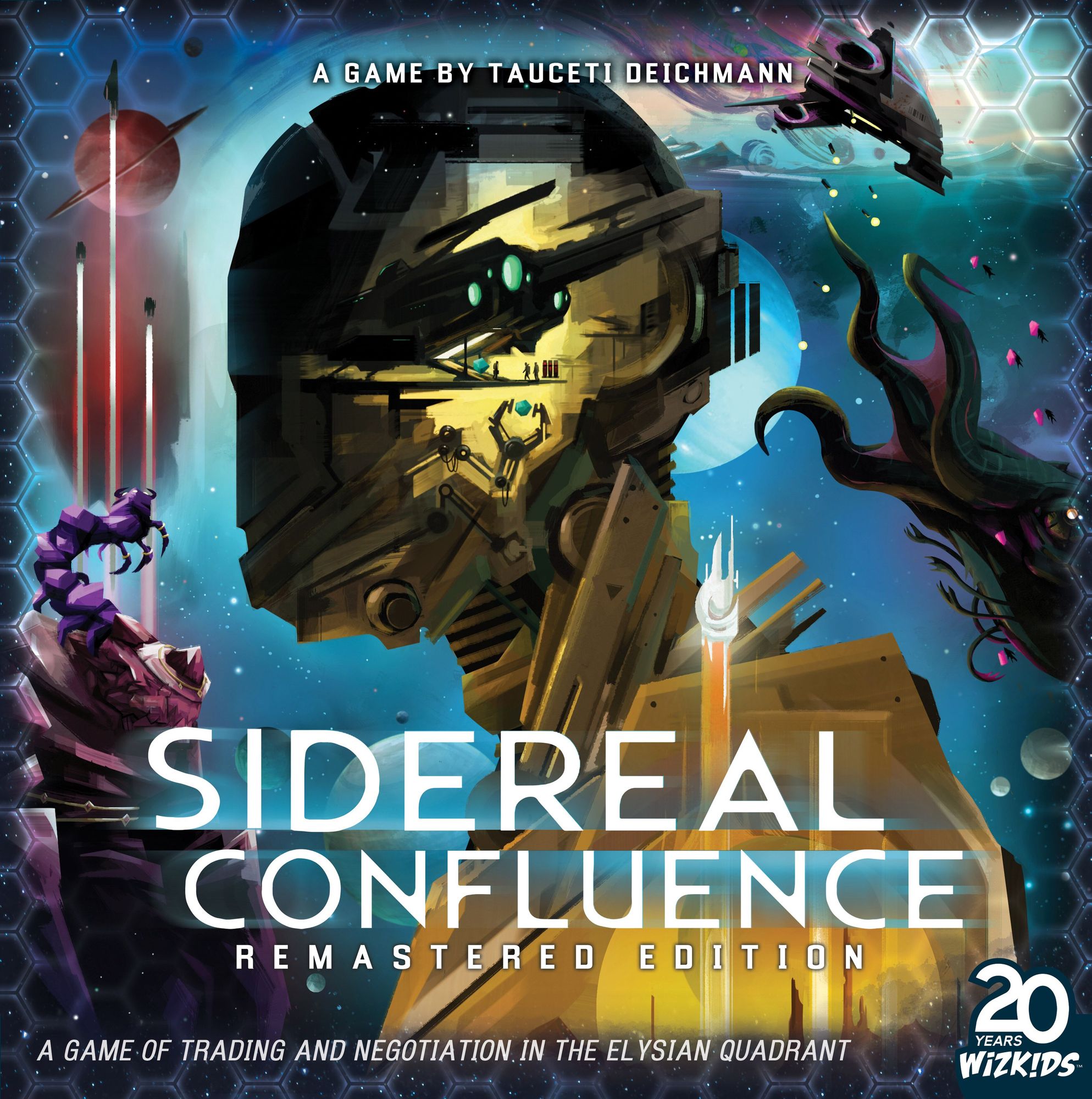
Sidereal Confluence is a trading game where players run alien civilizations, trading resources and inventing shared technology. Inventing a technology earns its inventor points, while everyone gets its benefits. The player with the most victory points after six turns wins.
Setup
Each player chooses a species, starting from the least experienced player, and takes its starting cards, components and board. Each player receives the starting technology and random colonies listed in their starting resources. Use the Bid Track that matches the player count, adding one player to the colony track if Kjasjavikalimm are in the game. Stack the Confluence cards for the player count with Turn 1 on top. Shuffle the colony deck front side up and fill the colony track from it. Shuffle each era of technology separately, stack eras I to IV with era I on top, and fill the research team track from it. Put the points, ships and resources in a general supply within reach of everyone.
A turn
Each turn has three phases, played simultaneously by all players.
Trade Phase: In any order, negotiate binding trades of resources, ships, cards and promises (points cannot be traded), run violet-arrow converters once each, upgrade cards, and invent technologies by running a converter on a research team you control. Trades are binding even across turns. The phase ends when all but one player has finished trading.
Economy Phase: Negotiation is not allowed. Check colony support and put any excess colonies under the colony deck. Run white-arrow converters simultaneously, using inputs from the pool before outputs are taken. Place any donation outputs on your donation card.
Confluence Phase: First, announce and share your inventions, placing them in the middle and gaining the Sharing Bonus for each one. Put shared technologies into play from your species deck. Then secretly split your ships between a colony bid, a research team bid and unspent ships, and reveal bids simultaneously. Bids are resolved from highest to lowest; each player buys a card at the track spot they can afford or passes and keeps their bid ships. Brief negotiation about bids is allowed, but nothing may be traded until the next Trade Phase.
At the end of the Confluence Phase, unpurchased cards with a minimum bid of 1 go under their decks and the tracks are refilled from the left. At the end of the turn, return any cards bearing another species' border and flip the current Confluence card to show the next phase.
End of the game
The game ends when no Confluence cards remain, which begins the last turn. In that turn's Economy Phase, players keep any donations they output. The final Confluence Phase is replaced by scoring.
Scoring
Players receive the final Sharing Bonus for each technology they have invented, as if it had been shared. Ships and resources are then worth points: each octagon is half a point, every two large cubes is half a point, and every three small cubes or ships is half a point. Players reveal their hidden victory points and add everything up. The player with the most points wins. The rulebook gives no tiebreaker.
Variants
Handicapping: To adjust a species or a player's strength, add or remove one small cube from that player's starting resources.
Precise resource scoring: Count octagons as 6/12 of a point, large cubes as 3/12 and small cubes as 2/12, for a more precise but slower final score.
Changes
- Variants, by the rulebook draft, 22 November 2026 (shown now)
- Scoring, by the rulebook draft, 22 November 2026 (shown now)
- End of the game, by the rulebook draft, 22 November 2026 (shown now)
- A turn, by the rulebook draft, 22 November 2026 (shown now)
- Setup, by the rulebook draft, 22 November 2026 (shown now)
- Summary, by the rulebook draft, 22 November 2026 (shown now)