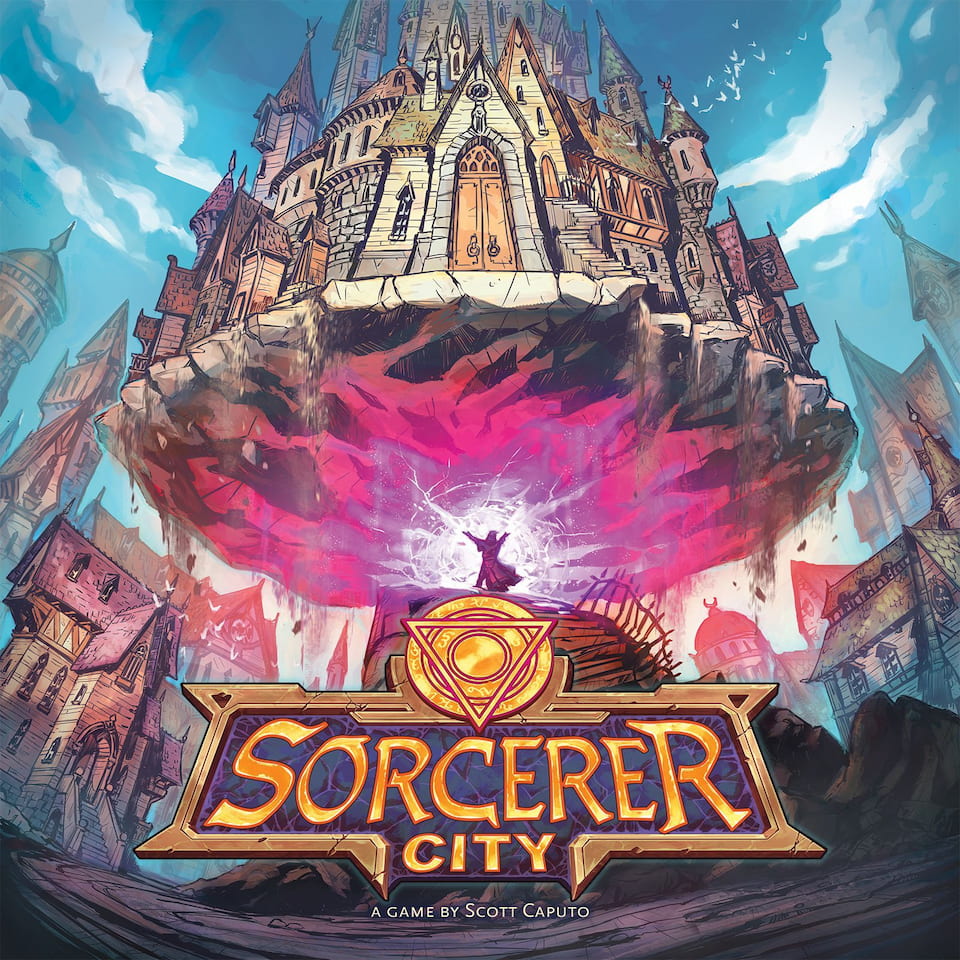
Rules of Sorcerer City
Summary
Rival wizard architects build a district in Sorcerer City over five rounds, called years, gaining Money, Influence, Raw Magic and Prestige while defending against monsters. Each round you build tiles and score their Goals, and the player with the most Prestige after Year 5 is crowned Head Wizard.
Setup
- Each player gets a set of twelve Starting tiles, a set of Raw Magic Transformation cards, an Annual Progress track, and four Annual Progress markers placed at 0.
- Place the Market board in the center. Shuffle each set of Vendor tiles into its own face-down deck above the board, reveal three tiles from the bottom of Vendors 1 to 4, and place the stack of Rainbow tiles costing 7 at the bottom of Vendor 5.
- Place the Influence Rewards board near the center. Put the Year 5 Reward card below the Year 5 position. Shuffle the other Reward cards and reveal one for each of Years 1 to 4. If a reward that cannot be used in Year 1 is revealed for Year 1, return it to the bottom and reveal another. Return unused Reward cards to the box.
- In a 2-player game, randomly choose one Mystery Player card for each year and place them face down below the Reward cards.
- Set up Monsters: choose a Tier 1 Monster for Year 1 and another for Year 2, and a Tier 2 Monster for Year 3 and another for Year 4, placing each matching Monster tile stack beside its year and the Randomizer card nearby. With 3 or fewer players, the same Monster may be used for two years of a tier. Do not use both the Skeleton and the Lich as Tier 1 Monsters with 5 or 6 players.
- Place the Prestige tokens within reach.
- Each player shuffles their Starting tiles to form a face-down City deck.
- Give the timer to the player who most recently watched a fantasy movie or TV show; they are the starting player.
A turn
Each round (year) follows these phases in order:
1. Prepare: Each player shuffles their tiles into a face-down City deck. Abilities that place tiles during this phase resolve now.
2. Build: The timer starts and everyone builds at once. Each tile drawn is placed in your district, the first anywhere and later ones adjacent (sharing a full edge) to a placed tile. Placed tiles cannot be moved or rotated. Build-phase Monsters resolve immediately when placed. You may stop building at any time, but tiles not placed do not count.
3. Score: Score-phase Monsters resolve in any order you choose. Each player scores their district on their Annual Progress track. Score-phase Spells then resolve. Finally, transform all Raw Magic into Money, Influence or Prestige: each player secretly picks a Raw Magic Transformation card, then all reveal at once.
4. Influence and Buy: Influence Rewards are awarded to the players with the most Influence, and Reward-phase effects resolve. Going from the most Influence to the least, each player may buy up to two Market tiles with Money, and Buy-phase Rewards and Spells then resolve. Each tile bought is added to your deck and replaced in its Vendor deck. Once per round, you may pay 1 Money to discard a Market tile to the bottom of its Vendor deck and reveal the next one.
5. Collect Prestige: Take Prestige tokens equal to your Prestige total for the round. The player with the least Prestige gets a free tile from the top of the matching Vendor deck (Year 5 gives none); ties for least each receive one.
6. Cleanup: Dismantle districts, return tiles to your City deck, reset Annual Progress tracks to zero, and pass the timer to the left. Monsters for the next round are added at the end of Years 1 to 4.
End of the game
The game ends after the Year 5 round is scored. In Year 5 there is no Influence Reward, only the player(s) with the most Influence win Prestige, there is no second or third place, no Market or Rainbow tiles are bought, and no new Monster is added. No extra end-game scoring is made beyond normal round scoring. Then all Prestige gained during the game is totaled to find the winner.
Scoring
Each Annual Progress category is capped at 60 per round, and excess points are lost; flip a marker to its "+30" side when it passes 30. Each Goal scores as its shape describes: Group Goals count connected same-color tiles (minimum 3), Line Goals count straight lines (minimum 3), and Shield Goals count the shield on the tile plus neighboring shields, requiring at least two neighbors with shields.
Influence Rewards are awarded by Influence each round:
- 1st place: the Reward and Prestige shown for that year.
- 2nd place: chooses either the Reward or the Prestige. A tie for 2nd means no 3rd place is awarded.
- 3rd place (3 or fewer players): chooses 5 Money or one extra buy. With 4 or more players, receives whichever option 2nd place did not choose.
- 4th to 6th place: each chooses 5 Money or one extra buy. Tied players all receive the effect for their place.
In a 2-player game, the Mystery Player can take 1st or 2nd place. Influence ties are settled by the same place rules above.
In the final Year 5, the player with the most total Prestige wins. A tie on Prestige is broken by the most Money.
Variants
Solo mode: Set up as a 2-player game for one player, with one set of Annual Progress tracking and three Raw Magic Transformation cards. Two Mystery Player cards are drawn for each year, and two Reward effects that target other players are removed. Each round, you compare your Influence to both Mystery Player values, and after buying, the remaining five Monsters for that round are placed on matching Market tiles. You lose immediately if no valid Market spot remains for a Monster or if a Monster covers the last available Market tile. Reaching the end of Year 5 ranks you by final Prestige: 0-50 Junior Wizard, 51-100 Veteran Wizard, 101-150 Head Wizard, 151+ Legendary Wizard.
Artifacts: After a few games, deal each player two Artifact tiles during setup. Each player keeps one and returns the other, then shuffles the kept one into their Starting tiles to begin with thirteen tiles.
Expert variant: Split the Skeletons in half, adding half to the Tier 1 pile and setting the rest aside. Shuffle all Tier 2 Monsters together. Draw six Tier 1 Monsters for each of Years 1 and 2, pairing a second Skeleton from the set-aside pile whenever a Skeleton is drawn. Draw six Tier 2 Monsters for each of Years 3 and 4; one goes into your district and the other five go to the Market.
Changes
- Variants, by the rulebook draft, 23 November 2026 (shown now)
- Scoring, by the rulebook draft, 23 November 2026 (shown now)
- End of the game, by the rulebook draft, 23 November 2026 (shown now)
- A turn, by the rulebook draft, 23 November 2026 (shown now)
- Setup, by the rulebook draft, 23 November 2026 (shown now)
- Summary, by the rulebook draft, 23 November 2026 (shown now)