Rules of Star Trek: Catan
Summary
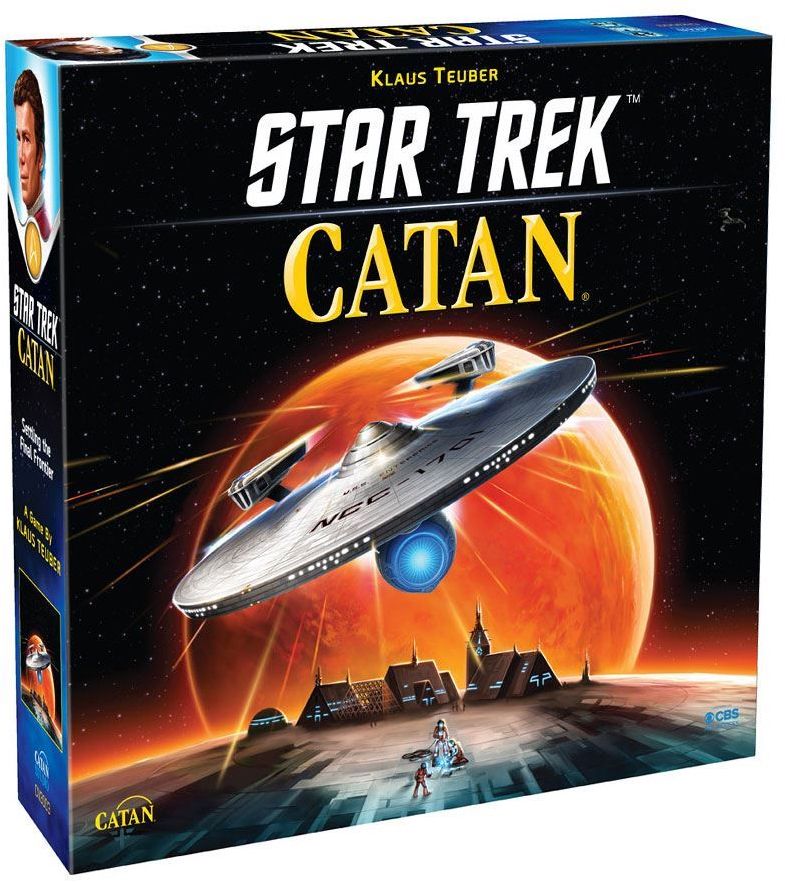
Star Trek Catan is a trading and building game in which players expand the Federation territory by placing starships, outposts, and starbases on a hex board. Resources come from dice rolls and from trading with opponents or the bank. The first player to reach 10 victory points on their own turn wins.
Setup
Give each player a color set: 7 outposts (2 go into a reserve beside the board), 4 habitat rings for upgrading to starbases, 15 starships, and a building costs card. Skip the red pieces in a 3-player game.
Place the resource cards in five stacks and shuffle the development cards into a face-down stack. Put the dice and the Longest Supply Route and Largest Starfleet cards beside the board, and place the Klingon battle cruiser on the asteroid field.
Set-up phase, round one: each player rolls both dice, and the highest roller starts. In turn, each player places one outpost on a free space intersection and one starship on an adjacent space route, observing the distance rule. Round two: the last player of round one places a second outpost and starship, then the others follow in reverse order. Each player takes resource cards for each planet adjacent to their second outpost.
Support cards: display the A-sides beside the board. After placing their second outpost and starship, players take support cards in turn order, with the first player taking A1, the next A2, and so on. The oldest player of a 4-player game takes A4 first in the starting setup; in a 3-player game the cards in play are A1 to A3.
A turn
On your turn, take these steps in order:
- Roll for production. Roll both dice and add them. Each outpost or starbase bordering a planet sector with that number gets one card of that planet's type per outpost, or two per starbase. Everyone is affected by the same roll.
- Trade. Trade with opponents by agreeing on terms, always as an exchange and never a gift. Opponents may only trade with the active player. Or do a border trade with the bank: give 4 identical cards for any 1 different card, or use a trading post for a better rate (3:1 for a generic post, 2:1 for the special post of that resource).
- Build. Starship costs 1 dilithium and 1 tritanium and goes on a free space route connected to your network. Outpost costs 1 food, 1 dilithium, 1 tritanium, and 1 oxygen and must sit on an intersection connected to your starship while observing the distance rule. Starbase costs 3 water and 2 oxygen and upgrades one of your outposts. Development card costs 1 water, 1 food, and 1 oxygen. Return spent cards to the supply.
You may play one development card and/or support cards at any time during your turn, including before the roll, but not a card bought this turn. Then pass the dice to the player on your left.
Rolling a 7: nobody produces. Players holding more than 7 cards discard half, rounded down. Then you move the Klingon battle cruiser to another sector, including the asteroid field, and steal one random card from an opponent with an outpost or starbase next to it. That sector produces nothing while the cruiser stays there.
End of the game
The game ends immediately when a player has or reaches 10 or more victory points on their own turn. That player is the winner. Players can only win on their own turn, so a player who reaches 10 points on someone else's turn must wait for their next turn. Victory point cards stay hidden until then and may all be revealed on the winning turn.
Scoring
Points: each outpost is worth 1 VP, each starbase 2 VPs, the Longest Supply Route 2 VPs, the Largest Starfleet 2 VPs, and each victory point card 1 VP.
Longest Supply Route: the first player with a continuous line of at least 5 starships gets the card. Branches do not count, only the longest single route. Foreign outposts or starbases break a route, while your own do not. If another player builds a longer route, they take the card. If the holder is in a tie for the longest route, they keep it. If the holder is not in the tie, the card is set aside until only one player qualifies again.
Largest Starfleet: the first player to have 3 Starfleet Intervenes cards face up gets the card. If another player has more of these cards than the holder, they take it.
The rulebook gives no tie-break for Largest Starfleet and no separate tiebreak for points beyond the 10 VP win condition.
Variants
Combined Trade/Build Phase (recommended for experienced players): after rolling, you may trade and build in any order, and trade and build repeatedly during the same turn. You may use a trading post on the same turn you build the outpost there.
Variable board set-up (after two or three games): shuffle the frame pieces and hex tiles, fill the frame in random order, and place the number tokens counterclockwise from a corner in alphabetical order, skipping the asteroid field.
3-player game: do not use the red pieces or the red set-up, and use the A1 to A3 support cards.
The rulebook does not describe solo, team, or short-game variants.
Changes
- Variants, by the rulebook draft, 23 November 2026 (shown now)
- Scoring, by the rulebook draft, 23 November 2026 (shown now)
- End of the game, by the rulebook draft, 23 November 2026 (shown now)
- A turn, by the rulebook draft, 23 November 2026 (shown now)
- Setup, by the rulebook draft, 23 November 2026 (shown now)
- Summary, by the rulebook draft, 23 November 2026 (shown now)