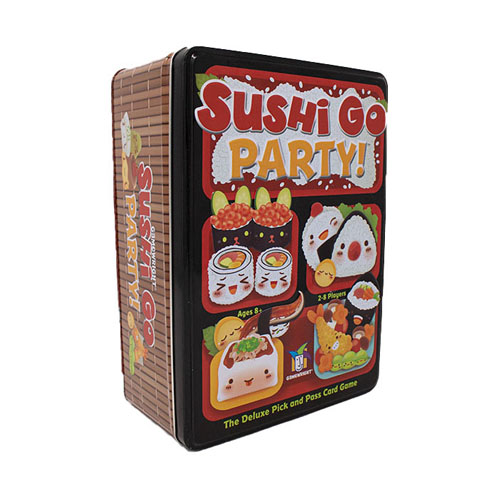
Rules of Sushi Go Party!
Summary
Sushi Go Party! is a card drafting game for 2-8 players. Each turn, players secretly pick one card from their hand and pass the rest along, building sets of cards in front of them over three rounds. The player with the most points at the end wins.
Setup
Place the game board in the center and have each player take a pawn in their color and place it on or near the 0 space. Sort the cards by type into the box slots and choose the card selection to use. Place the matching menu tiles on the board; for 6-8 player games with maki rolls, flip the maki tile to its 6-8 player side. Shuffle the chosen dessert cards into a face-down pile beside the board. Shuffle all other chosen cards into a face-down deck beside the board.
At the start of each round, shuffle a set of dessert cards into the main deck. The number depends on player count and round: with 2-5 players, 5, 3 and 2 dessert cards for rounds 1, 2 and 3 (any extra desserts are not used); with 6-8 players, 7, 5 and 3. Then deal cards face-down to each player: 10 cards each for 2-3 players, 9 for 4-5, 8 for 6-7, and 7 for 8 players.
A turn
All players act at the same time. Each player looks at their hand, secretly chooses one card to keep, and places it face-down in front of them. When everyone has chosen, all players reveal their chosen cards. Kept cards stay in front of their owner until the round is scored, so group them in columns by color as they build up.
After revealing, each player passes their remaining hand face-down to the player on their left. Players then pick up the new hand and the next turn begins, with each hand getting smaller.
Chopsticks and spoon cards can be used on a later turn as a bonus action. A player calls out the card name while everyone is revealing; after the normal plays, the bonus action resolves before hands are passed. If several bonus actions, menus or takeout boxes are used in the same turn, they resolve in the order shown by the small number in the lower-right corner of each card, lowest first.
A round ends when all cards have been played and every hand is empty. Then each player scores their non-dessert cards according to the card guide and moves their pawn on the score track. Scored cards, except desserts, are collected and reshuffled for the next round, and desserts are set aside until the game ends.
End of the game
The game ends after three rounds. Dessert cards, which each player has kept set aside through the game, are scored at that point, along with the regular scoring.
Scoring
Points come from the card guide for each card type, including nigiri, maki rolls, temaki, uramaki (with placings among players), dumplings, onigiri, tempura, sashimi, tofu, eel, miso soup, edamame, tea, soy sauce and others. Some cards score at the end of a round, while uramaki can score immediately when a player reaches the thresholds. Desserts are scored at the end of the game.
The player with the most points wins. If there is a tie, the player with the most dessert cards wins.
Variants
The rulebook offers four preset card selections: Sushi Go! (the classic menu), Party Sampler, Master Menu (for experienced players) and My First Meal (a gentler menu for new players).
It also suggests named combinations: Cutthroat Combo (interactive play), Big Banquet (works well with 6-8 players), Dinner for Two (works well with 2 players) and Points Platter (big scoring).
You can also create your own menu with these requirements: nigiri in every game, 1 type of rolls, 3 types of appetizers, 2 types of specials and 1 type of dessert. Menu and special order may not be used in 7-8 player games, and spoon and edamame may not be used in 2-player games.
Some cards have rules changed by player count: maki rolls use a 6-8 player scoring table, and temaki and pudding have no penalty for the fewest in a 2-player game.
Changes
- Variants, by the rulebook draft, 22 November 2026 (shown now)
- Scoring, by the rulebook draft, 22 November 2026 (shown now)
- End of the game, by the rulebook draft, 22 November 2026 (shown now)
- A turn, by the rulebook draft, 22 November 2026 (shown now)
- Setup, by the rulebook draft, 22 November 2026 (shown now)
- Summary, by the rulebook draft, 22 November 2026 (shown now)