Rules of Tash-Kalar: Arena of Legends
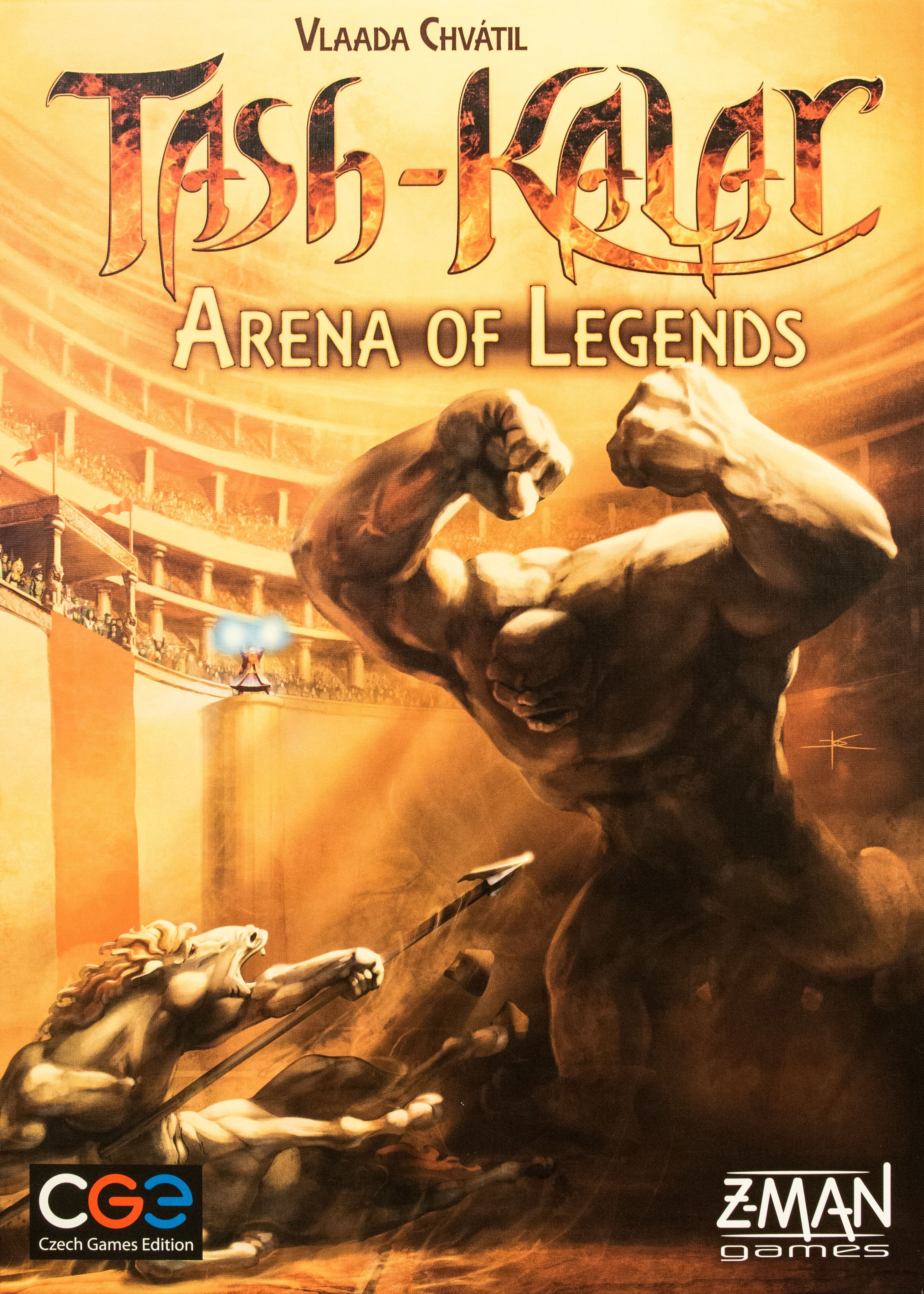
Summary
Tash-Kalar is a two-to-four player abstract game of magical combat in which players place stones called common pieces to form patterns that summon beings onto the arena. Summoned beings and their effects let players destroy, upgrade, and move pieces, while flares and tasks reward strategic play. In the High Form the winner is the player with the most points from claimed tasks, and in a deathmatch the winner is decided by points from destroyed pieces and summoned legends.
Setup
Put the two board halves together to form the arena or task board as the chosen form requires, and set the arena with the chosen side up. Each player takes a school deck and the pieces in that deck's color, leaving out the three pieces marked for removal in the first game. Shuffle the shared flare deck near the arena. For the first game, remove the advanced tasks, arrange the first three current tasks as 1- and 2-point tasks with different symbols, and turn up the top card of the remaining task deck as the next task. Choose a starting player; each player shuffles their deck, draws 3 beings, and draws 1 flare.
A turn
The starting player takes only one action on the first turn; afterward each player takes two actions per turn. An action is either placing a common piece on an empty square or summoning a being. To summon, match the pattern on a card with your pieces on the board, then place a piece of the rank shown in the white-framed square, destroying any piece there of the same or lower rank. Resolve the being's effect, then discard the card. Summoning draws you back to three beings at the end of your turn.
Moves and leaps are not actions; they come only from being or flare effects. A standard move goes to an adjacent square that is empty or holds a lower-ranked piece. A combat move also goes onto a piece of the same rank. Leaps are similar but not limited to adjacent squares.
A flare may be invoked before or after any action, not during one, and does not cost an action. You may invoke it if your opponent has enough more upgraded pieces (upper criterion) or enough more pieces in total (lower criterion), and you get the effects of every criterion you meet. Then discard it and draw a new flare at the end of your turn.
At the end of your turn you may claim one task whose requirements you meet, then refill the current tasks from the deck and reveal the next task.
End of the game
In the first game the game ends when a player reaches 6 or more points or draws the last card from their deck. In the full High Form, the end is checked at the end of each turn and triggers when a player has 9 or more points or draws their last deck card. Once triggered, the player who was taking or finishing their turn becomes the last player, and every other player then gets one final complete turn, with the last player taking the final turn.
Scoring
In the High Form, a player's score is the total point value of claimed tasks plus 1 point for each legendary piece they have on the board. The player with more points wins. In a deathmatch duel, players score points by destroying opponent pieces at the end of their turn: 2 for each legendary piece, 1 for each heroic piece, and 1 for each pair of common pieces, with an unpaired common piece scoring nothing. Summoning a legend gives 1 point, and each invoked flare gives the opponent 1 point. In a deathmatch melee, points are tracked separately for each opponent color, and a player's final score is the lowest of their color totals.
Ties are broken by the player with more upgraded pieces on the board, then by the player with more pieces on the board. A deathmatch melee applies its own tiebreakers first: compare second-lowest colors, then the remaining color, before using the general tiebreakers. If players are still tied, they remain tied.
Variants
Team play lets four players form two teams sitting opposite each other, sharing one set of pieces per team, passing control of a turn to a teammate, and using sideways cards at the bottom of each deck, with the same end triggers as a two-player game. Deathmatch duel is a scoring form for two players or teams that uses the score board instead of tasks. Deathmatch melee is for three or four players, each fighting all others, and uses improvised summoning with each opponent color usable once per game. The full game adds legends, the discard action, and the full deck of flares and legends. The first game uses simplified rules without legends, discards, or advanced tasks.
Changes
- Variants, by the rulebook draft, 23 November 2026 (shown now)
- Scoring, by the rulebook draft, 23 November 2026 (shown now)
- End of the game, by the rulebook draft, 23 November 2026 (shown now)
- A turn, by the rulebook draft, 23 November 2026 (shown now)
- Setup, by the rulebook draft, 23 November 2026 (shown now)
- Summary, by the rulebook draft, 23 November 2026 (shown now)