Rules of Tawantinsuyu: The Inca Empire
Summary
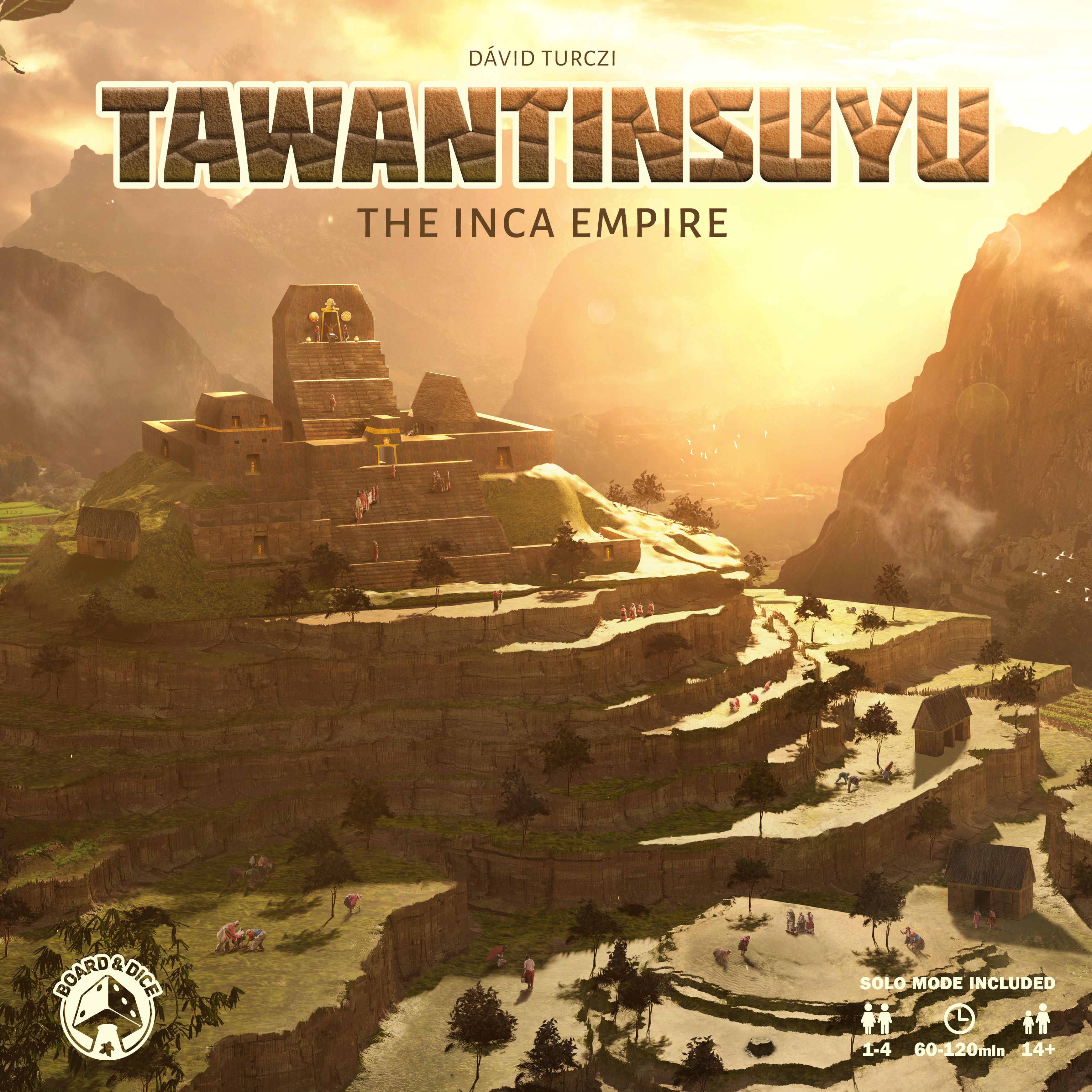
Tawantinsuyu: The Inca Empire is a worker-placement and engine-building game where players compete for fame to become the next Sapa Inca. Players gain fame by worshipping gods, building tapestries, conquering the four regions, building steps and statues, and similar actions. The player with the most victory points at the end of the game wins.
Setup
- Place the main board in the play area and put all resources next to it as a general supply.
- Give each player their Step markers, put their Scoring marker on 10 of the score track and their Temple marker on the bottom space of the Temple track.
- Optionally rotate the Coricancha tile randomly and place it on the top of the hill; skip this in your first game.
- Remove Workers from the game according to player count: 1 of each color for 2 players, 2 of each color for 3 players.
- Put 2 Workers of each color in the draw bag. Each player draws 2 Workers, redrawing if they get a duplicate color and returning one duplicate to the bag.
- Add the remaining Workers to the bag, draw them randomly and fill the Village queue and the Nomads space as the board indicates for the player count.
- In a 2-player game, place one random Worker from the bag on each marked space around the Coricancha.
- Shuffle the Army cards into a face-down deck near the Building Market and separate the Statues by God symbol.
- Set aside the four starting Weavings, remove the tiles marked for fewer players, shuffle the rest into a face-down stack and reveal the top one.
- Split the Buildings into Production and Passive stacks, shuffle each, and reveal two of each as the Building Market.
- Give each player 2 stone. Shuffle the God cards, deal 8 to each player, each player keeps 3 and plays 5 on the table for their benefits, which are received in reverse turn order. Then form a central offer of 3, 4 or 5 face-up God cards for 2, 3 or 4 players.
- The last person to harvest a vegetable is the first player, or determine it another way. Players then pick starting Weavings in turn order. Finally, place the Festival tile near the board.
A turn
On your turn, choose one of two options:
- Place a Worker: Pay a matching God card or 1 gold to put a Worker from your supply on an empty space, paying food for Roaming and Descending costs. Then perform tasks equal to 1 plus the Worker's ability bonus plus 1 for each adjacent Worker of the same color.
- Perform two different secondary actions in any order: Moving the High Priest, Praying, Training, or Recruiting.
At any time during your turn, you may discard Army cards from hand for their resources as a free action, with no limit.
At the end of your turn, you may buy one Worker from either end of the Village, then discard down to 2 Workers in supply. If the Village is empty at the end of your turn, a Festival is triggered. Replenish the Building Market if you built anything.
The High Priest secondary actions are Produce, Worship, Offering, Conquest and Rejuvenate. The active player moves the High Priest and triggers the chosen action, and other players may take a weaker version of it in turn order.
End of the game
The game ends after the third Festival. Then Final Scoring is carried out, including the Festival rewards for the third Festival's scoring step being skipped as described in the rulebook.
Scoring
Each Festival awards 1, 2 or 4 VP for the first, second and third occurrence, and each Festival also scores Temple rewards, Conquest region majorities and potato payments for God cards held.
Final Scoring awards:
- Tapestry VP by length: 1 to 7 different Weavings score 0, 1, 3, 6, 10, 15 or 21 VP.
- VP printed at the top four Temple steps reached.
- 2 VP per face-up Building, including Passive Buildings.
- 1 VP per God card in hand and per face-up Army card in the player area.
- 1 VP per leftover Worker in supply and 1 VP per gold in supply.
The player with the most VP wins. A tie is broken by the most total resources (gold, stone, corn and potato). If still tied, the tied players share the victory.
Variants
Solo play: the player faces an automated opponent called Axomamma, which uses its own player board, personality tokens, a die and numbered tokens to choose its actions. The rulebook says a solo win requires at least 120 VP and a lead over Axomamma. Difficulty can be lowered or raised by the listed adjustments, such as changing Axomamma's building cost or its High Priest action conditions, if one side wins or loses by 25 VP or more.
The rulebook gives no teams or short-game variant.
Changes
- Variants, by the rulebook draft, 23 November 2026 (shown now)
- Scoring, by the rulebook draft, 23 November 2026 (shown now)
- End of the game, by the rulebook draft, 23 November 2026 (shown now)
- A turn, by the rulebook draft, 23 November 2026 (shown now)
- Setup, by the rulebook draft, 23 November 2026 (shown now)
- Summary, by the rulebook draft, 23 November 2026 (shown now)