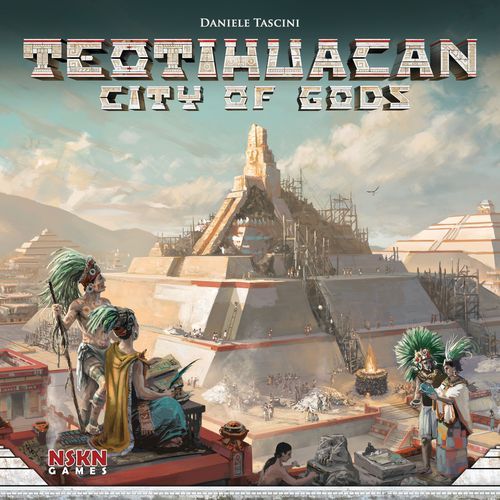
Rules of Teotihuacan: City of Gods
Summary
Players are noble families building the city of Teotihuacan, earning victory points by winning the gods' favour, constructing the pyramid, and claiming prestigious spots along the Avenue of the Dead. The game ends after the final Eclipse scoring, and the player with the most victory points wins.
Setup
Place the Main Board in the middle of the table. Shuffle Action Boards 2 to 7 and lay them face up over spaces 2 to 7, or use the pre-printed boards for a first game.
Shuffle the Decoration tiles and Discovery tiles into face-down piles, then reveal the offered ones. Build the Pyramid grid according to the player count and reveal the Pyramid tile offer.
Place 3 Royal tiles (one each from categories A, B and C) on the Palace (1). Reveal 6 Technology tiles on the Alchemy (5) board in ascending number order. Place one Temple Bonus tile on each temple's penultimate step.
Put the light Calendar disc on space 0 and the dark disc on space 10, 11 or 12 depending on whether there are 2, 3 or 4 players. Place a Building on each Buildings row space except the leftmost.
Place the Discovery tiles on the Worship spaces, the Avenue of the Dead and the temple major steps as the rulebook indicates.
Each player takes a colour, 4 workers (dice), and 6 Technology markers and 6 track markers in their colour. Hand out the Player Order tokens and cocoa: the first player gets 1 cocoa and the "1" token, the Last Player gets 3 cocoa and the token matching the player count, and everyone else gets 2 cocoa.
In a first game, players use fixed starting workers and resources from the rulebook. In later games, each player receives Starting tiles, keeps 2, and places workers according to the chosen tiles.
A turn
On your turn, choose one of two options:
- Take a normal turn, or
- Free unlock: unlock all of your locked workers at no cost.
For a normal turn, move one of your unlocked workers 1, 2 or 3 Action Boards clockwise. Then take one action on the board where it stops:
- Collect Cocoa: gain cocoa equal to the number of different colours of unlocked workers already there, plus 1.
- Worship: only on Palace (1), Forest (2), Stone Quarry (3), Gold Deposits (4) and Decorations (7). Place the worker on a Worship space, and either activate the space's ability or claim the nearby Discovery tile, or pay 1 cocoa to do both.
- Main action: pay cocoa equal to the number of other colours of unlocked workers present, then resolve the board's effect. The Palace has no Main action.
Locked workers cannot be moved. At any point in a normal turn you may pay 3 cocoa to unlock all of your locked workers. If you have no usable worker and cannot pay, you must use the free unlock option.
If you hold the Last Player token, advance the light Calendar disc one step after your turn. Then play passes clockwise.
End of the game
An Eclipse is triggered when the light Calendar disc reaches the dark disc. If this happens on the Last Player's turn, one more full round is played. If it happens on any other turn, the current round is finished and then one more full round is played. Scoring follows after that.
The game ends after the third Eclipse. It also ends when a final Pyramid tile is placed and triggers an Eclipse.
Scoring
At each Eclipse, resolve these steps in order:
- Each player scores the lowest visible value on the Buildings row for every step they have advanced on the Avenue of the Dead.
- The player furthest ahead on the Pyramid track scores 4 points. Ties score for all tied players.
- Each player scores points for steps moved on the Pyramid track: 4 points per step at the first Eclipse, 3 at the second, and 2 at the third.
- The Pyramid track resets for all players. It is the only track that does.
- Players group their masks into sets of different masks. A set of 1 to 7 masks scores 1, 3, 6, 10, 15, 21 or 28 points.
- Each player pays cocoa salary: 1 per worker, plus 1 more for each worker with power 4 or 5. Each cocoa not paid costs 3 points, but a player's total cannot drop below 0 this way.
- After the first or second Eclipse, reset the light disc to 0 and move the dark disc to a new position based on the player count. Some player counts also bring in neutral workers from unused colours.
- At the third Eclipse, or when the game ends from the Pyramid, each player who reached a Temple Bonus tile scores its bonus.
The player with the most victory points wins. A tie goes to the tied player with the most cocoa left. If still tied, the lower Player Order number wins.
Variants
Alternative Starting tiles: instead of dealing each player 4 Starting tiles, place 6, 8 or 10 face-up Starting tiles in the middle of the table for 2, 3 or 4 players. This is recommended only for experienced players.
Cutthroat version: the Eclipse resolves immediately after the turn that triggers it, with no extra round. The game can end mid-round. A tie on points and cocoa goes to the player with the higher Player Order number.
Solo mode: you play against an automated opponent, Teotibot, which simulates a 2-player game. It uses extra Action tiles and Direction tiles, has its own setup and rules changes, and scores differently at the third Eclipse. You win by having more points than the bot at the end.
Solo difficulty: the rulebook lists optional adjustments to the bot's starting workers, resources, cocoa conversion points, Worship steps, Temple Bonus points and Technology points, so that a first game can be easier.
Changes
- Variants, by the rulebook draft, 22 November 2026 (shown now)
- Scoring, by the rulebook draft, 22 November 2026 (shown now)
- End of the game, by the rulebook draft, 22 November 2026 (shown now)
- A turn, by the rulebook draft, 22 November 2026 (shown now)
- Setup, by the rulebook draft, 22 November 2026 (shown now)
- Summary, by the rulebook draft, 22 November 2026 (shown now)