Rules of The Bridges of Shangri-La
Summary
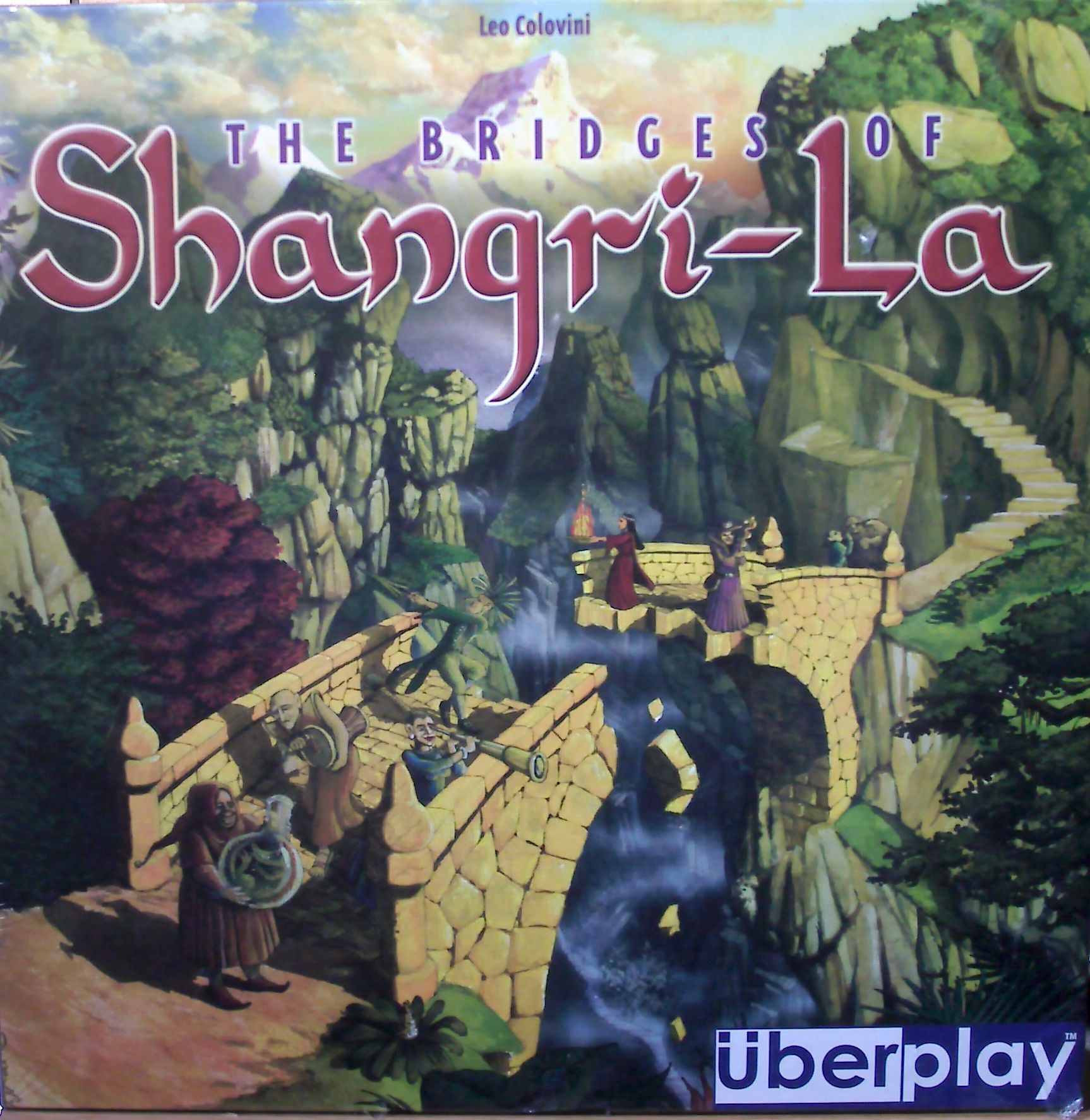
Players are rival mountain clans placing Masters into the villages of Shangri-La. Each player has tiles in seven disciplines, and Students spread the clan into new villages by journeying across bridges, which then break. The player with the most Masters on the board at the end wins.
Setup
Place the game board in the middle of the table. Put one wooden bridge on each broken path, using 23 bridges in a 4-player game or 20 in a 3-player game. Each player takes all the Master tiles of one color, six sets of seven different symbols. Set the 12 Stones of the Wise Men beside the board. In a 3-player game, put one stone on the unused red village.
In turn order clockwise, each player places one Master of each of the seven disciplines on a village space showing the matching symbol. The placement limits are at most 2 tiles of one color and 3 tiles total per village. In a 3-player game the limits are 1 tile of one color and 2 tiles total per village. After placement, each player should have 5 of each Master type left in supply. Starting positions for 3- and 4-player games are printed on the Rules Summary sheets.
A turn
The starting player is whoever last reached the peak of Mount Everest on stilts, with a tie going to the wisest player. On a turn, a player chooses one of three actions, then play passes clockwise.
- Place a Master: Take one Master from supply and place it on an open space with the matching symbol in a village that already holds at least one of your Masters. You may place only one new tile per turn.
- Recruit Students: Take up to two tiles from supply and place each on one of your own Masters with the matching symbol, anywhere on the board. A Master can have at most one Student. If only one of your Masters is eligible, you place only one Student.
- Begin the Journey of the Students: Only Students can journey, and only this action spreads your clan into villages where you have no Master. Choose a Student in a village and an unbroken path to a directly neighboring village. All Students in the starting village move together, including opponents' Students. Masters never move. The bridge on the path used is then removed from the game, so that path cannot be used again.
A village with all of its paths broken receives a Stone of the Wise Men, and no actions may take place in a village holding a Stone.
Village strength equals the total number of tiles of all players in the village, Masters and Students alike. When Students journey from a stronger village to a weaker one, each Student on a matching empty space becomes a Master. On a matching space holding an opposing tile, the opposing tile(s) are returned to their owners and the Student becomes a Master. On a matching space holding your own Master, the Student is placed on top of it and remains a Student. If that space already holds your own Master and Student, the journeying Student is returned to supply.
When Students journey from a weaker village to a stronger one, each Student on an empty matching space becomes a Master. Any Student landing on an occupied matching space, whatever the color, is returned to supply.
If two villages are equal in strength, the one with more Masters (Students not counted) is stronger. If that is still tied, the destination village is considered stronger.
Scoring
Count only the Master tiles each player has on the board; Students are not counted. The player with the most Masters wins. If players are tied, the tie is broken by the number of villages each tied player occupies, and the player occupying more villages wins.
Variants
The rulebook describes a 3-player game. The red village is not used, 20 bridges are used instead of 23, one stone is placed on the red village, and the placement limits are tighter (1 tile of one color and 2 tiles total per village during setup). It also provides suggested starting positions for 3- and 4-player games on the Rules Summary sheets, and says that after the first game, players can rely on their own strategy for placement instead.
Changes
- Variants, by the rulebook draft, 23 November 2026 (shown now)
- Scoring, by the rulebook draft, 23 November 2026 (shown now)
- A turn, by the rulebook draft, 23 November 2026 (shown now)
- Setup, by the rulebook draft, 23 November 2026 (shown now)
- Summary, by the rulebook draft, 23 November 2026 (shown now)