Rules of The Castles of Burgundy: The Card Game
Summary
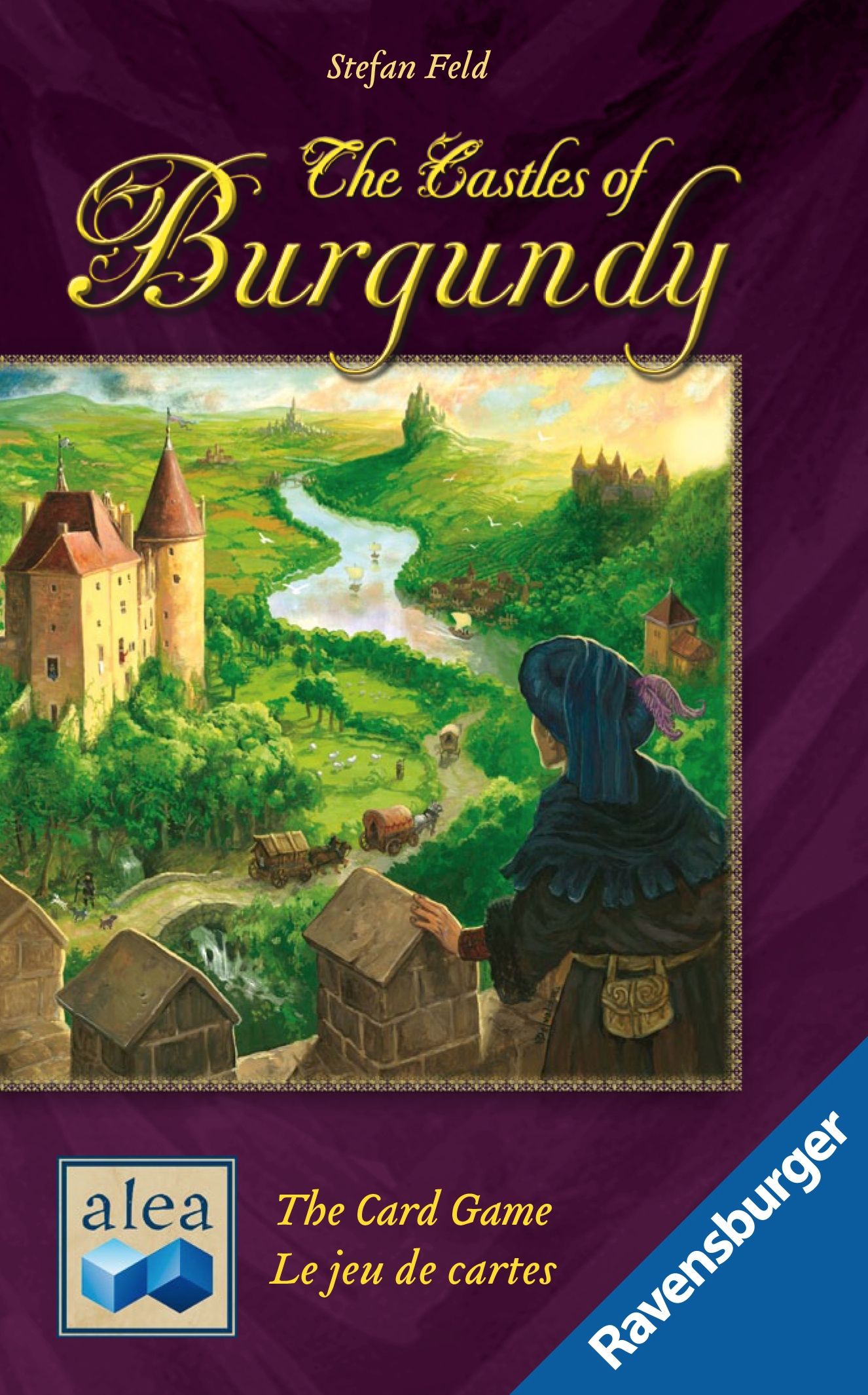
Loire Valley Estates is a card game where 15th-century nobles build up their estates through trade, building, research and mining. Action cards act as dice that offer possible actions, but each player chooses the action. After five rounds, the player with the most victory points wins.
Setup
Each player gets a project, estate and storage card, plus one good, one animal and one silver placed in their storage. Good and animal cards go into two face-up piles each. Silver and workers form supply piles. Workers are handed out by turn order: the youngest player (the starting player, who takes the start player card) gets none, the next two players get one each, and the last player gets two. Place display cards in rows 1 to 6, and put the 7 bonus cards marked "1." above them. Place the "All 7 types" bonus cards in a pile (4 on top, then 3, 2, 1). With fewer than 4 players, use only 3+2+1 for three players and 3+1 for two. Shuffle the 15 victory point cards into one pile, and stack the 5 round cards A to E with A on top. Shuffle the 114 red-backed action cards, deal 6 face down to each player as their draw pile, and place 7, 10 or 13 action cards face up in the display for two, three or four players. Display cards are placed by their die numbers, with the last card going to the matching row.
In a three-player game, the display starts with 10 cards: the first six go one at a time from top row to bottom, and the last four follow the die numbers.
A turn
A round has six turns. Starting with the starting player and moving clockwise, each player takes the top two cards from their draw pile and looks only at their die numbers. They discard one card face up and perform the action matching its die number:
- Take a card from the display: Take a card from the display row matching the die number and place it under your project card. You may hold at most three projects.
- Place a project in your estate: Move a project whose number matches the die into your estate. Matching types stack and different types sit side by side. Placing a project gives its bonus immediately.
- Sell goods: Sell all goods of the type matching the die from your storage to the right of your estate. Take one silver per good sold, and take the start player card face down.
- Restock workers: Bring your workers up to two, regardless of the die.
- Take one silver: Regardless of the die.
- Convert workers and/or silver into victory points: Return any number of workers and silver to the supply, then take one victory point card per three returned, regardless of the die.
A worker card may be returned to change the die number by one, up or down, including from 6 to 1 or 1 to 6. Each worker changes the die by one step.
Once per turn, you may pay 3 silver to buy the top three action cards. Keep one as a new project or use it as an extra action with its die, and discard the other two. This can be done before, during or after your normal action.
After all players have taken their turns, the round ends and the next round starts.
End of the game
The game ends after round E. Before the final scoring, each player adds victory points from their animals, and the player holding the start player card gets 1 victory point.
Scoring
Victory points come from completed triples in estates (three cards of one type), bonuses, victory point cards, sold goods and animals. Each triple is worth the value shown on its cards, and cloisters are worth 6 points when they form a triple of their own. The first player to complete a triple also gets the matching bonus card, worth 1 point. Each triple also gives a round bonus, which each player may choose. The first player to have all seven types in their estate gets the top "All 7 types" card.
Animals score by variety: 4 different types give 4 points, 3 types give 2 points, and 2 types give 1 point.
The player with the most victory points wins. If players are tied, the one with more remaining cards in storage (workers, silver, unsold goods and unused animals) wins. If still tied, the tied players share the win.
Variants
Solitaire: You play against "Aaron," a virtual opponent. Use the 2-player setup with only the 3 and 1 "All 7 types" bonus cards, and place 7 display cards each round. Start with one worker, one silver, one good and one animal in your storage. Prepare five piles for Aaron with 3, 4, 5, 6 and 7 cards, and sort one pile into his estate at the start of each round. Aaron keeps cloisters as their own type. For each cloister he gets, you take 1 victory point card. He also takes bonus cards for triples and "All 7 types," but he has no other abilities and gets no workers, silver, goods, animals or round bonuses. The start player card is not used.
After each round, compare victory points, including animal points. If Aaron has more, he wins and the game ends immediately. If you have the same or more at the end of the game, you win.
Changes
- Variants, by the rulebook draft, 22 November 2026 (shown now)
- Scoring, by the rulebook draft, 22 November 2026 (shown now)
- End of the game, by the rulebook draft, 22 November 2026 (shown now)
- A turn, by the rulebook draft, 22 November 2026 (shown now)
- Setup, by the rulebook draft, 22 November 2026 (shown now)
- Summary, by the rulebook draft, 22 November 2026 (shown now)