Rules of The Castles of Burgundy: The Dice Game
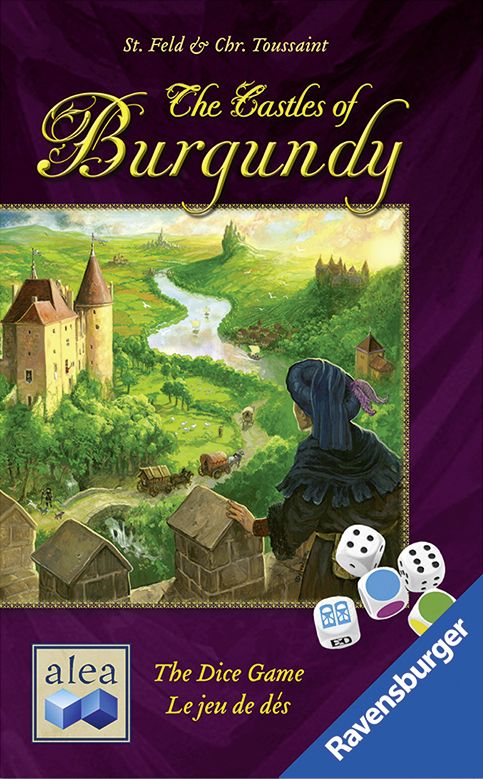
Summary
A roll-and-write game for 3 to 5 players set in 15th century France, where each player runs a noble duchy by marking hexes on a score sheet using combinations of dice results. The player with the most victory points at the end wins.
Setup
Each player takes one duchy page and a pencil; the owner of the game takes the five dice and rolls them for the whole game. Duchy A is recommended for new players, and all players use the same duchy. Each player secretly chooses one of their four castle hexes at the same time, checks it off, and circles the matching bonus (monk, silver, commodity or worker). Players may choose the same castle, and the starting castle's victory point is already entered in the first column.
A turn
The owner rolls all five dice and checks off boxes in the current phase's time column equal to the hourglass results (a double hourglass also triggers commodity selling). Then, using the remaining four dice at the same time, each player builds one combination of one color die and one pip die and marks one adjacent unmarked hex with that pip value. Players cannot touch the dice. If no useful combination is possible, the player circles an unused worker instead.
Color rules: purple (monastery) needs 1 or 2; gray (mine) needs 3 or 4; blue (river) needs 5 or 6; orange (city) needs any number, with no repeated numbers in the same city area; green (castle) needs a number already marked adjacent in that castle area; yellow (pasture) needs any number, with all numbers in that pasture area identical.
Bonuses: each player may use at most one bonus per round, which lets them change a die's color (monk), reuse a die pair differently for a second hex (silver), or change a pip value (worker). Selling commodities during a double hourglass does not count as using a bonus. Completing a colored area gives victory points and a bonus as printed on the duchy, and a player who completes a color first or second earns extra points.
End of the game
The game ends after the final round of phase 3, when the last hourglass box of the third time column is checked off. Phases end when a time column is full, and the game lasts three phases.
Scoring
Each player adds up the victory points for each phase and enters the total in the final star. Completing a yellow area doubles its points. Extra points go to the first and second players to complete each color; ties for a place all receive the full amount. The player with the most victory points wins. If tied, the player with the most unused circled bonuses wins, and if still tied, the players share the win.
Variants
All different starting castles (up to 4 players): the owner chooses first, then others choose in turn order, each castle used once. All same starting castle: the group agrees on one castle, or the owner decides if there is no agreement.
Solo variant: play for the highest score, with 8 rounds per phase. Extra points for completed colors are higher in phases 1 and 2 and lower in phase 3. Scores above 50, 60, and 70 are rated as good, excellent, and incredible.
Changes
- Variants, by the rulebook draft, 22 November 2026 (shown now)
- Scoring, by the rulebook draft, 22 November 2026 (shown now)
- End of the game, by the rulebook draft, 22 November 2026 (shown now)
- A turn, by the rulebook draft, 22 November 2026 (shown now)
- Setup, by the rulebook draft, 22 November 2026 (shown now)
- Summary, by the rulebook draft, 22 November 2026 (shown now)