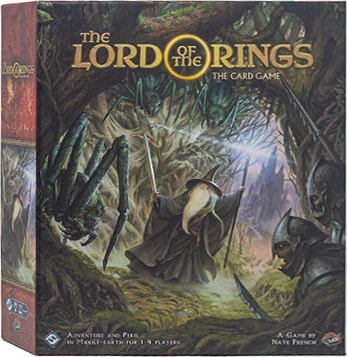
Rules of The Lord of the Rings: The Card Game – Revised Core Set
Summary
This is the rules reference for The Lord of the Rings: The Card Game, a cooperative game in which players work together as heroes to complete the stages of a quest in a scenario. The guide is organized as an alphabetical glossary, with timing appendices and card anatomy, and it does not teach the game. The players win if at least one of them survives through the final stage of the scenario.
Setup
Setup has seven steps:
- Shuffle all player decks and the encounter deck. Do not shuffle the quest deck.
- Each player places their heroes in their play area, adds up their threat cost, and sets their threat dial to that total. This is the player's initial threat level.
- Place the damage, progress, and resource tokens in a bank next to the encounter deck.
- Choose a first player by majority group decision, or at random if no decision can be reached. That player takes the first player token.
- Each player draws 6 cards as a starting hand, and may take one mulligan.
- Arrange the quest cards in numerical order, with stage 1A on top, and place the quest deck near the encounter deck.
- Follow the setup instructions printed on the back of the first quest card.
After setup, play begins with the first round.
A turn
Each round runs through these phases in order:
- Resource: each player gains 1 resource on each hero and draws 1 card.
- Planning: in player order, players may play allies and attachments from hand, paying resources that match the sphere of influence.
- Quest: each player may commit characters by exhausting them. Encounter cards are then revealed, one per player, and the committed willpower is compared with the threat in the staging area. Excess willpower places progress on the current quest, and excess threat raises the players' threat.
- Travel: the players may travel to one location in the staging area, paying its travel cost if it has one.
- Encounter: each player may optionally engage one enemy, then engagement checks are made against the staging area.
- Combat: each engaged enemy gets a shadow card and attacks, with defenders able to block. Then players declare attacks with their ready characters against enemies.
- Refresh: all exhausted cards are readied, each player raises threat by 1, and the first player token passes clockwise.
During action windows, players may use action abilities. Playing a card means paying its resource cost, and the first player decides ties in turn order.
End of the game
The game ends in victory for the players if at least one player survives through the completion of the final stage of the scenario. Some card abilities can add other victory conditions, which end the game immediately when met.
A player is eliminated if all of their heroes are destroyed, if their threat reaches 50, or if a card effect forces it. If all players are eliminated, the game is a loss for the players.
Scoring
Scoring is an optional tool for comparing decks or groups across games, and it applies only when the players win. Lower scores are better.
- Add the final threat level of each player, the threat penalty on all defeated heroes, and the number of damage tokens on surviving heroes.
- Add 10 for each completed round.
- Subtract any victory points collected.
An eliminated player's threat counts as 50. The rulebook does not give a rule for ties.
Variants
Campaign Mode links the core set's scenarios into one continuing adventure. Players play the scenarios in order and advance only after defeating the current one, with no penalty for losses. Results are tracked in a Campaign Log, which records fallen heroes, threat penalties, and a Campaign Pool of boons and burdens earned along the way. Boons and burdens are added to later scenarios as the log directs.
Expert Campaign Mode is a harder version. Heroes keep their damage between scenarios instead of healing, and players may heal that damage at the cost of a permanent +1 starting threat for each hero healed.
Changes
- Variants, by the rulebook draft, 22 November 2026 (shown now)
- Scoring, by the rulebook draft, 22 November 2026 (shown now)
- End of the game, by the rulebook draft, 22 November 2026 (shown now)
- A turn, by the rulebook draft, 22 November 2026 (shown now)
- Setup, by the rulebook draft, 22 November 2026 (shown now)
- Summary, by the rulebook draft, 22 November 2026 (shown now)