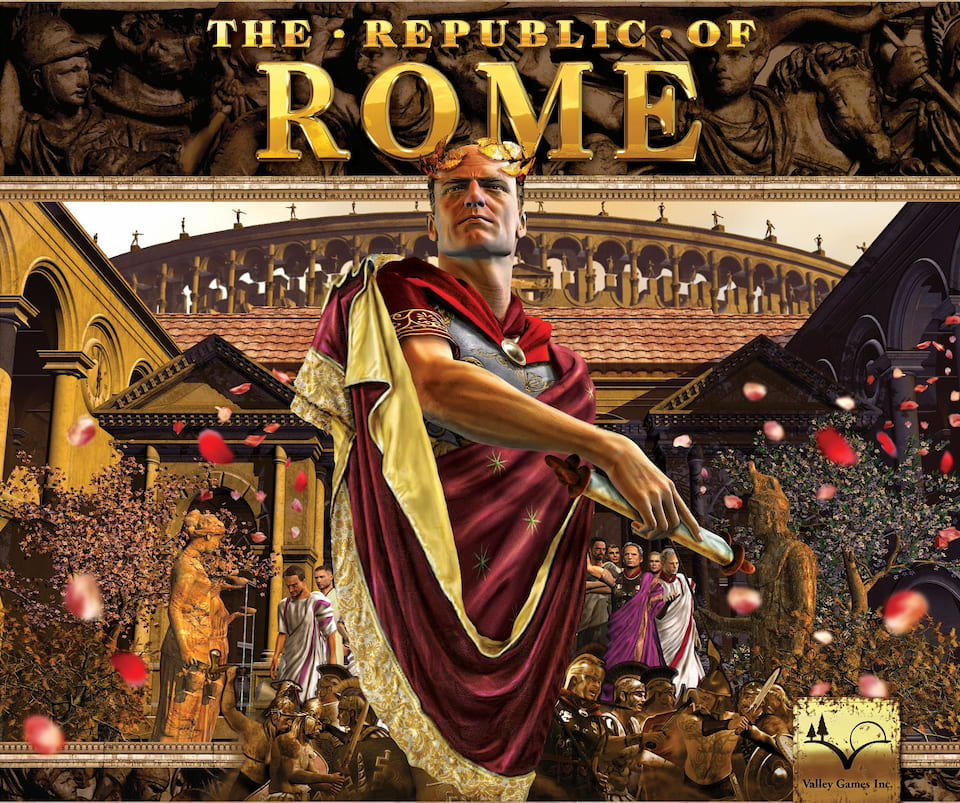
Rules of The Republic of Rome
Summary
Republic of Rome is a game of Roman Republic politics, covering roughly 264 BC to 44 BC. Each player leads a Faction of Senators competing for offices, military commands, concessions and Influence. A player wins by having the most combined Influence from non-Rebel Senators when the game ends, by getting a Senator appointed or elected Consul for Life, or by a Rebel seizing control of the Senate by force. The state itself is a threat: if Rome goes bankrupt, the people revolt, or four Active Wars are going at once, all players lose, so cooperation matters.
Republic of Rome is a card-driven game in which each player controls a faction of Senators competing for influence while Rome faces wars and unrest. The glossary names Consul for Life as the usual winning outcome, and the advanced tips say a conquest victory is most practical in the Late Republic scenario. This part of the rulebook covers strategy tips, history and credits only, so the full win conditions are in part 1.
Setup
Setup depends on the chosen scenario. The Early Republic scenario is the base setup and the others refer back to it.
- Place the board with room for each player's Faction cards, and give each player a Faction Treasury box.
- Put the 36 Mortality Chits in a cup and set the State Treasury to 100 Talents, with Unrest at 0.
- Build the Early Republic deck from the white-bordered cards, put the 1st Punic War in the Inactive Wars area, and deal each player 3 face-up Family cards and 3 hidden Faction cards. Forum cards dealt by mistake are discarded and replaced.
- Mix 6 random Middle Republic cards and 6 random Early Republic cards with the Era Ends card, and place them at the bottom of the deck.
- Place 4 Legions in the Active Forces boxes.
- Draw Mortality Chits until one matches a Senator in play to become the temporary Rome Consul, who gets the Rome Consul and Prior Consul markers and +5 Influence.
- Starting with the temporary Rome Consul and going clockwise, each player places a Faction Leader marker on one of his Senators, then may play Statesmen or Concessions from hand.
The Middle Republic and Late Republic scenarios use their own colored decks, extra Legions and Provinces, and a different card mix. Provinces are dealt to players and each player assigns his Province to a Senator and sets its term.
A turn
Each turn represents a political year and has seven phases in order.
- Mortality: war from the Imminent box may become Active, and one Mortality Chit is drawn to see whether a Senator dies of natural causes.
- Revenue: Senators collect base income, Knights and Concession income, Governors may take Provincial Spoils, Provinces may develop, the State collects revenue and pays for Wars, Land Bills and maintained forces, and Talents are redistributed among Senators and Faction Treasuries. Contributions to the State can earn Influence. Governors return when their terms run out.
- Forum: the HRAO and then each player in clockwise order rolls 2d6 for Initiative. A roll of 7 draws a random Event instead of a card. Otherwise the player draws from the Forum deck, keeping Faction cards and revealing Forum cards. Each Initiative may include a Persuasion Attempt to win over a Senator, an attempt to attract a Knight or pressure Knights for money, and sponsoring Games for Popularity, plus a possible change of Faction Leader. Any Initiatives left over are auctioned.
- Population: Unrest is adjusted for Unprosecuted Wars and Drought effects. The HRAO gives the State of the Republic speech by rolling 3d6, which can change Unrest, restrict recruitment, cause Manpower Shortages, trigger a mob or a people revolt.
- Senate: the Senate votes on elections for Consuls, a Dictator if the war threat is high, a Censor who may prosecute, Governors, Concessions, Land Bills, forces, and deployments against Wars. Players can use Tribunes and Assassins here.
- Combat: forces sent to Wars fight in the order they were sent. Battles use 3d6 on the Combat Results Table, with possible Disasters, Standoffs and Victories. Wars left unprosecuted increase Unrest.
- Revolution: players play Statesmen and Concessions, excess Faction cards are discarded or traded, and commanders who won may declare Civil War.
End of the game
The game normally ends in the Forum Phase when the Era Ends card is revealed. Victory is checked at the end of each Revolution Phase. The Republic loses if four or more Active Wars are in play at the end of a Combat Phase, if the State goes bankrupt with no Rebel in play, or if a People Revolt result occurs with no Rebel in play. A Rebel wins by defeating the Senate in battle, or by bankruptcy or a people revolt, provided Rome survives the turn. If a Consul for Life is appointed or elected, that player wins if Rome survives the turn.
Scoring
The usual win is having the most combined Influence held by non-Rebel Senators when the Forum Phase in which Era Ends is revealed finishes. An immediate win comes from a Senator appointed or elected Consul for Life, which can happen as soon as a Senator reaches 35 Influence in the appointment case or 21 Influence when nominated for election. When several Senators reach 35 Influence at the same moment, the one exceeding 35 by the most wins. If still tied, the Faction with the most combined Influence wins. The rulebook's general tie rule is that ties not resolved by a stated tiebreaker go to the highest 2d6 roller. Its final-score tie handling is otherwise not spelled out.
Variants
Advanced rules can be mixed and matched:
- Pontifex Maximus: an office that assigns Priesthoods and can veto proposals without a Tribune.
- Provincial Wars: Governors raise local forces to defend their Provinces from attacking Wars.
- Rebel Governors: Governors can revolt and march on Rome or hold their Province. Requires Provincial Wars.
- Legionary Disbandment and Recall: veteran Legions can be disbanded for Influence and Oratory, and later recalled for Talents.
- Advocates: Prosecution trials where an Advocate argues against the Censor using Oratory.
- Passing Laws: Laws are proposed like normal proposals and reward Influence when passed.
Scenarios:
- Middle Republic and Late Republic: longer scenarios with more Legions and Provinces.
- Extended Scenario: continue from one period's deck into the next.
- Alternative History: all three decks shuffled together.
Solitaire and two-player rules: the game is played against Neutral Factions run by guidelines and dice, with up to five Factions in total. These versions do not use the Advanced Rules.
The glossary describes these scenarios: Early Republic uses the white deck, Middle Republic uses the gray deck, and Late Republic uses the red deck. An Extended scenario plays the decks in sequence (white, then gray, then red), and an Alternate History scenario shuffles all the decks together.
The glossary also cross-references solitaire and two-player rules and several advanced rules, covering provincial wars, rebel governors and passing laws. Their details are not in this part.
Changes
- Variants, by the rulebook draft, 23 November 2026 (shown now)
- Scoring, by the rulebook draft, 23 November 2026 (shown now)
- End of the game, by the rulebook draft, 23 November 2026 (shown now)
- A turn, by the rulebook draft, 23 November 2026 (shown now)
- Setup, by the rulebook draft, 23 November 2026 (shown now)
- Summary, by the rulebook draft, 23 November 2026 (shown now)