Rules of The U.S. Civil War
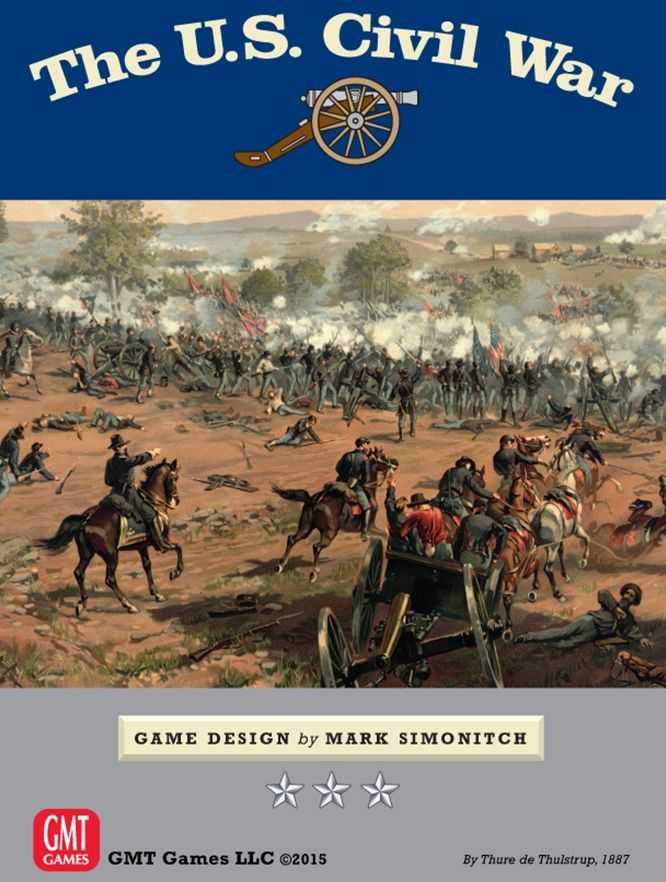
Summary
The U.S. Civil War is a two-player strategic war game of the American Civil War. One player commands the Union in the North and the other the Confederacy in the South. The Confederacy aims to defend its new nation and break the North's will to keep fighting. The Union aims to put down the rebellion. This part of the rulebook does not spell out the victory conditions; see the scoring and end sections in the rest of the rules.
This is a strategy game of the American Civil War that focuses on maneuver and largely leaves out politics and social issues. It is meant as a desk-top military exercise where one side tries to put down the rebellion and the other tries to save it. The Union must cut the Confederate reinforcement rate, and the Confederacy can win quickly by invading the North, though that is also the fastest way to lose. This part of the rulebook does not spell out the full win conditions.
A turn
Each game turn runs through these phases in order:
- Reinforcement Phase: the Union places its set reinforcements, may build or upgrade a Fort, and draws Special Action Cards. The Confederacy converts Build Points into new Strength Points (SPs) and draws cards.
- Strategic Movement Phase: each side moves SPs by rail, river, ocean, or road within set limits. Generals do not move in this phase.
- Leader Management Phase: the Union acts first, then the Confederacy, to place, promote, demote, remove, and transfer Generals.
- Action Cycle: four Action Phases.
- End Phase.
In each Action Phase both players roll one die. The higher roll goes first, and the difference between the two rolls gives each player that many Action Points. The first player spends his points, fights his battles, and then checks supply. The second player then takes the same number of points. A dice difference of 1 gives one Action Point in each of the three theaters, and those points must stay in their theater. Doubles give both players a Special Action Card and a reroll.
Common Action Point costs: moving one General with its stack costs 1; moving up to 3 SPs in one hex without a General costs 1; rallying a Demoralized stack costs 1; transferring two 1- or 2-star Generals costs 1; building an Entrenchment costs 1; training costs 1 for every 10 points committed; repositioning Militia and dispersing SPs to the Displaced Box cost 0.
Variants
The Basic Game uses only the untinted rules. The Advanced Game adds the naval rules and the tinted rules, and players may ignore them when playing the Basic Game. The Advanced Game also requires the Naval Units and Naval Leaders counters.
Salt rules: an optional rule set that can be added to the game, with Salt hexes worth pursuing.
Naval rules: the basic game uses simpler naval rules, and the advanced Naval Units are meant for players who have already played the basic game several times.
Changes
- Variants, by the rulebook draft, 22 November 2026 (shown now)
- A turn, by the rulebook draft, 22 November 2026 (shown now)
- Summary, by the rulebook draft, 22 November 2026 (shown now)