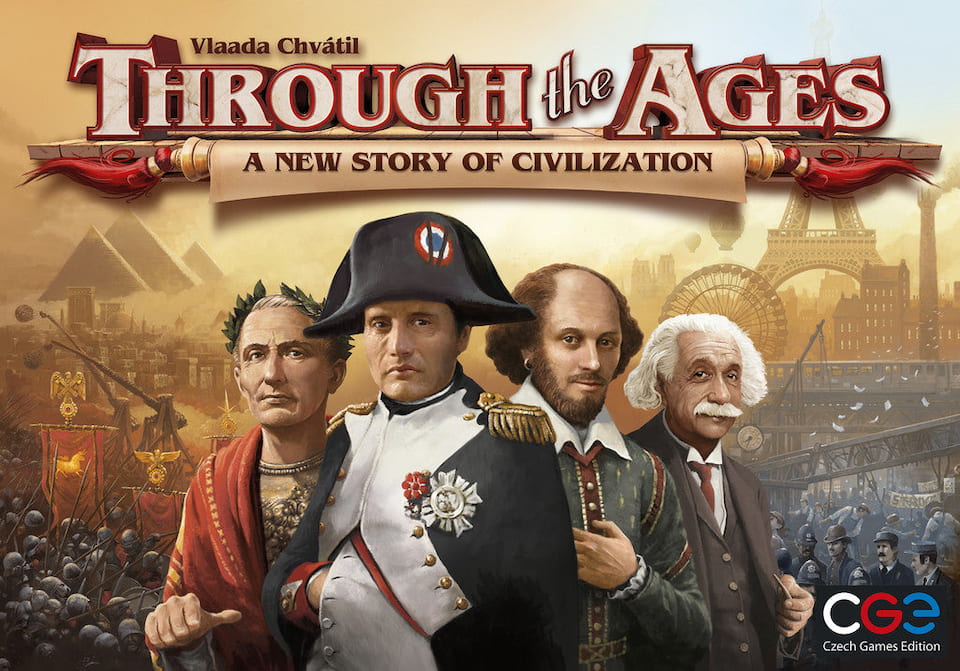
Rules of Through the Ages: A New Story of Civilization
Summary
Through the Ages is a civilization-building game in which each player develops a civilization from Antiquity to the modern era, scoring culture points through literature, drama, religion, wonders, and great leaders. The player with the most culture points at the end of the game wins. This handbook teaches a shortened first-game version that omits player-versus-player attacks and uses only Ages A, I and II.
Setup
Each player takes a player board in a chosen color and sets up their pieces: rating markers at their starting spaces, 16 blue tokens in the blue bank, and 25 yellow tokens split between the yellow bank, the worker pool and the technologies. Six yellow tokens start as workers on the initial cards, one worker is unused in the worker pool, and white and red tokens are placed beside the board.
Place the science and culture boards, the current age board, and the military board in the middle. Put the octagonal counters on zero and the round rating markers on their starting spaces. Sort the cards into decks by back. For your first game, remove the Age III decks and use only the event, territory, tactics and military bonus cards from the Age I and II military decks. Remove the cards marked for 3- or 4-player games depending on the number of players.
Deal 13 Age A civil cards to the card row and place the rest of the Age A civil deck on the current age board. Shuffle the Age A military deck, return a set number of cards to the box, and place the top cards face down as the current events deck (number of players plus two). Choose a starting player at random and give each player white tokens on their Despotism card: 1 for the starting player, then 2, 3 and 4 going clockwise.
A turn
Round one (Antiquity) is a preparatory round. Each player has only a few civil actions and no military actions, and their turn has just an Action Phase followed by the End-of-Turn Sequence.
From the second round on, a turn begins by replenishing the card row: remove the indicated leftmost cards (1 to 3 depending on player count), slide the remaining cards left, and deal new civil cards to the empty spaces. The turn then has these parts:
- Politics Phase: play at most one political action, which in this game is preparing an event or territory.
- Action Phase: spend civil and military actions in any order, such as taking cards, increasing population, building or upgrading farms, mines, urban buildings and units, playing leaders, developing technologies, and playing action cards or tactics.
- End-of-Turn Sequence: follow the steps on the player board, which include corruption, production, consumption, drawing military cards, and resetting actions.
Taking a card costs the civil actions shown below its space. Technologies go to your hand until developed, leaders are kept in hand until played, wonders go straight into play, and action cards are played once and then discarded. Military cards are kept secret.
End of the game
The game ends in the Age II end phase. When the Age II civil deck runs out, Age I cards are discarded, Age I leaders and unfinished wonders are removed, and each player loses 2 yellow tokens. Since there are no Age III cards in the first game, no new cards are dealt to the card row afterward.
After Age II ends, each player gets one more turn. If Age II ends during the first player's turn, that round is the last round. Otherwise the following round is the last one. The player to the right of the starting player takes the final turn so that everyone finishes with the same number of turns.
Scoring
At the end of the first game, each player scores extra culture points for achievements:
- 1 culture for each Age I technology and 2 for each Age II technology, with the government counted twice.
- Culture equal to the science rating, strength rating and happiness rating.
- Culture equal to total food and resource production during the Production Phase, ignoring corruption and consumption.
- 3 culture for each colony.
- 6 culture for each completed Age II wonder.
Scoring is done step by step, with each player counting their own points. The player with the most culture points wins. If players are tied, they all share the victory.
Variants
The handbook describes the first game as a shortened version of the full game. The full game adds Age III, air forces, aggressions, wars, pacts, resignation, and Age III events for final scoring. The full game is played with all military cards and ends in Age IV.
The back page of the handbook describes two variants for the full game. A shorter game uses only two ages, with each player keeping one of two Age III events drawn at the end of Age I and final scoring from Age III events. A peaceful game removes aggressions, wars and pacts from the military decks, and an optional global conflicts rule gives each civilization culture equal to its strength minus the weakest strength at the end of an age.
Changes
- Variants, by the rulebook draft, 22 November 2026 (shown now)
- Scoring, by the rulebook draft, 22 November 2026 (shown now)
- End of the game, by the rulebook draft, 22 November 2026 (shown now)
- A turn, by the rulebook draft, 22 November 2026 (shown now)
- Setup, by the rulebook draft, 22 November 2026 (shown now)
- Summary, by the rulebook draft, 22 November 2026 (shown now)