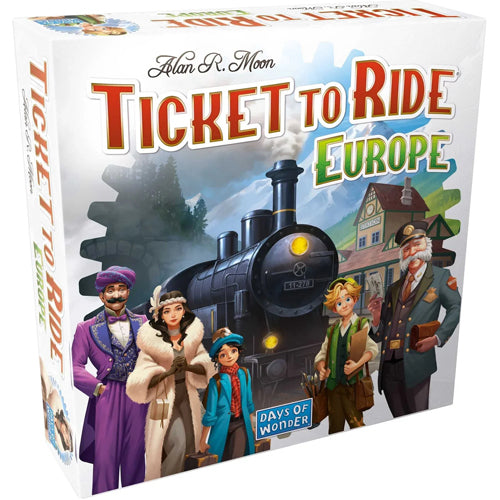
Rules of Ticket to Ride: Europe
Summary
In Ticket to Ride Europe, players lay colored train routes across a map of early 1900s Europe, connecting cities named on their secret Destination Tickets and building Train Stations. The player with the most points at the end wins.
Setup
Place the map in the center. Each player takes 45 colored trains, three matching stations and a scoring marker, which starts on the Start space of the Scoring Track. Shuffle the Train cards, deal four to each player, place the deck by the board and turn five cards face up in a row. Set the European Express bonus and Summary card beside the board. Shuffle the six long-route tickets (blue background), deal one to each player and return the rest unseen to the box. Shuffle the regular short-route tickets, deal three to each player and place the rest face down as a draw pile.
A turn
On your turn, take exactly one of these four actions. Draw Train cards: draw two cards from the face-up row or the deck, replacing any face-up card you take. If you take a face-up Locomotive, it is your only card that turn. If three face-up cards are Locomotives, discard all five and reveal five new ones. Claim a Route: play a set of Train cards matching the color and number of spaces of an open route, place one of your trains on each space, discard the set and score the route's points. A route must be claimed in one turn, and you may claim only one route per turn. Gray routes can use any single color, and Locomotives act as wild cards. In two- or three-player games only one route of a Double-Route pair can be used. Draw Destination Tickets: draw three tickets, keep at least one (you may keep all three), and return unkept tickets to the bottom of the deck. Build a Train Station: in a city with no station yet, discard one card for your first station, two matching cards for your second, or three matching cards for your third. You may build at most one station per turn and three in total. Two players cannot share a city. Ferries need a Locomotive for each Locomotive symbol on the route plus matching cards for the rest. For a Tunnel, play the route's cards, then reveal three cards from the deck; each revealed card matching the played color requires one more matching card or Locomotive. If you cannot or do not want to pay, take your cards back and your turn ends, and the revealed cards are discarded.
End of the game
When a player's stock of trains is two or fewer at the end of his turn, every player, including that player, takes one final turn. Then the game ends and final scores are calculated.
Scoring
Route points are added as each route is claimed, using the Route Scoring Table on page 7. At the end, reveal all Destination Tickets. Add the point value of each completed ticket and subtract the value of each incomplete ticket. A completed ticket requires a continuous path of your own color between its two cities; a station you own can let you use one other player's route into its city. Add 4 points for each station you did not use. The player or players with the Longest Continuous Path of a single color receive the 10-point European Express bonus. Loops are allowed, but no train may be used twice in one path. Stations and opponents' routes they provide do not count toward path length. The player with the most points wins. Ties are broken by the most completed Destination Tickets, then the fewest stations used. If still tied, the player holding the European Express card wins.
Changes
- Scoring, by the rulebook draft, 23 November 2026 (shown now)
- End of the game, by the rulebook draft, 23 November 2026 (shown now)
- A turn, by the rulebook draft, 23 November 2026 (shown now)
- Setup, by the rulebook draft, 23 November 2026 (shown now)
- Summary, by the rulebook draft, 23 November 2026 (shown now)