Rules of Tiletum
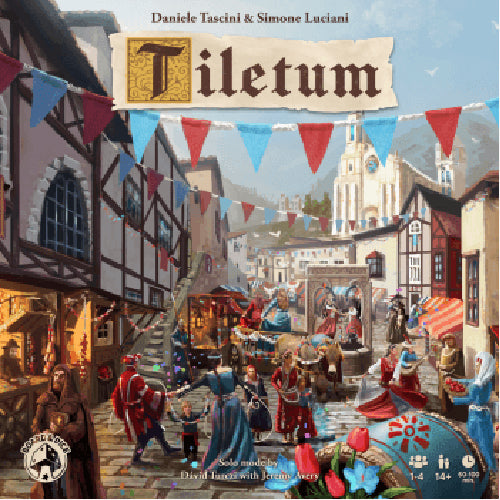
Summary
Tiletum is a dice management game in which players are rich merchants trading across early Renaissance Europe. They acquire trade contracts, build houses and pillars, invest in cathedrals, gain noble favor and score at fairs. Each die taken gives resources matching its color and value and then triggers an action; lower values give fewer resources but more Action Points. Over four rounds, the player with the most Victory Points wins.
Setup
- Place the game board in the middle of the table and the Action Wheel in its top-left space. Make a general supply of resource tokens and Action Point counters.
- Separate the Bonus, Contract and Character tiles by type. With 3 players remove tiles marked 4; with 2 players remove tiles marked 3+ or 4. Shuffle the Bonus tiles into a face-down pile. Place 6 Bonus tiles on the Action tiles around the wheel, 1 Bonus tile next to the King track, and one on each map space that is valid for the player count.
- Shuffle the Contract and Character piles and reveal 5 of each as the offers.
- Shuffle the Construction Cost tiles and place one under each Cathedral spot. Stack Cathedral tiles by type, highest value on top. Shuffle the Town and Fair tiles and place 3 Town tiles and 4 Fair tiles on the board; return unused ones and the Cathedrals marked unavailable to the box. Place the Fair Order tiles in the fair cities.
- Shuffle the Corruption tokens, place them face down by the Turn track, then take 3 at random and place them face down on the Turn track.
- Give the Compass Rose marker to the first player. Each player takes a color: a player board, 3 markers (one on the Scoring track at 10, one on the King track stacked in turn order, one on the Turn Order track), a Merchant and an Architect placed in Tiletum, 8 Houses (5 on roof spaces, 1 in Tiletum, 2 in supply), 7 Pillars (5 on the first Contract spaces, 2 in supply), 5 Bonus Action Point markers, and the +100/+200 VP marker.
- Each player takes 1 Iron, 1 Wool, 1 Stone and 1 Food. Gold is taken by seat: first player 1, second 3, third 5, fourth 6.
- Put one die of each color per player into the bag and return the rest to the box.
A turn
Each round has phases in this order: Preparation, Action, King, Fair, Cleanup. In the Preparation phase, take 8, 11 or 14 dice from the bag for 2, 3 or 4 players, roll them and place them on the Action Wheel by value. The first player reveals the rightmost face-down Corruption token and moves King track markers left by its value, stopping at the lowest space.
In the Action phase, players take turns in Turn Order. Each turn has three steps: take one die from the wheel and place it on your leftmost empty die space; take the Resources matching that die's color and number; then perform the action on the space you took it from. You may take the Bonus tile there into your Storehouse, which is optional. Before taking a die you may spend 2 Gold to raise or lower its value by 1, as often as you like. Each turn is repeated three times per player before the Action phase ends.
Action Points equal 7 minus the die value. Actions include:
- Architect: move, add a Pillar to a Cathedral, or take a Bonus tile.
- Merchant: move, add a House to a Town, or take a Bonus tile.
- Character: take a Character tile, discard the offer, or place a Character in a Room.
- Contract: take a Contract, or exchange one Resource for another.
- King: advance your marker one step per Action Point, up to +15.
- Joker: spend all Action Points on one other action.
Tasks can be done at any time during your turn, often by spending Resources. They include fulfilling a Contract, covering a Crest, contributing Stone to a Cathedral where you have a Pillar, and using a Helper from your Storehouse.
In the King phase, the highest King track player takes the Bonus tile next to the track, or scores 4 VP in the last round. Players then score according to their King track position, and Turn Order is reset from the King track.
In the Fair phase, each fair town is scored by players who have a House or Merchant there. Fair tiles are then flipped face down.
In Cleanup, replenish claimed Bonus tiles on the wheel and King track, reset the Corruption tokens, return dice to the bag and rotate the Action Wheel one step clockwise.
End of the game
The game ends after the Fair phase of the fourth round. Proceed directly to final scoring.
Scoring
Victory Points are tracked on the Scoring track. Players also score during play from the King track, fairs, fulfilled contracts, Crests, Cathedrals and other effects. The Scoring track cannot go below 0.
Final scoring:
1. Multiply your Houses on the map by your Pillars on the map and gain that many VP.
2. Count your Completed Buildings, meaning those with a Crest and all Rooms filled. Gain 0, 0, 5, 10, 20 or 30 VP for 1, 2, 3, 4, 5 or 6 of them.
3. For every 4 Resources left in your supply, gain 1 VP.
The player with the most points wins. In a tie, the tied player who is first in Turn Order wins.
Variants
Action tiles: for more variety, especially once players know the game, shuffle the six Action tiles and place one at random on each space around the Action Wheel. The rulebook says these are not used in the first game.
Player counts: the rulebook gives separate setup for 2, 3 and 4 players, as described in setup.
Solo mode: the rulebook says solo components are in a separate Solo Mode booklet, which is not included in this text.
Changes
- Variants, by the rulebook draft, 22 November 2026 (shown now)
- Scoring, by the rulebook draft, 22 November 2026 (shown now)
- End of the game, by the rulebook draft, 22 November 2026 (shown now)
- A turn, by the rulebook draft, 22 November 2026 (shown now)
- Setup, by the rulebook draft, 22 November 2026 (shown now)
- Summary, by the rulebook draft, 22 November 2026 (shown now)