Rules of Time of Legends: Joan of Arc
Summary
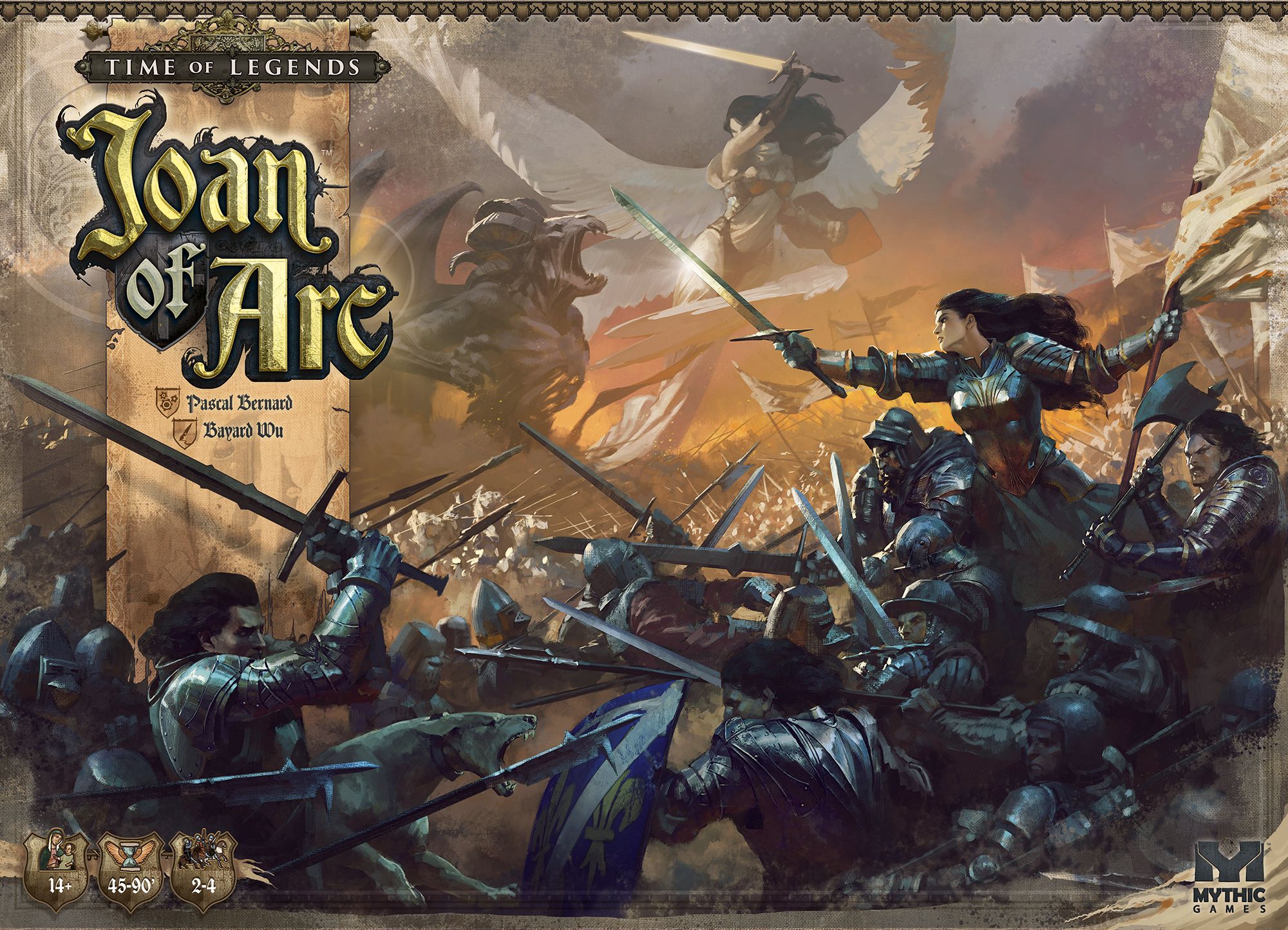
Time of Legends: Joan of Arc is a miniatures wargame set in the Hundred Years War, where historical armies and myths such as witches, ghosts and dragons fight on a hex-tile board. Players spend orders to activate groups of units over a series of rounds. The winner is the player who meets the victory conditions of the chosen scenario.
Setup
Choose a scenario and follow its instructions. Give the 1st player token to the side the scenario names, then assemble the board tiles and scenario elements as shown.
Place the battle board beside the board and shuffle these decks face down on it: war council, round (only the cards the scenario lists), legend (only the myth or tactics type the scenario lists), and discussion (only the cards matching units with the bubble icon in play).
Each player takes a player board, their units and unit cards, the bases, rally point token, resources and reroll token listed by the scenario, and the intrigue card for their side. Characters with a level 2 side go under their level 1 card.
Put the remaining resources, wound tokens and legend cards in a common pool within everyone's reach. Place civilians, their unit cards and any building interior overlays as the scenario directs. The player holding the 1st player token starts.
A turn
The game is played in rounds. Each round has a council phase, a turn for the first player, a turn for the second player, and a camp phase. With 3 or 4 players, extra turns follow the second player.
Council phase: Flip the top round card, which shows how many activation orders each player gains. Reveal three different war council cards into the river, redrawing duplicates. Starting with the 1st player, each player takes one card and applies its effect. Then pay upkeep: each level 2 character costs 1 XP token to keep, or it drops back to level 1.
Player's turn: In the orders phase, place an order on an allied area to activate every unit there, then declare and resolve each unit's actions. Players must use at least one order per turn and may keep activating areas while they have orders. Each unit joins only one action per activation, plus any bonus actions. Actions include move, attack, recruitment, wait, discussion, command, equip, focus and the skill actions. In the reserve phase, spent orders go back to the common pool and unused orders are stored on the player board, up to 3 of each type.
Camp phase: Rally units waiting in the infirmary. Then, starting with the 1st player, roll doom dice for each allied disrupted unit and apply the result: death, disrupted, rally or delayed rally. Finally, check the victory conditions.
End of the game
The game ends when the round deck runs out of cards. Some scenarios also end the game as soon as their victory conditions are met. Other victory conditions are checked by the 1st player during the camp phase. When a player has met the scenario's victory conditions, the game ends and that player wins.
Scoring
The rulebook has no general points system. Winning is decided by each scenario's victory conditions, and some scenarios award victory point tokens, for example for enemy units in the graveyard. The rulebook does not say how ties are resolved.
Variants
Optional rules, which are required in some scenarios and otherwise need the agreement of all players:
- Forced March: before moving an infantry unit, roll doom dice. A death result means it cannot move, a disrupted result sends it to the infirmary, and any other result lets it move 2 areas.
- Massed Target: a shooting attack against a full enemy area adds one white dice.
- Breakthrough: after a cavalry charge, the unit may move into a free area next to the target if at least half of the enemy units were pushed, killed or disrupted.
- Capture: a character that would be destroyed by an attack may instead be captured. A captured character can be rescued at the end of a later camp phase by spending 3 XP and rolling a rally result on the doom dice.
With 3 or 4 players, extra turns follow the second player and turns run clockwise. In cooperative games, players on the same side do not sit together and the opposing sides alternate turns.
Changes
- Variants, by the rulebook draft, 22 November 2026 (shown now)
- Scoring, by the rulebook draft, 22 November 2026 (shown now)
- End of the game, by the rulebook draft, 22 November 2026 (shown now)
- A turn, by the rulebook draft, 22 November 2026 (shown now)
- Setup, by the rulebook draft, 22 November 2026 (shown now)
- Summary, by the rulebook draft, 22 November 2026 (shown now)