Rules of Torres
Summary
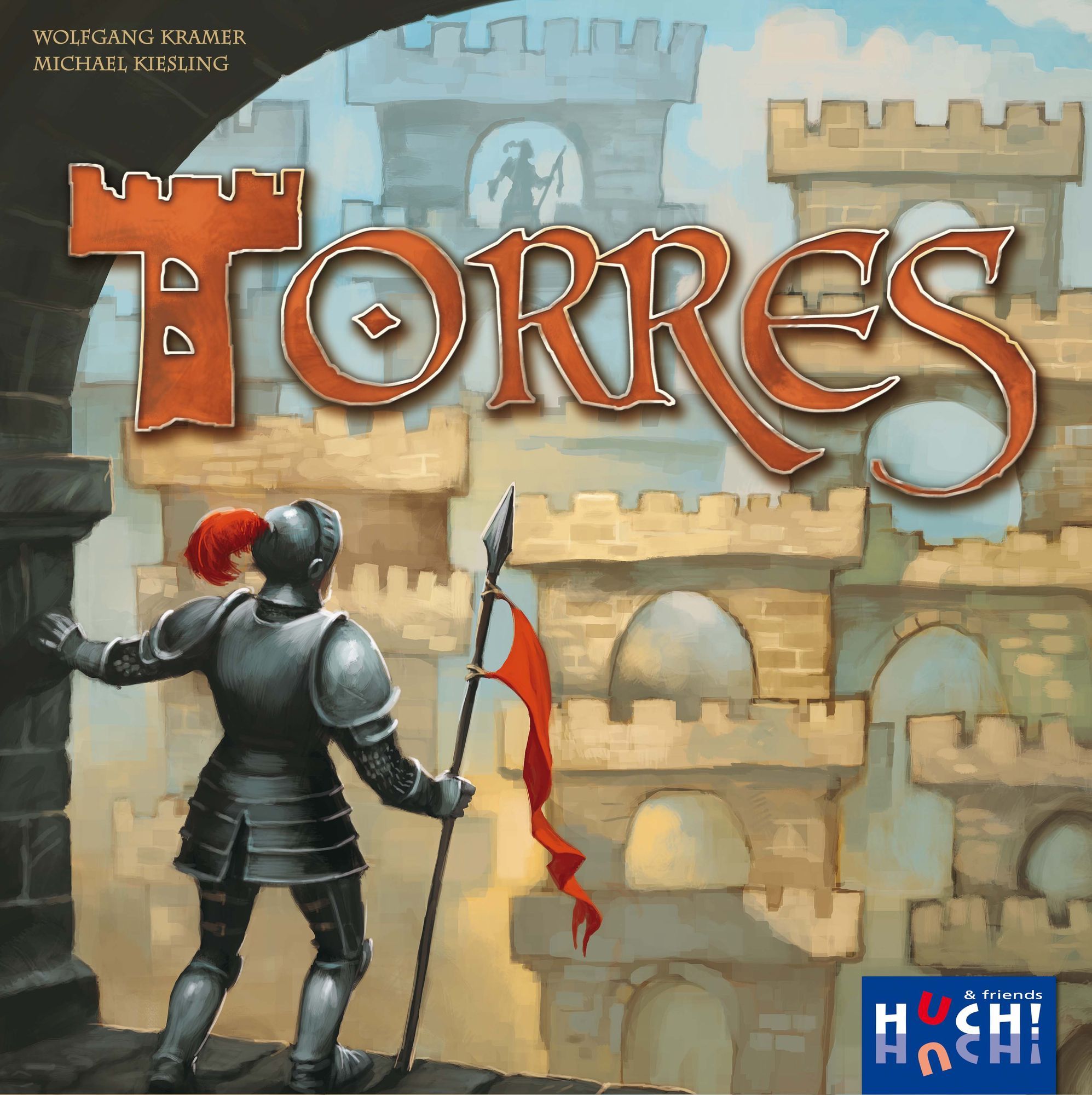
A castle-building game for 2 to 4 players played over three phases (years). Players extend castles with their knights and tower blocks, and score for each castle where they have a knight, based on the castle's surface area and the knight's height. The player with the most points after the third phase wins.
Setup
- Place the board in the middle of the table.
- Each player picks a color, takes a scoring marker and 6 knights in that color, a CODEX card, and their 10 action cards, which they shuffle and place face down.
- Use the PHASES card for the player count (2, 3 or 4) and return the others to the box.
- Put the scoring markers at the start of the scoring track.
- Place the king next to the board and the tower blocks as the common supply.
- Put 8 tower blocks on the marked spaces as the castle foundations.
- Starting with the youngest player and going clockwise, each player places one knight on an empty castle, so each starts on a different castle.
- The last player places the king on any empty castle, which becomes the king's castle for the first year.
A turn
Each round, every player takes one turn in clockwise order, starting with the youngest player. On a turn you have 5 action points (AP) to spend in any order:
- Add a knight (2 AP): place a knight on an empty space on the board or on a tower block, orthogonally adjacent to one of your knights. The new knight can be at the same level or lower, never higher.
- Move a knight (1 AP per space): move orthogonally. A knight can go up only one level per move but down any number of levels. It cannot enter a space holding the king or any knight. Tower block doors let a knight pass through a castle for 1 AP, climbing no levels on the way.
- Place a tower block (1 AP each): take blocks from only one of your stacks per turn. You may place up to three blocks in a turn, and you can split unused blocks onto your other stacks, but no stack may exceed three blocks. Blocks go either next to a castle at level 0, enlarging it, or onto an existing block, making it taller. A castle can never be taller than its surface area, and a castle cannot be extended so that it touches another castle orthogonally (diagonal touching is fine).
- Acquire an action card (1 AP per card): draw the top 3 cards from your deck, keep 1, and return the others to the top or bottom of the deck. You may acquire up to two cards per turn. A card cannot be played on the turn it is acquired.
- Move the scoring marker (1 AP per space): only one marker per space; a marker landing on an occupied space goes to the next empty one.
You may play at most one action card per turn, at no AP cost, at any point in your turn. Played cards are removed from the game.
At the start of each phase, take tower blocks from the common supply as shown on the PHASES card and stack them as shown. Leftover blocks at the end of a phase return to the common supply.
End of the game
The game ends after scoring following the third phase.
Phase lengths: phase 1 lasts four rounds, phases 2 and 3 last three rounds each, except in a two-player game where all three phases last four rounds.
After each phase's scoring, the player with the lowest score may move the king to any empty space of any castle, at any level. If no empty space exists, the king does not move. Play then continues with that player.
Scoring
Scoring happens at the end of each phase.
Castle positions: for each castle where you have one or more knights, you score the castle's surface area multiplied by the level of your highest knight there. You score each castle only once, even with several knights. Knights of different colors each score separately. Players score in clockwise order starting with the starting player, and each marker moves forward on the track by the points earned.
King's bonus: after all castle positions are scored, each player with a knight on the matching level of the king's castle gets a bonus: 5 points on level 1 after phase 1, 10 points on level 2 after phase 2, and 15 points on level 3 after phase 3. The bonus is given once even with two knights on that level. A player can receive the bonus and the castle position score for the same castle.
The player with the most points after the third phase wins. The rulebook does not give a separate tie-break for the final result.
Variants
- Common action deck (rule variant): shuffle all action cards together regardless of color into one face-down deck. When acquiring a card, draw from the top of this common deck instead. All other rules stay the same.
- Master version: adds the following to the basic game.
- Starting castles: players choose the foundation positions in clockwise order, each placing one tower block at a time. Each new castle needs at least 2 empty spaces between it and any other castle, measured orthogonally.
- Action cards: each player starts with all 10 action cards of their color in hand. Acquiring cards is no longer possible.
- Master cards: shuffle the 8 master cards, draw one, and place it face up. It offers optional bonus points that each player may choose to pursue, without announcing it.
- Turn order: after the first round, the player with the most points becomes the starting player. Ties keep the existing order.
Changes
- Variants, by the rulebook draft, 23 November 2026 (shown now)
- Scoring, by the rulebook draft, 23 November 2026 (shown now)
- End of the game, by the rulebook draft, 23 November 2026 (shown now)
- A turn, by the rulebook draft, 23 November 2026 (shown now)
- Setup, by the rulebook draft, 23 November 2026 (shown now)
- Summary, by the rulebook draft, 23 November 2026 (shown now)