Rules of Tournament at Avalon
Summary
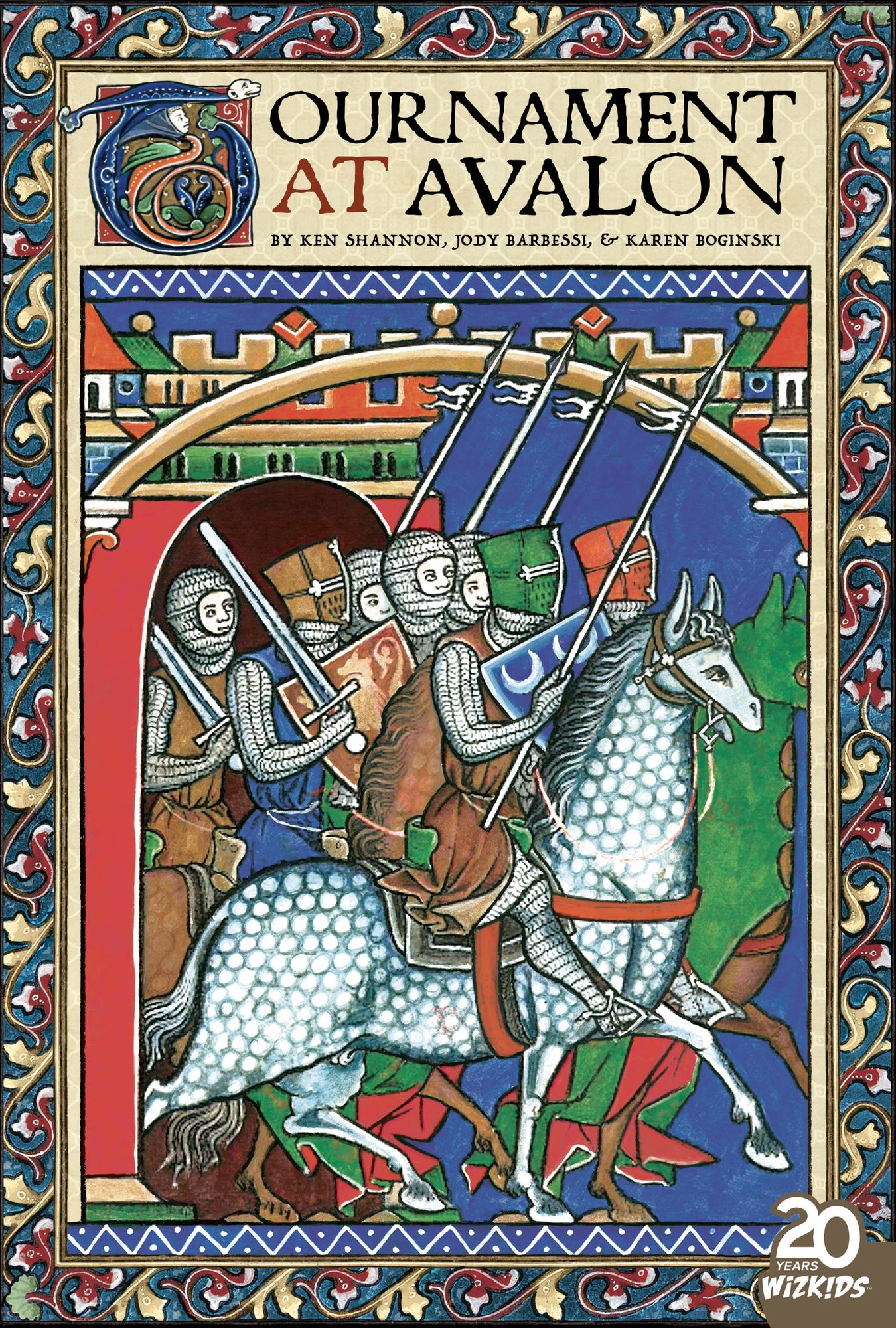
Tournament at Avalon is a trick-taking game built around Arthurian characters with unique powers. Players play Weapon cards into Melees, and whoever loses a Melee takes its cards as Injury. The goal is to take as few tricks as possible while forcing opponents to take them. The game ends when one or more players reach zero Health, and the player with the most Health left wins.
Setup
- Weapons deck: Shuffle together all Basic Weapon and Alchemy cards, plus the Mists of Avalon, Morgan le Fay, and Apprentice Sorceress Special Weapon cards. Keep the Merlin card out of this deck. Place it facedown with space for a discard pile.
- Godsend deck: Shuffle all Godsend cards into a facedown deck with space for discards. Keep Location cards in the box unless a card calls for them.
- Character cards: Each player gets a Protagonist and its paired Companion, plus any tokens listed for those cards. Stack the Protagonist on top of the Companion, leaving the Threshold for Use visible. Characters can be chosen, picked randomly, or assigned by any method the group likes.
- Health: Each player gets a set of Health cards and a Health marker. Agree on a starting Health. The default is 400, and 300 is suggested for shorter games. Set each marker to the starting value.
- Dealer: Choose a dealer at random. The player to the dealer's left leads the first Melee. Place the Weapon Card Passing token in front of the dealer.
A turn
Each Tourney Round has four phases.
Dawn Phase
- Reset all Character powers and tokens to their unused state.
- The dealer shuffles the Weapons deck and deals 12 cards to each player.
- Each player passes three chosen cards to the player next to them. The first round passes left, and the direction alternates each round.
Combat Phase
- The lead player plays a card. Its suit becomes the Lead Suit for that Melee.
- Play continues clockwise. Each player must follow suit. Alchemy and Special Weapon cards count as in-suit.
- If two or more cards with the same number value are played in one Melee, they form a Feint. Feinted cards cannot lose the Melee.
- A player who cannot legally play is Shamed. They discard a card from hand face up and immediately take 5 Injury.
- The lowest-valued card loses the Melee. The loser places all Melee cards in their Weapon Hits pile and leads the next Melee.
- If every card in a Melee is Feinted, nobody loses. Set those cards aside and play the next Melee with the same lead player. The eventual loser takes all accumulated cards.
- The Combat Phase ends when a Melee is about to begin but a player has no cards left.
Dusk Phase
- Discard unused Weapon cards and any special cards left under Characters.
- Total the Injury from each player's Weapon Hits pile and subtract it from their Health (see Scoring).
- The player with the lowest Health becomes the next dealer.
Godsend Phase
- Discard any old Godsend cards, then deal new ones to the most injured players (see Scoring for the recipient rules).
End of the game
The game ends immediately when at least one player reaches zero Health or less. This can happen during the Combat Phase from Shame or other immediate Injury, or during the Dusk Phase when Injury is tallied. If it happens mid-round, the game ends at once and the winner is determined then.
Scoring
Injury values
- Standard Basic Weapon and Alchemy cards: 5 points each.
- Poisoned Basic Weapon cards: 10 points each.
- Apprentice Sorceress cards: 10 points each.
- Morgan le Fay and Mists of Avalon cards: 25 points each.
- Card powers can modify Injury. A Weapon card's Injury can be doubled only once by card powers.
Godsend recipients
Godsend cards go to the most injured players, and the number of recipients increases each round. The healthiest player never receives one. Players 100 or more Health behind the least injured player get an extra card, and players 200 or more behind get another. Selection starts with the most injured player. Recipients either take a face-up card or draw from the top of the deck.
Winner
The player with the most remaining Health wins. If players are tied for the most Health, they share the win.
Variants
Tournament at Camelot crossover
- Cards from both games can be mixed. Character choices and Godsend decks can be combined.
- To play with Tournament at Camelot rules, do not pass Fey Changeling cards. Place the Guinguemar Godsend card on the table to show that Enhanced Alchemy is not in effect.
Chaos of Battle (7-8 players, adaptable to 5)
- Requires both the Camelot and Avalon sets. Two suits from Camelot are added to the Weapons deck.
- The game lasts three Tourney Rounds or until a player reaches zero Health. The most Health wins.
- The host chooses a Location, which sets the extra suits. The host gains that Location's Host Ability.
- Each new Location must share at least one suit with the previous one, or the host may keep the same Location.
- Godsend recipients follow the 7-8 player chart. Godsend cards are shuffled together from both games, and the Beswitched, Dwarves, Alchemy, and Black Knight Godsend cards are set aside.
- With fewer players, the variant has less Feinting.
Changes
- Variants, by the rulebook draft, 23 November 2026 (shown now)
- Scoring, by the rulebook draft, 23 November 2026 (shown now)
- End of the game, by the rulebook draft, 23 November 2026 (shown now)
- A turn, by the rulebook draft, 23 November 2026 (shown now)
- Setup, by the rulebook draft, 23 November 2026 (shown now)
- Summary, by the rulebook draft, 23 November 2026 (shown now)