Rules of Unconscious Mind
Summary
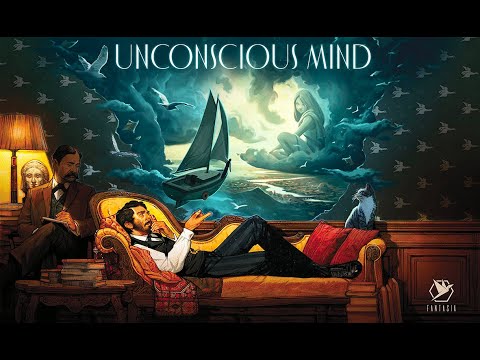
Unconscious Mind has players take the roles of Freud's contemporaries in the early days of psychoanalysis. Over the game you share ideas, treat clients, publish treatises and raise your reputation. The player with the most Victory Points at the end wins the title of Freud's most distinguished contemporary.
Setup
Place the City Map and Meeting Table in the center, along with the Location Goal row. Put the District tokens on their stacks, set Freud's Reputation marker on the 1 space, and place Freud on a random Location. Set up the Notebook tile display using the number of tiles for your player count, and block Idea spaces on the Meeting Table when playing with fewer than four. Form the Treatise, Routine and Case-Study Client, Latent and Manifest Dream, Grief Layer and Research displays as the rulebook describes. Each player takes a color set, places their player board, Insight dial and Office board, and sets their markers at the starting positions. The player who most recently made a Freudian slip starts and receives the starting player token. Players then receive extra starting resources by seat order, and each receives an Office Room card. Draft one Routine Client per player plus one, with a starting Grief Layer on each. In reverse player order, each player drafts a Client and Dreams, and then in clockwise order from the starting player, each chooses a starting Notebook tile and places their Professor on the matching Location.
A turn
The game is played in rounds, starting with the starting player and proceeding clockwise. On your turn, choose one of three options: State Ideas, Recall Ideas, or Treat Clients. For State Ideas, place one or two Ideas from your supply onto a vacant Idea space on the Meeting Table, pointing their tails at a single adjacent action space that no other of your Ideas points to. Resolve the pointed-to action spaces, then advance your Inkpot by the number of Inkpot icons next to your placed Ideas. Recall Ideas gains Coffee for each Idea space you occupy, returns your Ideas to supply, and lets you claim a Location or District bonus. Treat Clients uses Dreams to produce Therapy points on your clients. Coffee is capped at 6. After your main action, you may use Heart-Shaped Boxes to produce Therapy points, and then you must draft a new Client and Dreams for each vacant Office Room.
End of the game
The game ends when Freud's Reputation marker reaches the final space on the Reputation track. The current round is completed, then one final round is played. During that final round, do not draft new Clients into vacant Office Rooms at the end of your turn. Then proceed to Final Scoring.
Scoring
Victory Points are scored during play and during Final Scoring. At the end, score the following: your Reputation level points; 2 points per Published Treatise and per Cured Client for the player furthest ahead on the Reputation track, and 1 point each for the player second furthest ahead; 2 to 10 points per the number of Districts where you have a player-color Insight in one, two or three different Districts; points for the number of completed Notebook tile rows on your board; points for the number of different Location tags in play; points for Case-Study Clients that reached Catharsis without a Grief Layer, up to each card's maximum; 2 points per remaining Heart-Shaped Box; and 3 Coffee converted to 1 Bright Idea, which is worth 1 point. Leftover Bright Ideas are worth 1 point each. The player with the most Victory Points wins. If there is a tie, the tied player with the highest Reputation level wins.
Variants
The rulebook offers optional modules. Fireworks lets a player claim a District bonus with one fewer tag, then moves the standee one District clockwise. The Journalist is a solo-oriented figure that moves in place of a Professor or Freud and lets the player count tags from all Published Treatises. Location overlays change the bonus slots available at the six Locations, with three setup options and a Treat a Client bonus. The rulebook also includes a solo mode where a non-player opponent called the Id uses the Fireworks, the Journalist and the overlays according to its own rules.
Changes
- Variants, by the rulebook draft, 22 November 2026 (shown now)
- Scoring, by the rulebook draft, 22 November 2026 (shown now)
- End of the game, by the rulebook draft, 22 November 2026 (shown now)
- A turn, by the rulebook draft, 22 November 2026 (shown now)
- Setup, by the rulebook draft, 22 November 2026 (shown now)
- Summary, by the rulebook draft, 22 November 2026 (shown now)