Rules of Villagers
Summary
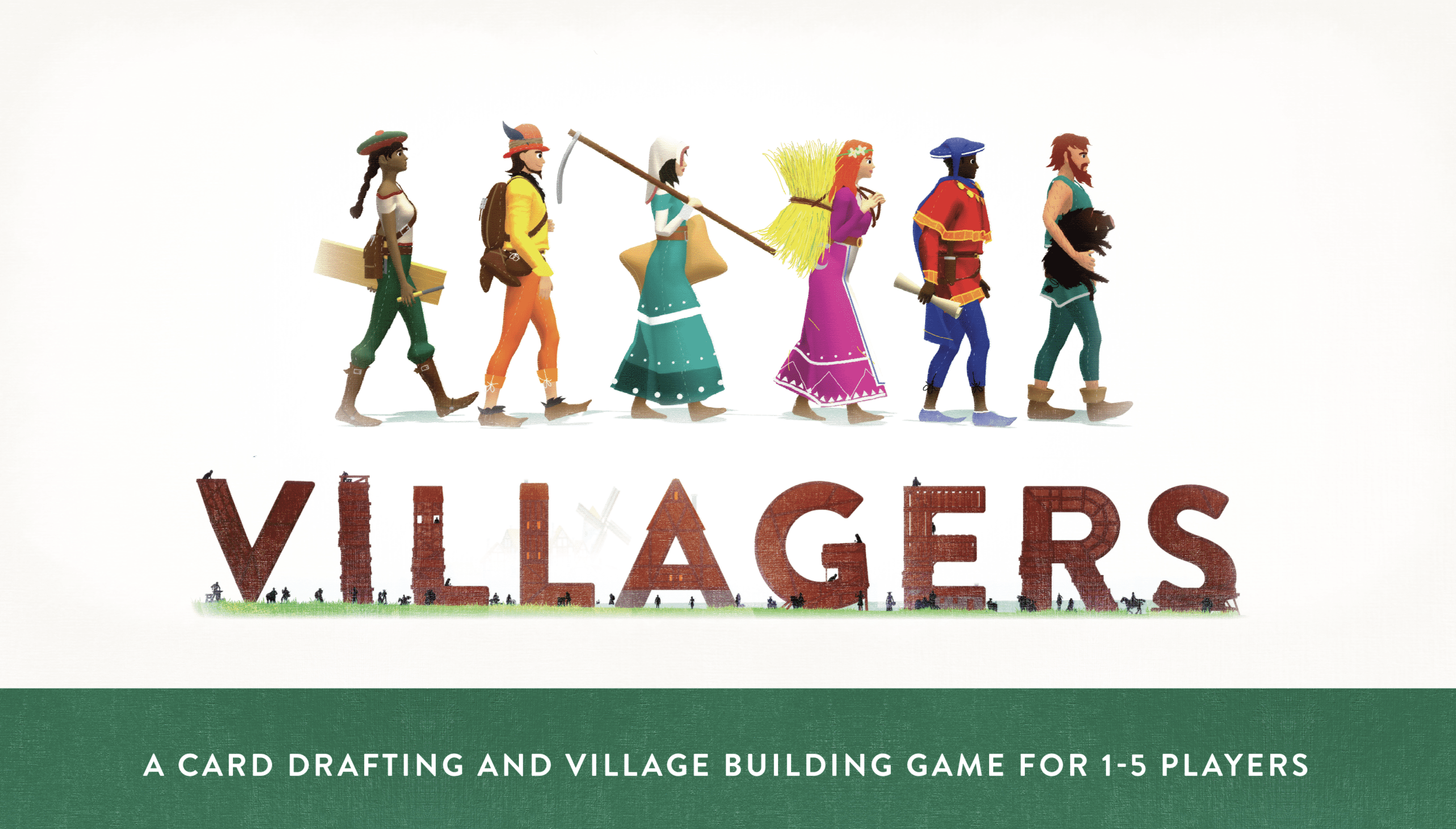
A card game of village building for 2 or more players, also playable solo, set in the years after a plague. Players draft villagers from a shared Road and then build them into production chains in their own village, which earn Gold. Gold is the victory point currency, and the player with the most Gold at the end wins.
Setup
- Place the 6 Starting Road Villagers marked with an asterisk face-up in a line in the centre. This is the Road.
- Place the Hayers, Lumberjacks and Miners face-up in separate stacks as Basic Villagers.
- Give each player a Founders card with the 2 Gold side up, a Village Square, and 8 Gold as their starting Supply.
- Put the remaining Gold beside the Road as the Bank.
- Give the First Player Card to the player who has lived in the same place the longest.
- In a 2 or 3 player game, remove the Wool and Leather suit cards (marked with an asterisk).
- Shuffle the remaining villagers into 6 face-down stacks, each with twice as many cards as there are players. Place the First Market Card beneath the second stack and the Second Market Card beneath the sixth stack.
- Deal each player 5 cards face-down as their hand. Put the leftover cards in a face-down stack beside the Road called the Reserve.
A turn
The game is played in rounds. Each round has a Draft Phase, then a Build Phase, and a Market Phase when triggered.
Draft Phase: Players take turns in clockwise order, starting with the First Player, drafting one villager at a time. You may take any face-up Road villager or blindly take the top card of a stack. Your Drafting Limit is 2, plus 1 for each Food in your village, to a maximum of 5. Drafted villagers go face-up in your village, and any face-down draft is flipped. Coins on a drafted card go to your Supply. After drafting a face-up card, replace it with the top card of the leftmost stack. Market cards are never drafted. Empty stacks are removed. When stacks run out, replace cards from the Reserve instead. Then add the drafted cards to your hand.
Updating the Road: Discard Road villagers that have coins on them and replace them, using the Reserve first and then the leftmost stack. Then place a coin on each face-up Road villager (in a 2 player game, the rule differs, see Variants).
Build Phase: Players take turns in order. Your Build Limit is 2, plus 1 for each Builder in your village at the start of the phase, to a maximum of 5. You may play fewer. You may announce and set out your intended cards before placing them.
- A villager with a production chain text must be placed on top of the villagers named before its name, in the listed order. Chains can be built over several turns, but must be built in order.
- The first villager of a chain can have up to 2 villagers stacked on it, creating branches.
- A card covered by another loses its symbols.
- Padlocked villagers must be unlocked when played. Pay 2 Gold to the owner of the unlocking villager, or to the Bank if no one has it.
- You may return up to 3 villagers from your hand to the Road stacks to take a Basic Villager (Lumberjack, Hayer or Miner) for free. These do not count toward your limits.
- Discarded Special villagers do not count toward the Build Limit.
After the Build Phase, if your Founders have no Food showing, flip them to the Food side. Once flipped, they cannot be flipped back. The First Player Card then passes to the next player.
End of the game
The game ends after the Second Market Phase, which is triggered when all stacks on the Road have been emptied. That Market Phase happens after the final Build Phase.
Scoring
At the Market Phases, each player earns Gold from the printed Gold symbols on the top card of each production chain, plus the coins on their villagers. In the First Market Phase, triggered when the first two stacks are emptied, coins stay on the villagers and Silver symbols do not score. In the Second Market Phase, Silver symbols also score, and coins are then moved to the Supply.
The player with the most Gold in their Supply wins. If players are tied, the player with the fewest villagers in their village wins.
Variants
Two player game: The Road update differs. After drafting, each player in reverse turn order may place 1 Gold from the Bank on a Road villager, or none. Then discard all face-up Road villagers that have no coins, and replace them from the Reserve, or from the leftmost stack if the Reserve is empty. Coins can build up on villagers over several rounds.
Solo mode (against the Countess): Set up as a 2 player game, with these changes: remove the Special suit, use 5 cards per Road stack, place the Jester card beside your village, and make separate Summer and Winter Event decks. Deal one Summer Event face-up. The Countess replaces a player, starting with her Countess card (4 Gold side up) and 1 Gold.
- During the Draft Phase, each time you draft from the Road, also place a face-up Road villager into the Countess village. Her villagers are placed separately, without production chains.
- In the Event Phase, resolve the face-up events, then the Countess takes the top card of the Reserve into her village. Deal 1 Event if its value is 10 Gold or more, 2 Events if 1 to 9 Gold, and 3 Events if 0 Gold.
- Events switch from Summer to Winter after the First Market Phase. If you run out of Events, shuffle the discards to make a new stack.
- The Countess scores like a player in the Market Phases. In the final round she does not take a Reserve card. You win with more Gold than the Countess.
Solo difficulty:
- Beginner: deal only 1 Event each round, start the Countess on her no-Gold side, and remove the 'It was you' Winter Event.
- Hard: deal 2 Events at the start, remove the Jester and the 'It was you' Event, and give the Countess 10 starting Gold.
Changes
- Variants, by the rulebook draft, 22 November 2026 (shown now)
- Scoring, by the rulebook draft, 22 November 2026 (shown now)
- End of the game, by the rulebook draft, 22 November 2026 (shown now)
- A turn, by the rulebook draft, 22 November 2026 (shown now)
- Setup, by the rulebook draft, 22 November 2026 (shown now)
- Summary, by the rulebook draft, 22 November 2026 (shown now)