Rules of Watson & Holmes
Summary
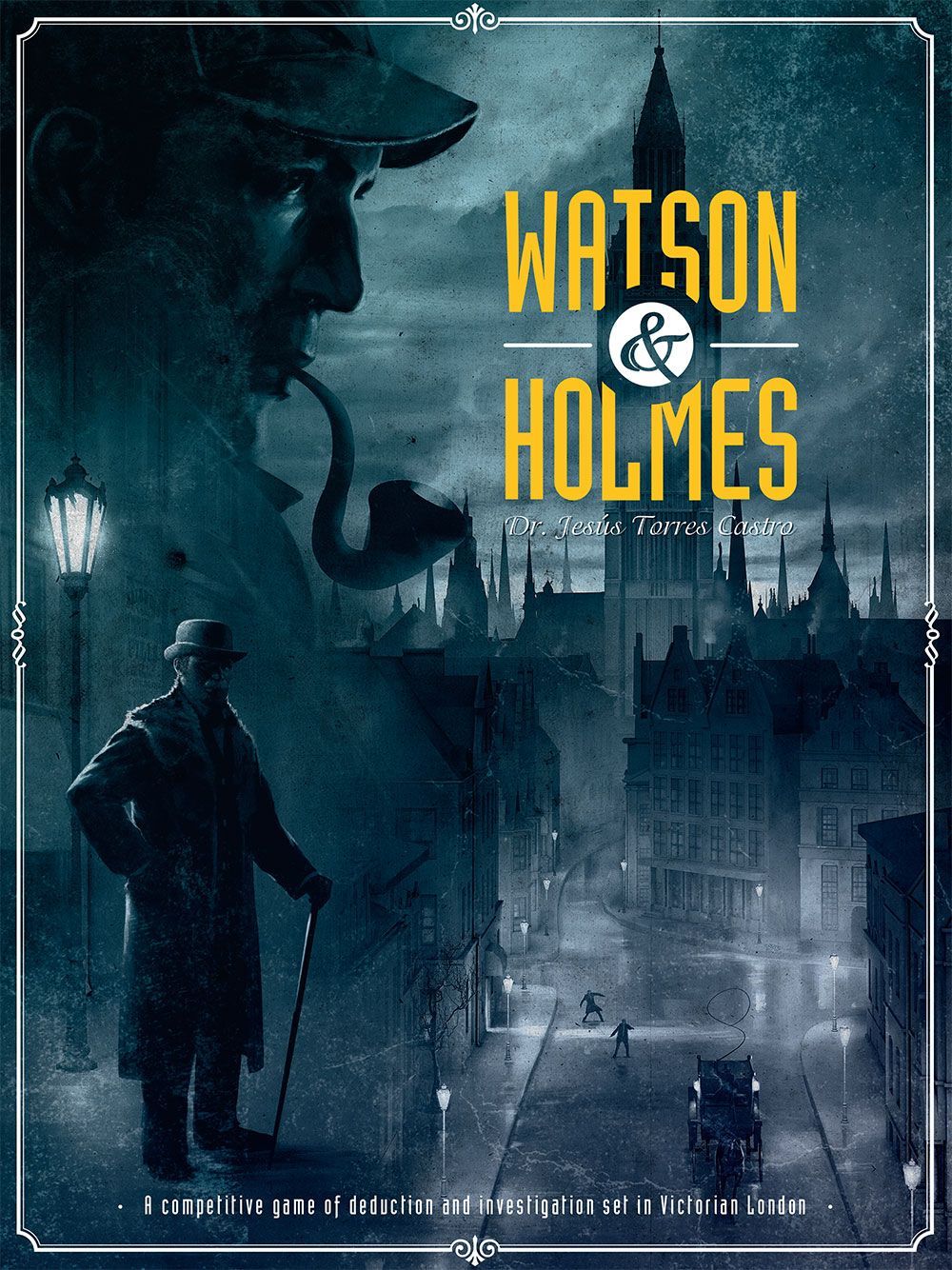
Watson & Holmes is a deduction game for two to seven players set in Arthur Conan Doyle's Victorian world. Players work through unpublished cases, visiting locations and reading clues to answer the questions set by each case. The first player to answer every question correctly at 221B Baker Street wins.
Setup
- Choose a case and do not open its booklet or read any card text.
- Place the location cards face up in the centre, with the Carriage Stop card, Watson card and Holmes card beside them (Holmes face down). Sort the tokens into a supply.
- The start player reads the case introduction and questions aloud, then explains any special rules.
- Each player picks a pawn and its matching token, and takes 10 Carriages, 1 Police Token, paper and a pen.
- Shuffle the character cards and deal one face down to each player, who keeps it secret.
- With 6 or 7 players, only the first five get a Police Token; the sixth and seventh players each get a Call Off Token instead.
- With fewer than 4 players, return the Wiggins card to the box before shuffling.
A turn
Each round has two phases.
Visiting phase: Starting with the start player and moving clockwise, each player places a pawn on a location card. If the card is free, the player goes on foot (no Carriages) or places Carriages on it. If another pawn is there, the player must bid more Carriages than the occupant; a player on foot can be outbid with a single Carriage. An outbid player takes back the pawn and all but one Carriage, and waits until their next turn. A location with a Police Token needs a Call Off Token (discarded before placing the pawn) or a Lockpick Token (discarded later). The Watson card can be bought for 4 Carriages. The Carriage Stop card has no bidding and gives 3 Carriages during the investigation phase. Visiting 221B Baker Street is allowed but counts as an attempt to solve the case. The last player to place a pawn takes the start player token.
Investigation phase: The Watson card's ability is used first if someone holds it. All players then take their location cards, return the Carriages they used, and read them in secret, making notes. A card with a Police Token requires discarding one Lockpick Token first; the Police Token stays. Cards are returned and pawns retrieved. A player holding a Police Token may place it on the location they just visited, unless that location is 221B, Carriage Stop, already restricted, or otherwise barred.
Solving: A player at 221B writes answers to all questions and checks them against the back of the 221B card. Guilty persons must be named by full name. A fully correct set wins. Otherwise the player announces only how many answers were correct, and thereafter acts only as the voice of Holmes.
End of the game
The game ends when a player who visits 221B Baker Street answers all questions correctly. If others want to keep playing, the winner announces the win but keeps the answers hidden until the game is over.
If no one solves the case and players remain, another full round begins with the start player. If only one player is left, they may play extra rounds equal to the Carriages they hold, up to a maximum of 4, then visit 221B. A correct answer wins; otherwise all players lose.
Scoring
The rulebook uses no points. The winner is the first player to answer every case question correctly at 221B Baker Street. Players who visit 221B in the same round try in order of Carriages remaining, most first. If several players have the same number left, they attempt simultaneously, and more than one can win.
Variants
- Expert version: play without the Watson card. Character card actions that mention Watson become Take 3 Carriage Tokens.
- Fewer than 4 players: remove the Wiggins card before shuffling.
- Lone survivor: a last remaining player may play extra rounds (up to 4) before the final 221B attempt, as described under End.
- Case-specific special rules and starting-player selection may change setup; the case booklet's QR code presents the introduction and questions, and if used, the start player is chosen at random.
Changes
- Variants, by the rulebook draft, 22 November 2026 (shown now)
- Scoring, by the rulebook draft, 22 November 2026 (shown now)
- End of the game, by the rulebook draft, 22 November 2026 (shown now)
- A turn, by the rulebook draft, 22 November 2026 (shown now)
- Setup, by the rulebook draft, 22 November 2026 (shown now)
- Summary, by the rulebook draft, 22 November 2026 (shown now)