Rules of ZhanGuo
Summary
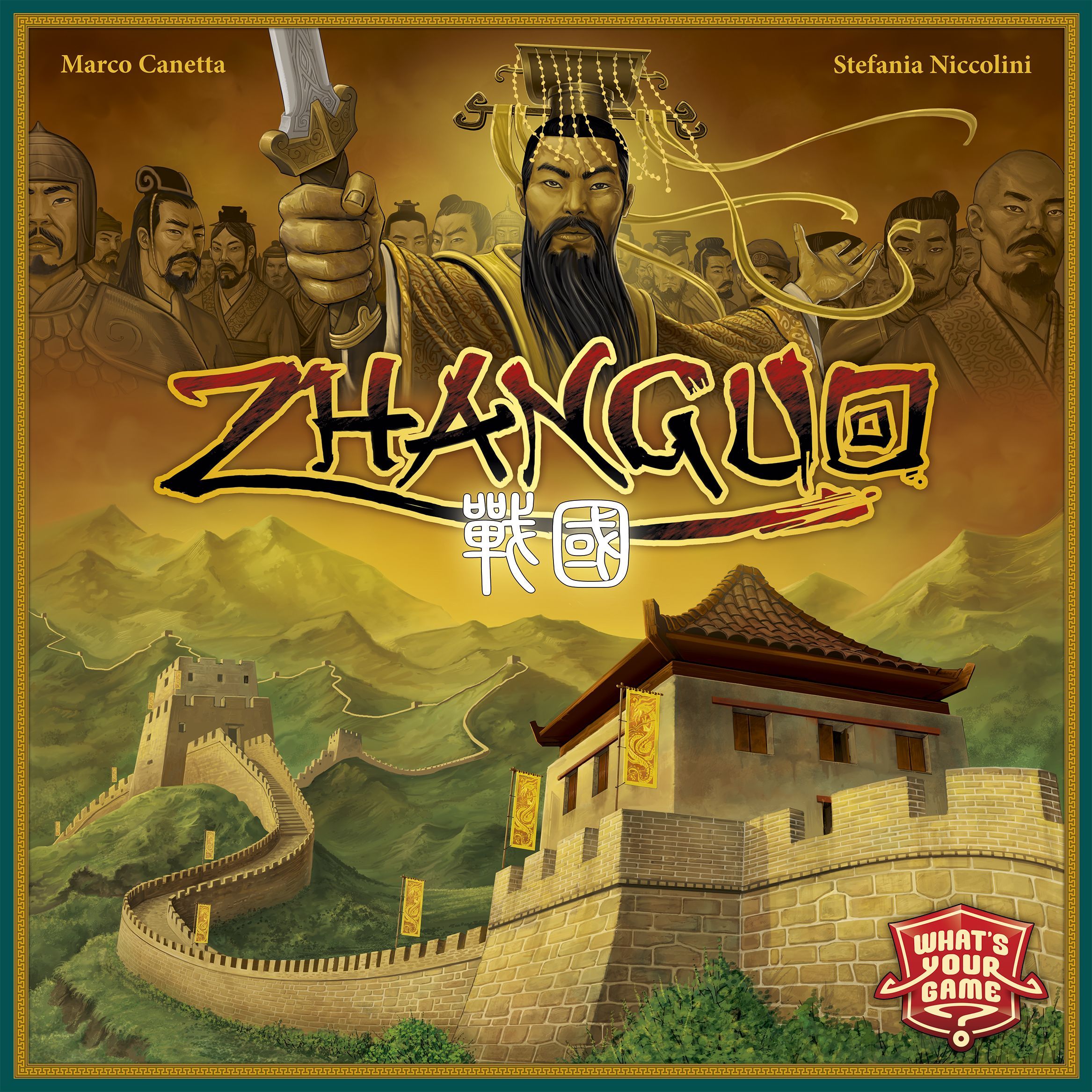
ZhanGuo is a game set after Qin's conquest of the Warring States, where players work to unify China over five rounds. Each round, players play cards to contribute to the three aspects of unification (writing, currency, and laws), recruit officials, hire workers, build palaces and walls, install governors, and complete tasks. The player with the most victory points at the end of the game wins.
Setup
- Sort the cards into three decks by back color (Ivory, Orange, Brown), shuffle each, and place them face-down beside the gameboard.
- Place the Round Marker on round 1 of the Round Track. Put the value-3 Unification Markers next to the Court Area.
- Make the general supply of Workers and value-1 Unification Markers: 12 of each color in a 4-player game, 9 in a 3-player game, 6 in a 2-player game.
- Randomly choose a 1st Player. Each player places one disc on the Rewards Track: the 1st Player on the topmost slot, the others randomly on the remaining slots.
- Each player takes a color and its supply: 8 discs, 8 Governors, 6 Palaces, 5 Walls, 5 Unrest markers, and 5 each of red, gray, and white Officials. Place one disc on 0 of the VP Track and the remaining 6 discs beside the Tasks Area.
- Shuffle the 6 Wall tiles and place one on each Wall section with a random side up.
- Shuffle each set of 4 Task tiles (Wall, Palace, Governor). Place one face-up in each of the two Task sections. Return the unused 2 tiles of each set to the box.
- Each player takes one red, one gray, and one white Official from supply and places them in the Governors area of Region 1 on his player board.
- Each player takes a player board. Use the A-sides for your first games. The B-side auction variant is described below.
A turn
The game lasts five rounds. Each round has three phases, always in this order.
Phase 1 - Draw cards: In rounds 1 to 4, each player draws 3 cards from each deck, keeps 2 of his choice, and discards the third face-down. The discards are shuffled and placed at the bottom of their decks. In round 5, each player simply draws 2 cards from each deck. Each player holds 6 cards at the end of this phase.
Phase 2 - Play cards: Starting with the 1st Player and going clockwise, each player plays exactly 1 card from his hand and performs 1 action. Continue until everyone has played all their cards. On his turn, the player chooses one of two options:
- Unification action: Place the card face-up in one of the 5 Regions of his player board, tucked so only the top icons show. Each Region holds up to 3 cards, and placed cards cannot be moved or removed later. He takes value-1 Unification Markers in the card's color: 1 for the first card in a Region, 2 for the second, 3 for the third. If the general supply runs out of a color, he gains 1 VP for each marker he cannot take. The second card in a Region raises unrest there by 1, and the third raises it by 2. Unrest is tracked with black cubes on each Region's Unrest Track.
- Court action: Place the card face-up on the Court Area pile and perform one of six actions: Build 1 Wall, Build 1 Palace, Hire Workers, Re-assign Officials, Recruit 1 Official, or Install 1 Governor. Any card can be used for any Court action, but the chosen action must be performed if possible.
After a Court action, the player may activate card abilities on his board if the played card's activation number is higher or lower than the card below it, as required by each action. Abilities are only available in Regions without a black cube on the rightmost unrest slot.
Phase 3 - Unification rewards: Resolve Writing (Ivory), then Currency (Orange), then Laws (Brown). For each aspect, the player with the highest total of markers (tall octagons worth 3, short ones worth 1) may accept the reward on that aspect's row for the current round, returning all his markers of that color. If he passes, he keeps them, and the next-highest player may decide. A player needs at least 1 marker of that color to qualify. After accepting, he moves his disc to that reward slot. Then, at any time during his turn or after a reward, a player may claim any tasks he has completed by placing a disc in the next free slot of that task.
At the end of the round, return all discs to the Rewards Track in tiebreaker order. The disc on the topmost slot gives the next 1st Player. Advance the Round Marker before the next round begins.
End of the game
The game ends after Phase 3 of round 5. Final scoring is then carried out. See the Scoring section for how each element is counted.
Scoring
Scoring is done in four parts. Each part is resolved on its own.
- Governor majorities: Score each Region one at a time. The player with the most Governors in a Region scores 9 VP plus 3 VP for each of his Governors there. If players tie for most, they split the 9 VP plus 3 VP per Governor, rounded down.
- Unification majorities: The player with the most Writing markers scores 5 VP, the most Currency markers scores 6 VP, and the most Laws markers scores 7 VP. Players do not move their discs. Ties go to the tied player whose disc is highest on the Rewards Track.
- Task discs: In each Task section, a player scores the VP below his disc if he has 1 disc in that section, 2 times that VP for 2 discs, or 3 times that VP for 3 discs. Add the totals across both sections.
- Walls on the gameboard: Each Wall is scored according to its position (1-rod, 2-rod, or 3-rod slot) and how well the player meets the criteria on the associated Wall tile. Use the left, middle, or right VP value shown on the tile.
The player with the most VP wins. If there is a tie, the tied player with the topmost disc on the Rewards Track wins.
Variants
- B-side player boards: Players may choose boards and use the B-sides, which have special abilities that are always active. Players choose in reverse player order.
- B-side player board auction: Players may use the B-sides with an auction for the boards instead. Each player starts with 15 VP on the VP Track. Boards not in use are discarded: 1 in a 3-player game, 2 in a 2-player game, and none in a 4-player game. The first bid starts with the 1st Player, who must bid at least 1 VP. Players bid in clockwise order, and a player who passes cannot re-enter that auction. The winner pays his highest bid in VP, takes a board, and places it B-side up. The next auction starts with the player clockwise from the last winner, and continues until every player has a board. A player cannot bid more VP than he currently has. The last board always costs the last player 1 VP.
- Variants may be used independently. Decide on any variants before starting the auction.
Changes
- Variants, by the rulebook draft, 23 November 2026 (shown now)
- Scoring, by the rulebook draft, 23 November 2026 (shown now)
- End of the game, by the rulebook draft, 23 November 2026 (shown now)
- A turn, by the rulebook draft, 23 November 2026 (shown now)
- Setup, by the rulebook draft, 23 November 2026 (shown now)
- Summary, by the rulebook draft, 23 November 2026 (shown now)