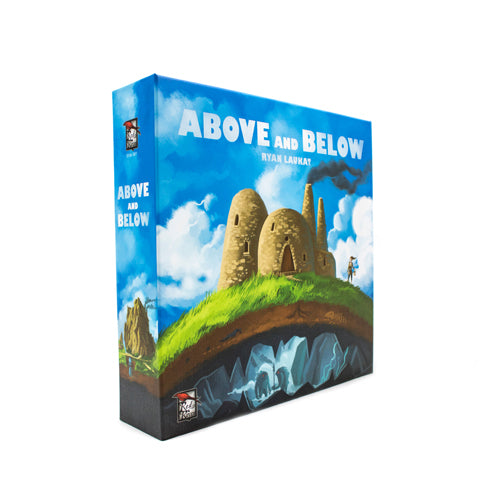
Regole di Above and Below
Riassunto
Above and Below is a village-building game set in and under a cave system. Over seven rounds, players send villagers to explore caves, build houses and outposts, harvest goods, train new villagers, and trade with each other. The player with the most village points at the end of the game wins.
Preparazione
Give each player a player board, seven coins, a starting house card, and their three starting villagers, placed in the ready area. With four players, two starting villagers go to the exhausted area instead.
Place the six star house cards face up in a row. Shuffle the nine key house cards, draw four, and place them face up in a row below. Return the rest to the box.
Put the reputation board in the center. Set aside the special villagers. Shuffle the remaining villagers, draw five, and place them face up along the top of the board. Place the round marker on the top cave of the track. Put coins, goods, cider, and potions beside the board as the supply, and place one cider on the cider space of the board. Shuffle the cave cards into a face-up pile.
Each player takes a cube matching their board's banner and places it on the torch space. Choose a first player, who receives the first-player card. Turn order runs clockwise. With two players, the second player gets one extra coin. With three, the second and third players each get one. With four, the fourth player gets one.
Shuffle the house cards and outpost cards into two face-down piles under the reputation board, and reveal the top four of each beside its pile. Place the encounter book and dice nearby.
Un turno
The game is played in rounds. Each round, players take turns in clockwise order, starting with the first player. On a turn, a player takes one action with a villager, or passes. Once a player passes, they take no more actions that round. Others keep taking turns until everyone has passed, so some players may act more often than others.
Available actions:
- Explore: Draw a cave card and send at least two ready villagers to it. Roll one die per villager and compare the total lanterns to the explore numbers. The player to your left reads the matching encounter paragraph aloud. Choose an option and try to meet one of its explore numbers. You may exhaust villagers from the card for extra lanterns. On success, gain the reward from the highest explore number reached and keep the cave card, which can later hold an outpost. On failure, gain nothing and return the card to the bottom of the deck. Villagers used on the card are exhausted either way.
- Harvest: Exhaust one or more ready villagers to take one good from a house or outpost for each villager.
- Build: Exhaust a ready villager with a hammer to buy an available house, star house, key house, or outpost by paying its cost. An outpost must go on an open cave card you own.
- Train: Exhaust a ready villager with a quill to pay for a villager from the reputation board. The new villager goes to your exhausted area.
- Labor: Exhaust one or more ready villagers to gain one coin each. The first player to labor in a round also takes the cider from the reputation board, if it is there.
Free actions can be done on your turn without exhausting villagers, but only before you take a normal action:
- Buy a good, cider, or potion from another player for at least 3 coins, paid in coins.
- Place one good, cider, or potion for sale in the top left of your board. You may change or remove it only on your turn.
- Pay one coin to replace all four cards in a house or outpost row, once per turn.
Goods can be stored, sold, or placed on your advancement track, where they stay permanently, filling slots from left to right.
At the end of each round, the round marker moves one space. The cider is restored if missing. Remaining villagers slide left and new ones fill the open slots. Villagers recover using potions, cider, and beds on your buildings. Players collect income based on their advancement track, starting at four. Goods are restored on buildings that show an arrow. The first-player card then passes to the left.
Fine della partita
The game ends after seven rounds. It also ends if the round marker cannot move forward at the end of a round. Players then count their village points.
Punteggio
Village points come from:
- Advancement track: Each good on the track is worth the points shown above its slot, multiplied by how many goods are in that slot.
- Buildings: Each house, key house, star house, and outpost is worth 1 point. Empty cave cards and the starting house are counted as described in the rules.
- Card bonuses: Some cards give fixed points or points for owned items, such as potions or ore, if those are on the track or in supply, not on buildings.
- Reputation: The player with the most reputation gets 5 points, second place gets 3, and third gets 2. With two players, only the top player gets a bonus, which is 3 points. Tied players split the combined points for their places, rounded up. Some track positions also add or subtract points.
The player with the most village points wins. Ties are broken by most coins, then most villagers, then most buildings. If still tied, the players share the win.
Modifiche
- Punteggio: bozza del regolamento, 22 novembre 2026 (mostrata ora)
- Fine della partita: bozza del regolamento, 22 novembre 2026 (mostrata ora)
- Un turno: bozza del regolamento, 22 novembre 2026 (mostrata ora)
- Preparazione: bozza del regolamento, 22 novembre 2026 (mostrata ora)
- Riassunto: bozza del regolamento, 22 novembre 2026 (mostrata ora)