Regole di Anachrony
Riassunto
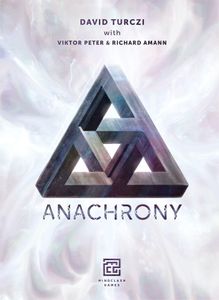
Anachrony is a worker-placement game for two to four players, each leading one of four ideological Paths (Harmony, Dominance, Progress, Salvation) through up to seven Eras. Players use Exosuits, Workers and Time Travel to build, research and prepare for an asteroid impact. The Path Capital with the most Victory Points at the end wins and becomes the seat of the World Council.
Preparazione
- Place the Main board in the middle; in a 2 or 3 player game, use the side with only two Hexagonal slots for the Research, Recruit and Construct spots.
- Set up the Research dice, Evacuation Action tile (A side up), the two shuffled Recruit and Mine pool decks, and the four primary building stacks (shuffled by type), with the top building of each available to Construct.
- Place Anomalies, the Paradox die and tokens, Resources, Water, Workers, Energy Cores, Breakthroughs and Victory Point tokens within reach.
- Lay out the Timeline tiles in a line with the Impact tile between the fourth and fifth tiles. Place a random Superproject above each Timeline tile except the Impact tile, with only the leftmost face up, and return the rest to the box.
- Each player places one Path marker below the leftmost Timeline tile as their Focus marker.
- Return the Most Completed Experiments card to the box, then randomly choose 5 Endgame Condition cards and place them face up above the Main board.
- Each player takes a Player board and Path board (random side up), their colored components, starting Resources, Water, Energy Cores and Workers as indicated, and chooses one of the two Leader cards for their Path.
- Players may choose A or B Player board sides, but all must use the same side.
- The player who most recently had a déjà vu becomes First Player and takes the banner to the World Council spot. Then, clockwise from the First Player, players receive 0, 1, 1 and 2 Water.
Un turno
Each Era has these phases, in order:
- Preparation: Flip the Superproject above the next Timeline tile, then shift each building stack by placing the top primary building face up beside it as a secondary stack.
- Paradox: Skipped in the first Era. Starting from the left, for each Timeline tile with Warp tiles, the player(s) with the most Warp tiles there roll the Paradox die and gain that many Paradox tokens. Three Paradox tokens trigger an Anomaly.
- Power up: Clockwise from the First Player, place up to 6 Exosuits on Player board Hex slots, paying an Energy Core for each one on the three bottom slots. Then gain 1 Water for each remaining empty Hex slot.
- Warp: Players may secretly hide 0 to 2 Warp tiles, reveal them together and place them on the current Timeline tile. In player order, each player gains the assets shown, paying 1 Water per Worker warped in.
- Action rounds: Starting with the First Player, players take turns clockwise. On a turn, a player may take any number of Free Actions, then either place a Worker on an empty Worker space on their Player board, place a powered-up Exosuit Worker on a Main board Hex space, or pass. Once all players pass, go to Clean up.
- Clean up: Return Workers from Exosuits and Action spaces to the Active column if motivated, otherwise to the Tired column. Return empty Exosuits to personal supplies, retrieve Path markers, check for Impact and game end, then return unused Exosuits and move Focus to the next Era's Timeline tile.
A Hex space becomes unavailable for the rest of the Era once a Worker is placed there. Capital Actions (Construct, Recruit, Research) each have up to three Hex spaces, with Water costs on the middle and lower spaces. Free Actions can each be used once per Era, marked by a Path marker.
Fine della partita
The game ends at the end of the Era in which the last Capital Action space becomes unavailable, or at the end of the 7th Era. Then, Warp tiles still on the Timeline are removed by returning the required Worker, Exosuit and asset, which does not count as Time Travel. Each Warp tile that cannot be removed costs -2 VP.
Punteggio
Final scoring uses points from buildings, Anomalies, Superprojects, Time Travel, Morale, Victory Point tokens, Timeline penalties and Endgame Conditions. Each Endgame Condition met is worth 3 VP to each player meeting it, with ties all scoring the full amount. Each Breakthrough is worth 1 VP, and each set of three Breakthroughs with different shapes adds 2 VP.
The Path with the most Victory Points wins. In a tie, the player with the most Water wins, then the most total Resources. If still tied, the tied players share the victory.
Varianti
- Chronobot (solo): Set up a 2-player game with the Chronobot as the other player. The Chronobot has its own Exosuits and Warp tiles, takes no starting assets and Workers, and uses a die and tokens to choose its Actions. No Endgame Conditions are used. Optional difficulty levels are Beginner, Normal and Expert.
- Doomsday module: Adds Experiment cards and the Doomsday track. Experiments are claimed with a new Main board Action and can move the Save Earth or Seal Fate tracker, which can change when the Impact occurs. The Most Completed Experiments Endgame Condition is added.
- Alternate Timeline: Players use the crimson side of the Timeline tiles, placing Warp tiles in order and gaining or losing the bonuses and penalties printed on the slots.
- Starting Asset Draft: Players receive a fixed base of Workers, Energy Cores and Water, then draft four Starting Asset cards. The lowest total sum becomes First Player.
- Endgame Condition Draft: Players draft from dealt Endgame Condition cards instead of drawing them randomly.
- Optional planned Experiments: Level 2 Experiments are face up and refilled as claimed, with none placed under the Timeline during Preparation.
- Asymmetric B sides: Each Path's Player board B side has different Exosuit, Morale, building cost and other rules, chosen before setup.
Modifiche
- Varianti: bozza del regolamento, 22 novembre 2026 (mostrata ora)
- Punteggio: bozza del regolamento, 22 novembre 2026 (mostrata ora)
- Fine della partita: bozza del regolamento, 22 novembre 2026 (mostrata ora)
- Un turno: bozza del regolamento, 22 novembre 2026 (mostrata ora)
- Preparazione: bozza del regolamento, 22 novembre 2026 (mostrata ora)
- Riassunto: bozza del regolamento, 22 novembre 2026 (mostrata ora)