Regole di Britannia
Riassunto
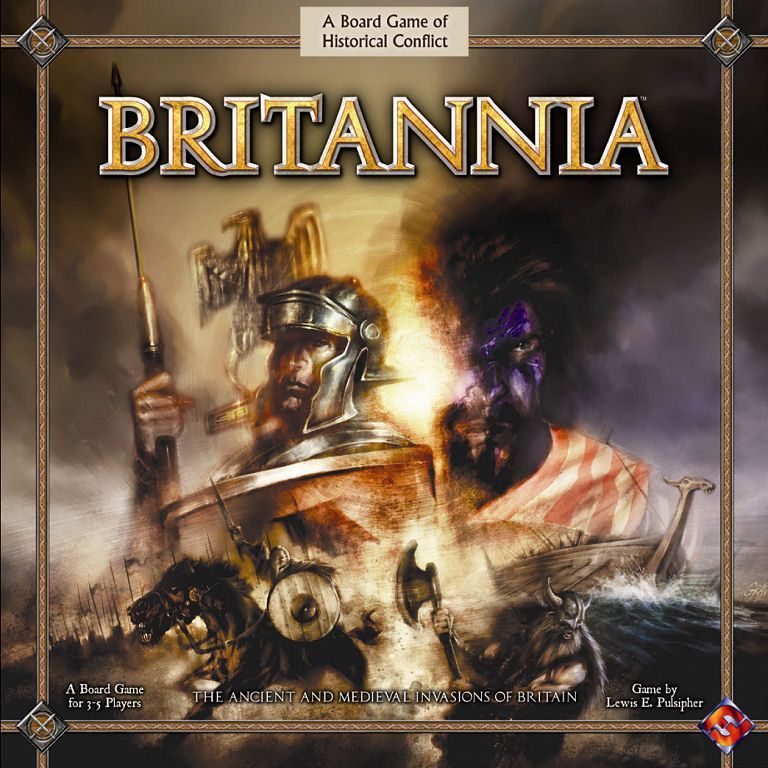
BRitAnniA is a historical board game for three to five players, covering the migrations and wars over Britain from the Roman invasion of 43 A.D. to the Norman Conquest. Each player controls several nations, and the player whose nations accumulate the most victory points after Round 16 wins. Points come mainly from holding and occupying areas, eliminating specified units, and claiming Bretwalda or King.
Preparazione
Place the round marker on Round 1 of the timeline. Randomly assign the four color groups of nations to players; in the four-player game each player takes the nations of one color and their Nation Cards. Place the starting infantry in the listed starting areas for each nation, and place the 16 Roman invading armies in the English Channel. Nations not yet in play are placed when the timeline calls for them. Set up for three or five players and for the two-player scenarios uses different groupings and starting placements given in the rulebook.
Un turno
Each round, every nation takes a nation turn in the order printed on the Nation List, skipping nations not yet in play or already gone. Each nation turn has five phases:
- Population Increase: count land areas held by the nation (normal areas give 2 points, difficult terrain 1), add leftover points, and gain one infantry per six points. The Romans receive reinforcements instead, and Romano-British and cavalry units enter only at set rounds.
- Movement: normal armies move up to two land areas, while cavalry, Roman infantry, and armies with a leader move three. Difficult terrain ends movement, and armies must stop when entering an enemy-occupied area unless they overrun it (more than twice the defending forces).
- Battles/Retreats: each side rolls a die per army and fort or burh. A normal army hits normal armies on 5 or higher, Roman and cavalry armies hit on 4 or higher, and Roman and cavalry armies are hit only on 6 or higher. Defenders in difficult terrain are hit only on 6 or higher. Retreats follow set rules on legal destinations.
- Raider Withdrawal: Raiding armies may return to the sea they started in.
- Overpopulation: armies in land areas above twice the number of land areas occupied must be removed. The Romans skip this phase.
After all nations have acted, the round ends with scoring for holding areas (in scoring rounds) and any Bretwalda or King check.
Fine della partita
The game lasts 16 rounds. It ends at the end of Round 16, after the final scoring and any final King check.
Punteggio
Nations score victory points in four main ways: holding areas at the end of scoring rounds (5, 7, 10, 13, and 16); occupying listed areas during specified rounds, once per area for each nation (the Danes have an exception in Rounds 11 and 12); eliminating listed units during specified rounds; and claiming Bretwalda or King. Each nation's points are tracked separately. Some nations have point limits: the Welsh can score outside Wales only up to half their Wales points, the Saxons can score in Wales only up to half their England points, and the Angles can score in Scotland only up to half their England points. Roman points come from limes at the end of Round 5 and from submitted nations. A Bretwalda gets 4 points and a King gets 8 points, or 10 in Round 16. The player with the most total points across his nations wins. The rulebook gives no tiebreaker rule in the section on determining the winner, and it does not describe a tie outcome.
Varianti
Three-player game: nations are divided among three players, with the same rules. Five-player game: nations are divided among five players, with the same rules. Shorter three-player variant: runs from Round 6 to Round 13 using a separate setup, with the Romans, Belgae, Norwegians, and Normans left out. Two-player scenarios: Early Invaders vs. Inhabitants of Britain (to Round 5), Germanic Invaders vs. Inhabitants of Britain (Rounds 6 to 10), and Vikings vs. Inhabitants of Britain (Rounds 11 to 14), each with its own setup. Optional bidding for sides: players bid victory points for groups of nations, and each bid is subtracted from that player's final total. Negotiation is allowed only over the board during other players' turns, and no deal is binding.
Modifiche
- Varianti: bozza del regolamento, 23 novembre 2026 (mostrata ora)
- Punteggio: bozza del regolamento, 23 novembre 2026 (mostrata ora)
- Fine della partita: bozza del regolamento, 23 novembre 2026 (mostrata ora)
- Un turno: bozza del regolamento, 23 novembre 2026 (mostrata ora)
- Preparazione: bozza del regolamento, 23 novembre 2026 (mostrata ora)
- Riassunto: bozza del regolamento, 23 novembre 2026 (mostrata ora)