Caricamento della pagina…
Diese Seite auf Deutsch ansehen
Vai al contenuto
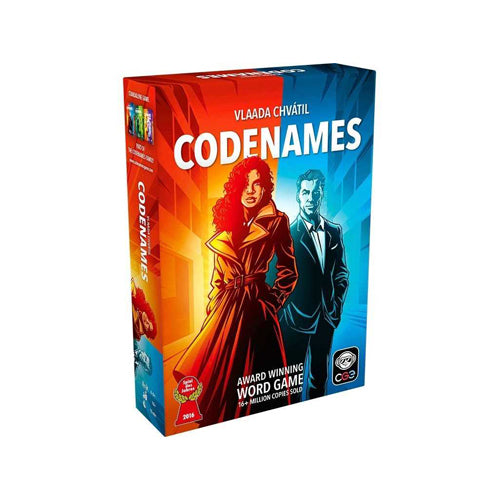
Codenames is a team word game for two teams. Spymasters give one-word clues with a number to help their field operatives find their team's codenames among 25 words on the table. The first team to contact all of its agents wins, and contacting the assassin makes that team lose immediately.
Split into two teams of similar size and skill, with at least four players. Each team picks one spymaster, and the spymasters sit on the same side of the table. The other players sit across from them as field operatives.
Randomly choose 25 codenames and lay them out in a 5-by-5 grid. Shuffle well by flipping over half the deck once in a while.
Choose a key card at random and slide it into the stand between the spymasters, with either side up. Keep it hidden from the field operatives. The four lights on its edge show the starting team, which has 9 words to find. The other team has 8.
Give each team its agent cards: 8 red, 8 blue, and 1 double agent. The double agent is flipped to the starting team's color and counts as one of that team's agents. Place the 7 innocent bystanders and the assassin between the spymasters.
On a turn, the spymaster gives a one-word clue and one number showing how many table words it relates to. The starting team gives the first clue.
The clue must be one word, with no extra hints. It cannot be a codename visible on the table, a form of one, or part of a compound word on the table. It must refer to meaning, not spelling, position, or sound. The number cannot itself be used as a clue. Spell-outs and proper names are allowed under the rules set by the players.
The field operatives then touch a codename to make a guess:
Operatives must make at least one guess. They can stop at any time, and they may guess up to one more than the number given. A wrong guess ends the turn. Then the other team takes its turn.
The game ends when one team has all of its words covered, and that team wins. A team can also win on the other team's turn if a guess uncovers its last word.
The game ends immediately if a field operative contacts the assassin, and the team that contacted it loses.
If a spymaster gives an invalid clue, the turn ends. As a penalty, the other spymaster may cover one of their own words before the next clue. If nobody notices the invalid clue, it stands.
For the next game, remove the covering cards, return them to their stacks, and flip the 25 codenames over.
The standard game has no points. The winner is the first team to contact all of its agents. The rulebook does not cover ties.
Scoring applies only to the two-player variant, where the team's score is based on how many turns it needed and how many enemy agents it contacted by accident.
Two-player game: Both players are on one team and face a simulated opponent. The spymaster covers one enemy word each time the enemy would have a turn, choosing which one. The team loses if it contacts the assassin or all enemy agents are found. If it wins, it scores based on the enemy agent cards left in the stack, the turns used, and accidental enemy contacts. This also suits larger groups who prefer not to compete.
Three-player game: Two players can each be a spymaster while the third is the single field operative, who guesses for both sides. Setup and play are otherwise standard, and the winner is decided as usual.
Codenames Duet: A cooperative version for small groups, using double-sided key cards so all players can be spymasters at once. It includes 400 new words.
Flexible and expert rules: The rulebook suggests optional rules for compound words, proper names, abbreviations, homonyms, rhymes, the zero clue (unlimited guesses), and the unlimited clue, which groups can accept or reject.