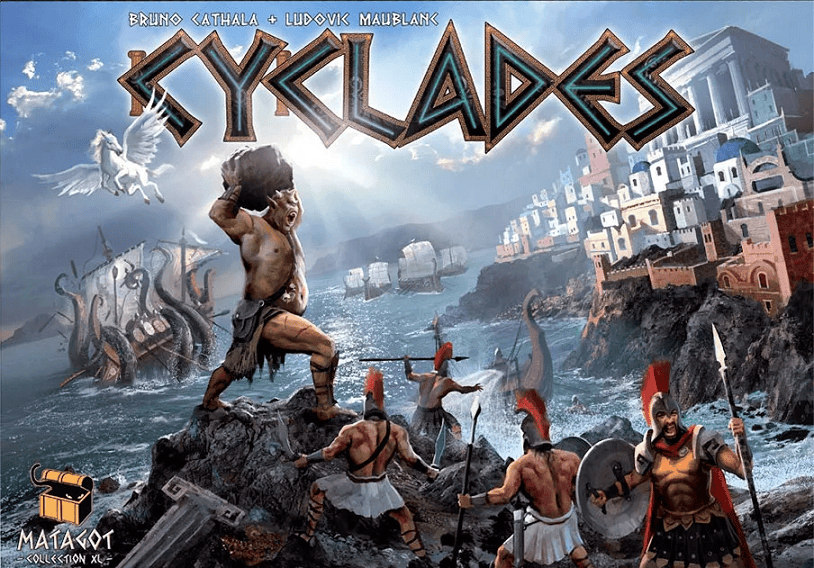
Regole di Cyclades
Riassunto
Players are rival city owners in the Cyclades, competing to show their parent city is the most supreme. Each cycle, players earn gold pieces (GP), bid on the favor of Gods, and then use the Gods' actions to build, recruit, and gain Mythological Creatures. The first player to own 2 Metropolises at the end of a cycle wins.
Preparazione
Give each player the items in his color, place his screen in front of him, and put 5 GP behind it. Set out the game board, Troops and Fleets according to the player count, using the numbers printed at the bottom of each board section and the illustrations on pages 7 and 8. Shuffle the Mythological Creature cards into a face-down draw pile. Place the 5 figurines beside the discard pile. Put the Philosopher and Priest cards on their reserved spaces on the board. Each player takes one of his two offering tokens (only one in games of 3 to 5 players), and these tokens are shuffled and placed randomly on the first spaces of the turn track. Place the 4 large God tiles beside the board. Set aside the buildings, Metropolis tiles, the two special dice, the prosperity markers and any unused GP. On the initial setup illustration, each player places 2 Fleets and 2 Troops, which gives each player 2 isles and 2 GP of revenue.
Un turno
Each cycle is played in these phases:
- Creature track: Discard the Creature on the 2 GP space if it was not used last cycle. Slide the remaining Creatures right to fill gaps, then draw new cards to fill the three spaces. When the draw pile runs out, shuffle the discard pile to make a new one. In the first cycle, the track is set up with the special rules given in the rulebook.
- God order: Shuffle the 4 God tiles and place them above Apollo's space to set the order for this cycle. With 5 players all are face-up. With 4 players the last tile is face-down and unavailable this cycle, and it becomes first in the next cycle. With 3 players the first two are face-up and the last two face-down, and the face-down pair is used next cycle.
- Revenue: Each player gains 1 GP for each prosperity marker he controls. Keep the GP hidden behind your screen.
- Offerings: In turn order, each player places his offering marker on a God, bidding GP. An offer above 10 uses a territory marker on the 10+ space, with the offering marker showing the remainder. The highest offer on a God wins it. A player who is outbid must withdraw and bid on a different God, and this may trigger further outbids that must be resolved before the next player bids. Apollo can be chosen for free, and several players may choose it. Priests reduce offering costs. Each player pays his offer, and players may never offer more than they can afford.
- Actions: Gods activate in the order set for this cycle. The winner of each God performs that God's actions in any order and may alternate them, paying the listed costs. Main Gods allow: calling Mythological Creatures, recruiting, building, and a special action. Apollo allows only increasing revenue. When finished, the player places his offering marker on the last free space of the turn track. The player who bid on the next God then acts.
- End of cycle: Once all players have finished, the cycle ends and the game checks for a winner.
Fine della partita
The game ends at the end of a cycle in which at least one player owns 2 Metropolises. If it is not over, a new cycle begins. A Metropolis can be created by collecting all four building types (Port, Fortress, Temple, University) and discarding them, by collecting 4 Philosophers, or by conquering an isle that already contains a Metropolis.
Punteggio
If only one player owns 2 Metropolises at the end of the cycle, that player wins. If several players do, the one with the most GP behind his screen wins. The rulebook does not say how to break a tie in GP.
Varianti
Two-player game: Set up as shown on page 8. Each player takes both of his offering tokens, which are shuffled and placed on the first turn track spaces. Play as in the four-player game, except each player makes offers on two Gods, and may outbid himself. Each player must be able to pay the full cost of both offers. The game ends when one player owns 3 Metropolises at the end of a cycle. The Apollo rules change: the player who chooses Apollo gains 1 GP if he owns more than one isle, or 4 GP if he owns a single isle, and takes a prosperity marker for his chosen isle, which adds 1 GP each later cycle. If several players choose Apollo, all gain the GP, but only the first one to choose Apollo gets a prosperity marker. The rulebook gives no solo or team variants.
Modifiche
- Varianti: bozza del regolamento, 23 novembre 2026 (mostrata ora)
- Punteggio: bozza del regolamento, 23 novembre 2026 (mostrata ora)
- Fine della partita: bozza del regolamento, 23 novembre 2026 (mostrata ora)
- Un turno: bozza del regolamento, 23 novembre 2026 (mostrata ora)
- Preparazione: bozza del regolamento, 23 novembre 2026 (mostrata ora)
- Riassunto: bozza del regolamento, 23 novembre 2026 (mostrata ora)