Caricamento della pagina…
Diese Seite auf Deutsch ansehen
Vai al contenuto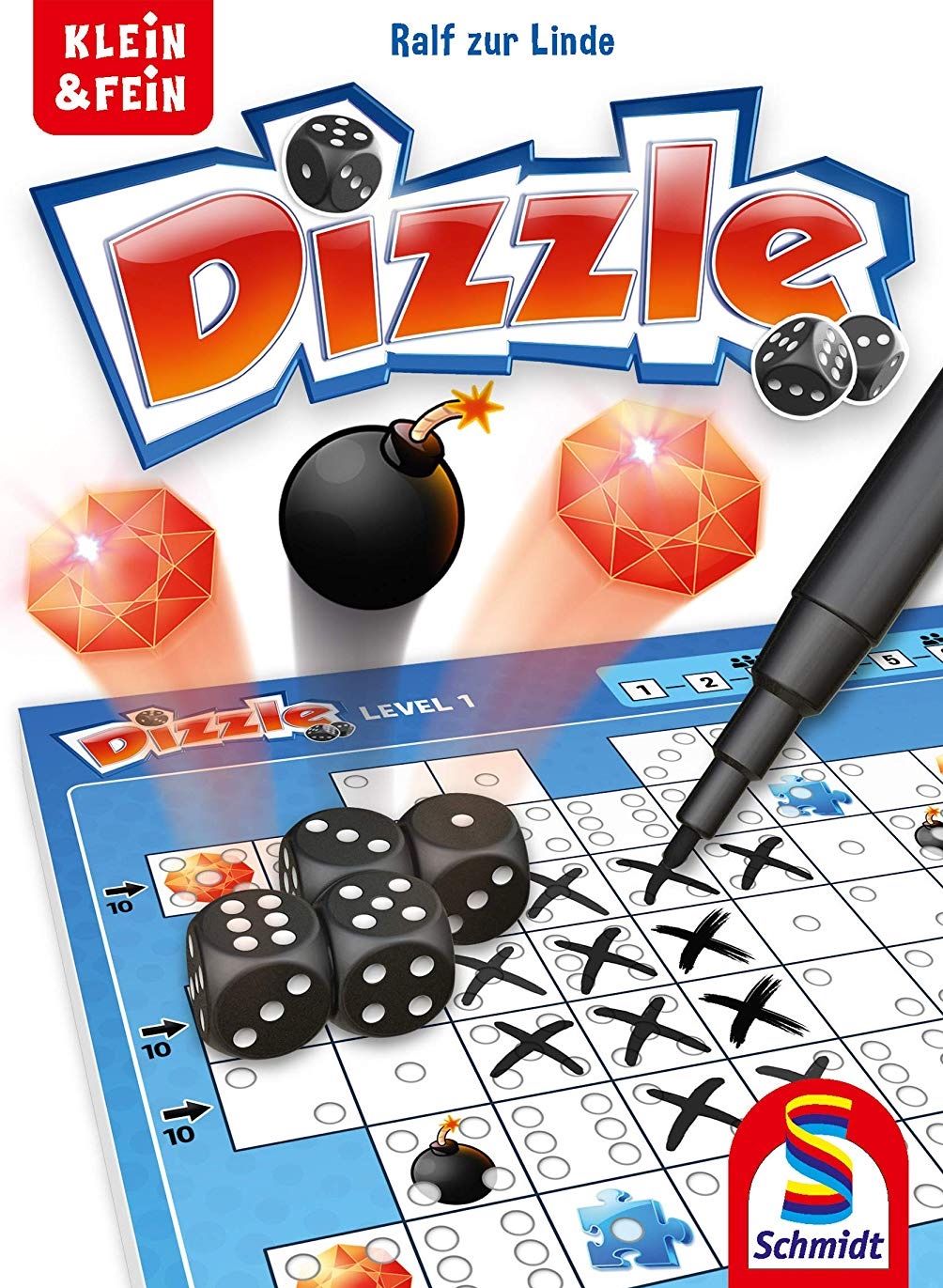
Dizzle is a dice placement game in which players take turns placing dice onto fields on their game sheets whose numbers match the pips shown. Each covered field gets marked with an X, and special fields grant extra points or effects. The player with the most points at the end wins.
Rounds: each player is the starting player once per round. The number of rounds depends on player count: 1 player 10 rounds, 2 players 6 rounds, 3 players 4 rounds, 4 players 3 rounds. Tick off the round on your sheet when your starting turn is done.
A turn:
1. The starting player rolls all the dice and sorts them in ascending order of pips.
2. Going clockwise from the starting player, each player takes exactly one die and places it on their sheet. Play continues around the table until all dice are taken, then the starting player takes another die and play continues clockwise.
Placement rules:
- The field must be empty (no X) and must show the same number as the die.
- A player's first die of the turn must sit horizontally or vertically next to a crossed-out field, including the printed starting fields.
- Each later die must sit horizontally or vertically next to a die already placed this turn, forming a connected cluster.
- A die must be taken and placed if possible.
- Jumping: only when a player has no legal field next to their placed dice (blocked by X's, the edge, or locked fields), they may place the next die on any available matching field next to an X. This starts a new cluster, and later dice must connect to it.
When no legal placement is left, the player may roll again or drop out:
- Rolling again: take all remaining dice from the table and roll them. If a rolled die can be placed legally, it must be used. If not, the player must return one die from their sheet to the table as a penalty, keeping its value. A player who rolls again stays in the turn regardless of the result.
- Dropping out: the player is out of the current turn and places their pen on their sheet.
When all players but one have dropped out, the last active player gets one final choice (take a die, roll again, or drop out), after which the round ends for everyone.
At the end of the turn, each player marks with an X every field covered by a die. Special field effects then apply as described in the rulebook.
The game ends after all rounds have been played. If a player has crossed out or covered all of their fields, the game ends early after the current player's turn.
Each player adds up the points earned from special fields, then subtracts the points from exploded bombs and brown piles. Points come from gemstone fields (each crossed-out gemstone scores its displayed value), completed rows or columns with arrows, completed puzzle sets of one color (in Level 2, puzzle pieces score only when combined with the correct colors), and flags, which are scored by circling numbers in order of arrival. The highest total wins.
If players tie on points, the player with fewer X's on their sheet wins. If still tied, the tied players share the victory.
Solo game: The goal is the same, to score as many points as possible over 10 rounds. Use 8 dice as a display, plus 2 extra dice rolled separately to simulate other players. After each die the player places, roll the 2 extra dice and remove matching dice from the display, up to two. If a rolled number is not in the display, nothing is removed. If both extra dice show the same number, remove up to two dice with that number. A bomb crossed out in a solo game gives 2 extra points. The rulebook gives a rating chart that ranks the solo score by level.