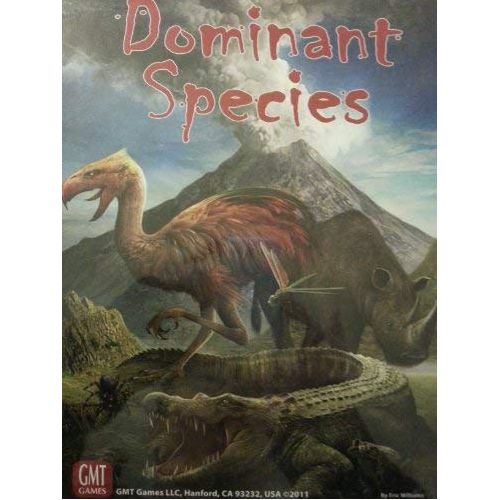
Regole di Specie Dominanti
Riassunto
Dominant Species is a game about an approaching ice age in which each player controls one of six animal classes (mammal, reptile, bird, amphibian, arachnid or insect). Players place action pawns to perform actions that spread species, change the earth's elements, and claim dominance over terrain tiles, aiming to gain the most victory points. The game ends when the Ice Age card is drawn and the player whose animal has the most victory points wins.
Preparazione
Place the board in the center of the table. Each player takes an animal display, and the initiative markers are placed in reverse initiative order, insects first. Place one large tile of each non-tundra terrain type in the center hex grid, put a tundra tile on the sea tile, and stack the remaining eleven tundra tiles face up on the Glaciation section. Shuffle the remaining 24 large tiles into three face-down stacks of eight on the Wanderlust section, turning the top tile of each face up.
Set aside the Survival card. Shuffle the 25 Dominance cards without Ice Age, place Ice Age at the bottom of the draw pile, and reveal five cards in the Available Dominance Cards section.
Place two of each element type on the earth as shown on the board, and place the rest in the cloth bag. Draw 4 elements each for the Adaptation, Abundance and Wanderlust leaf squares.
Each player takes ten dominance cones and a number of action pawns and species cubes based on player count, with more pawns and cubes in games with fewer players. Each player places a victory point marker on zero and places starting species on the tiles listed for their animal, so each animal begins dominating its central tile. The first turn begins with the player whose initiative marker is furthest left.
Un turno
Each turn has three phases: Planning, Execution and Reset.
Planning: In initiative order, players take turns placing one action pawn on an empty eyeball space of the action display, one pawn per space. Animals that have run out of pawns are skipped. Rounds continue until all pawns are placed.
Execution: Pawns are removed from the action display in top-to-bottom, left-to-right order, and the owner performs the action in that section's title bar. Actions are optional, except that some sections always act even without a pawn: Regression, Wasteland, the insect Speciation bonus and the arachnid Competition free action.
The action order is Initiative, Adaptation, Regression, Abundance, Wasteland, Depletion, Glaciation, Speciation, Wanderlust, Migration, Competition and Domination. Initiative lets a player move one step forward on the initiative track and place the pawn again. Adaptation lets a player take an element to their animal display, up to six elements. Abundance places an element on earth. Glaciation converts a non-tundra tile to tundra, and Wanderlust adds a new tile. Migration moves species, Competition eliminates opposing species, and Domination scores tiles.
Reset: Extinction, Survival card scoring, and reseeding the action display.
Fine della partita
The game ends when the Ice Age card is selected in a Domination action. The current turn finishes, including any remaining Domination actions, then Extinction and Survival card scoring are carried out, but the Reseed step is skipped. Final scoring then follows.
Punteggio
Victory points are earned during play from tile scoring in Domination, Wanderlust and Glaciation bonuses, and the Survival card. Dominance is established when an animal has at least one species on a tile and matches more elements there than any other single animal with a species present; ties mean no dominance. Endangered species, meaning those whose animal matches zero elements, cannot claim dominance.
In Domination, the animal with the most species on a tile gets the first value for that terrain, the second-place animal gets the second value, and so on, with ties broken by food chain order (mammal, reptile, bird, amphibian, arachnid, insect). Other tiles are scored only where the place exists.
For final scoring, all tiles are scored one more time with Domination ignored, and the animal with the highest total wins. If there is a tie for highest, the animal nearest the top of the food chain wins.
Varianti
Two- and three-player games: each player controls multiple animals. All six animals are assigned, each with its own cubes, pawns and victory point total. Opposing animals are treated as opponents for all purposes. At the end, each player's lowest-scoring animal provides that player's final score.
Optional random earth setup: seven tiles are drawn at random for the starting spaces with a tundra atop the central tile. Twelve elements are drawn at random onto starting corners, and species are placed according to the meat, sun, seed, water, grub and grass counts on each tile. Victory points start at the largest species count on earth, minus each animal's number of starting species. This setup can be used with the base game or the 2- and 3-player rules.
Modifiche
- Varianti: bozza del regolamento, 23 novembre 2026 (mostrata ora)
- Punteggio: bozza del regolamento, 23 novembre 2026 (mostrata ora)
- Fine della partita: bozza del regolamento, 23 novembre 2026 (mostrata ora)
- Un turno: bozza del regolamento, 23 novembre 2026 (mostrata ora)
- Preparazione: bozza del regolamento, 23 novembre 2026 (mostrata ora)
- Riassunto: bozza del regolamento, 23 novembre 2026 (mostrata ora)