Regole di Endless Winter: Paleoamericans
Riassunto
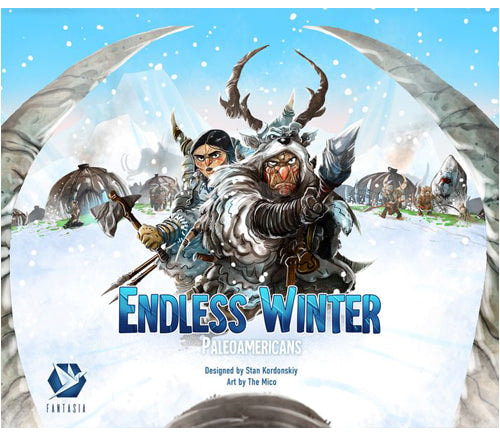
Endless Winter is a tribe-building game set in North America around 10,000 BCE, where players guide their tribe over four generations, from hunter-gatherer bands to prosperous societies. Players expand territory, grow their population, hunt big game, and build megalithic structures, with the highest final point total winning.
Preparazione
Place the main, animal, and idol boards in the middle of the table, with room below for rows of cards. Put the round marker on the first round space. Place Sacred Stone tiles on the supply pools, using 8 tiles in a 2-3 player game and 12 in a 4-player game. Sort the Tribe cards into five face-up decks of twelve identical cards each. Shuffle the two Culture decks by era, put the Culture Cap card on top of the Era II deck, and deal eight Era I cards face up in two rows of four.
Each player takes a player board, two resource markers, two neutral megaliths, a chief card, and their color components including nine starting cards. Set resource markers on the first Food and Tool spaces, place five camps on the Food track, three villages in supply, and the megaliths on their supply spaces. Place the chief and two tribe figures beside the player board, and the chief card A-side up nearby. Set score markers on the zero space, and place Labor and +100 tokens nearby. Each player places idol markers on the bottom of each idol track. Shuffle the Animal deck and reveal players plus one cards as the Animal display. Place tribe markers randomly on the turn order track, then give the second through fourth players 1 Food, 1 Tool, or both respectively.
Shuffle the Setup cards and deal one to each player, who gains the listed benefits, shuffles their starting cards into a deck, draws five cards and one extra, and flips the Setup card to its Player Aid side. Build the megalith board from four shuffled tiles in a layout chosen by the players, and build the terrain board by placing the Base Terrain tile, the six land types, the needed Glacier tiles, and enough other land tiles to total 18 around it, following the player-count table.
Un turno
The game lasts four rounds, each with an Action phase, an Eclipse phase, and a Preparation phase. In the Action phase, players take turns in turn order until each has taken three turns. On a turn, a player plays up to two Culture cards from hand and resolves their actions, then places one figure either on the top space of a Main board action column or on the Eclipse action space of their player board, and performs the actions there. Figures move down each column from the top section to the middle and then to the bottom section; the bottom section of each column can be used only once per round, by the first player to reach it.
Labor is generated by playing Tribe cards from hand, and Food can be spent on the Food track for Added Labor during the Action phase. Actions include initiating Tribe cards or burying cards, developing Culture cards or taking Sacred Stone tiles, migrating camps and villages, and hunting Animal cards. After playing, a player discards the cards played that turn. On the third turn of the round, a player may place any number of Culture and Tribe cards from hand face down on a Ritual pile; the rest stay in hand.
In the Eclipse phase, all players reveal Ritual piles and total their Labor from figures on the Eclipse space, Tribe card icons, and half a point per Culture card, with Food not spendable. Turn order is reset by Labor, with ties going to the player who acted later in the round. Then each player, in the new order, gains the turn order benefit, performs Eclipse actions of Tribe cards in their Ritual pile, gains terrain benefits where they have the most influence, and gains Eclipse benefits from their player board. Ritual cards are then discarded. In the Preparation phase, the round marker advances, figures return, the Animal display is refilled, Labor tokens are placed on remaining Culture cards, Era cards are refilled, and each player draws five cards.
Fine della partita
The game ends after the fourth Eclipse phase, when the game proceeds to Final Scoring.
Punteggio
Final Scoring counts points from Sacred Stone tiles, the Offering track (leftover Food and Tools converted at the marker's ratio, ignoring remainders), the Honor track (buried cards scored by relative position, using the two-player chart in two-player games), Tribe and Culture cards in hand, deck, discard and Burial Ground, Animal sets of matching color (Argentavis as wildcards; Tipped Animals do not count for sets), and stacked megaliths of your color based on levels. Points from the score track are gained during play, and a +100 token is taken when the marker passes 100. The player with the most points wins. In a tie, the tied player who is currently ahead in turn order wins.
Varianti
Variant setup rules: Setup Card Draft, where players draft Setup cards in reverse turn order from a face-up selection of players plus one; and Chief and Setup Card Draft, where Chief cards (B-sides up) are drafted in normal turn order before the Setup cards are drafted in reverse. Chief card rules change: A-side chiefs give Added Labor on the Main board, extra Labor on the Eclipse space; B-side chiefs give two Added Labor on their named column, with Chief Thunderpaw having a special Tool-for-Labor option.
Modifiche
- Varianti: bozza del regolamento, 22 novembre 2026 (mostrata ora)
- Punteggio: bozza del regolamento, 22 novembre 2026 (mostrata ora)
- Fine della partita: bozza del regolamento, 22 novembre 2026 (mostrata ora)
- Un turno: bozza del regolamento, 22 novembre 2026 (mostrata ora)
- Preparazione: bozza del regolamento, 22 novembre 2026 (mostrata ora)
- Riassunto: bozza del regolamento, 22 novembre 2026 (mostrata ora)