Regole di Gentes
Riassunto
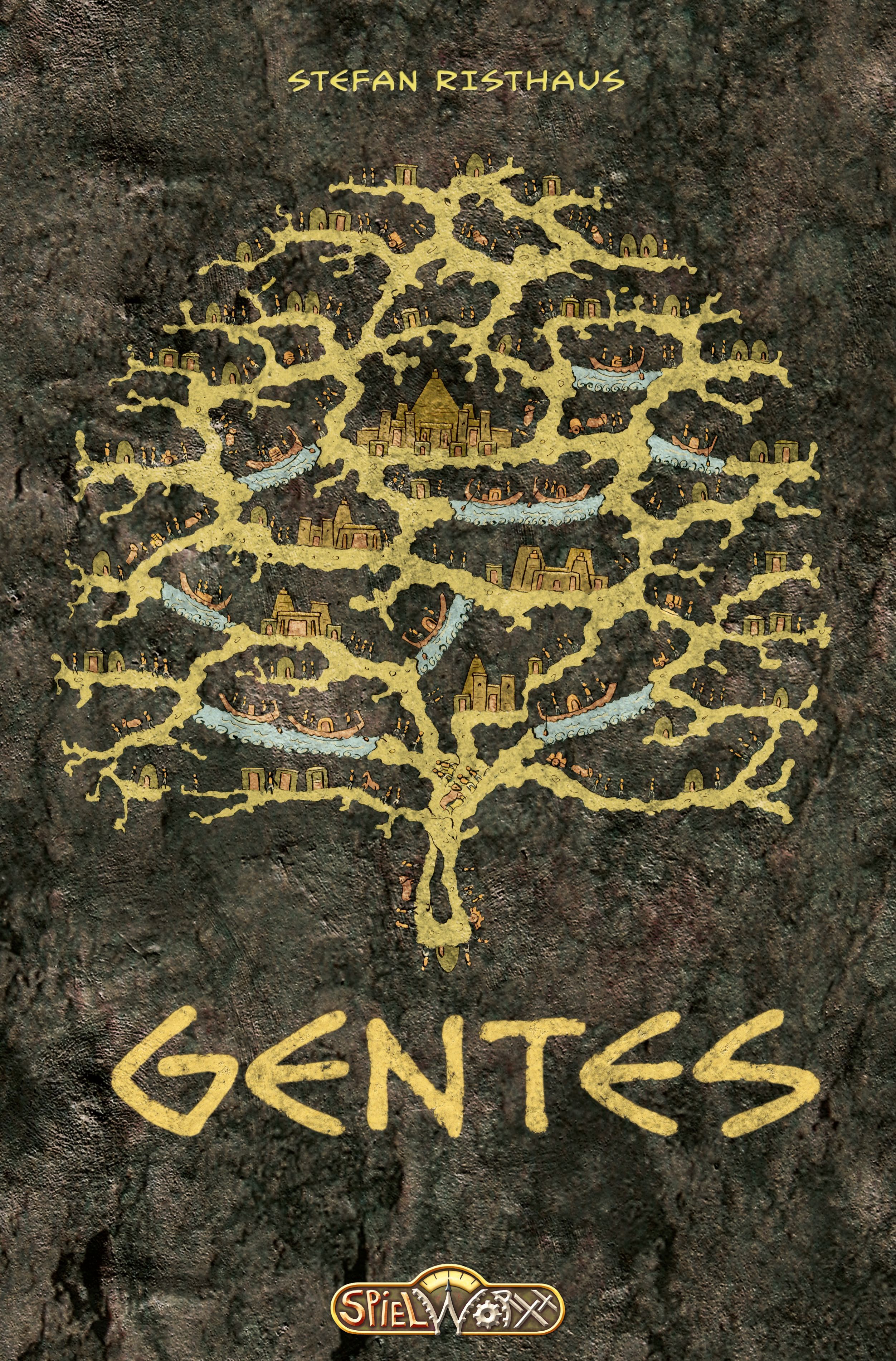
Gentes is a game for 2 to 4 players in which each player guides a people through several eras of ancient Mediterranean history. Players train people, build cities, and collect civilization cards to earn victory points. The game lasts six rounds, and the player with the most victory points at the end wins.
Preparazione
- Place the game board in the center. In a two-player game, cover the yellow region's cities with hourglasses.
- Shuffle the six training cost tiles and place them on the cost table in the philosopher area.
- Place action tiles on their spaces. For fewer than four players, put unused tiles face down, which also marks those action spaces as unused.
- Stack the bonus point tiles in their boxes, with the 8-point tile on top of each stack. With fewer than four players, return one or two 4-point tiles per stack to the box.
- Put the purple turn marker on the first space of the turn track.
- Each player takes a play aid, a player mat, the wooden parts in their color, 11 brown cubes, and one time tile. Place six cubes on the "0" spaces beside the population chart, and five cubes plus a single-hourglass time tile on the six rightmost time track spaces. Put the victory point marker on 0. Each player takes 20 coins and keeps them visible.
- Choose a starting player, who receives the starting player token. The starting player sorts the civilization cards by era, shuffles each era separately, and sets the era II and III stacks beside the board.
- The starting player places eight era I cards in a row below the board and puts the rest of era I beside the row.
- Reveal three era I cards per player. Starting left of the starting player and going counterclockwise, each player picks cards until everyone holds two. Shuffle the leftover cards back into the era I stack.
- Each player chooses four starting people and marks them on the population chart.
Un turno
The game is played over six rounds, with two rounds per era. Each round has two phases.
Heyday phase: Starting with the starting player, players take turns in order. On each turn a player must perform one main action while they still have a free space on their time track. Players may not pass. A player who fills the last space of their time track sits out the rest of the phase. The phase ends when all time tracks are full.
A main action has three steps:
1. Choose an action and pay its cost. Choosing the tax collector or becoming the new starting player gives coins instead.
2. Place the action tile on the leftmost free space of the time track, and add time tiles for the required hourglasses. Time tiles cannot be changed once placed.
3. Carry out the action.
Main actions are navigator (build cities), tax collector (gain coins), new starting player (take the starting token for the next turn), philosopher (train people), scribe (take civilization cards), and chronicler (play civilization cards from hand).
At any time during their turn, a player may also use additional actions: train a person by spending three cubes from the temple or oracle, exchange a person using a cube from the oracle, and take bonus point tiles when conditions are met. Civilization cards and hometowns can grant extra options.
Decline phase: Players clean up the round. Details are in the decline phase rules below.
Fine della partita
The game ends after the decline phase of the sixth round. Players then move to final scoring, and unclaimed bonus point tiles are returned to the box.
Punteggio
Final scoring happens in this order:
- Cards in hand: Each card whose requirements the player meets scores half its listed reward points (rounded up). Cards whose requirements are not met cost half their reward points (rounded up). Players may still use additional actions during this step.
- Coins: 1 victory point for every 10 coins.
- Cubes: 1 victory point for every 2 wooden cubes in the temple and oracle areas, counting all cubes regardless of origin.
- Hourglasses: Points are deducted for hourglasses left on the time track: 1 hourglass -2, 2 hourglasses -4, 3 hourglasses -8, 4 or more -16.
The player with the most victory points wins. In a tie, the tied player with more civilization cards in their display wins. If still tied, the tied player with the most coins wins.
Varianti
- Player count: The rulebook has variations for 2 to 4 players. Action tiles marked for certain player counts are used only in those games, and the yellow region is not used in two-player games.
- Tax collector removal: Experienced players may agree to cover the tax collector action space and give 4 coins with an hourglass to remove it from play during setup.
Modifiche
- Varianti: bozza del regolamento, 22 novembre 2026 (mostrata ora)
- Punteggio: bozza del regolamento, 22 novembre 2026 (mostrata ora)
- Fine della partita: bozza del regolamento, 22 novembre 2026 (mostrata ora)
- Un turno: bozza del regolamento, 22 novembre 2026 (mostrata ora)
- Preparazione: bozza del regolamento, 22 novembre 2026 (mostrata ora)
- Riassunto: bozza del regolamento, 22 novembre 2026 (mostrata ora)