Regole di Hammer of the Scots
Riassunto
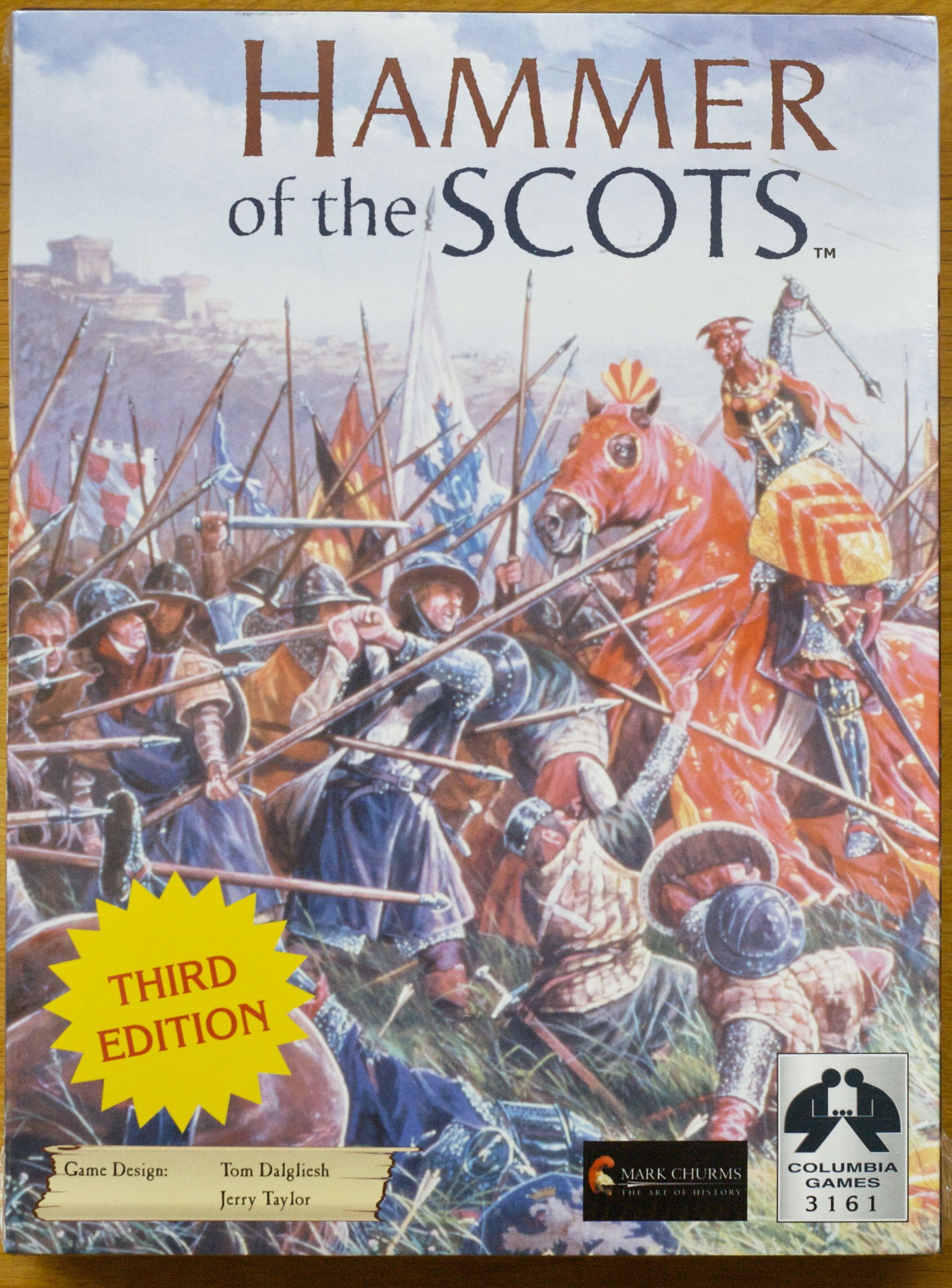
Hammer of the Scots is a two-player wargame of the Scottish Wars of Independence, with one player commanding the Scots and the other the English. The object is to control a majority of the nobles when the game ends. Blocks stand upright so their strength and identity stay hidden from the opponent.
Preparazione
Choose a scenario: Braveheart (1297 to 1305), The Bruce (1306 to 1314), or the Campaign game, which starts as Braveheart and continues past 1314 if needed. Each side deploys its blocks at full strength as the chosen scenario lists, and places the remaining blocks face down in its Draw Pool. Each player is dealt five move or event cards at the start of each year.
Un turno
Each year has one to five Game Turns, and each Game Turn has three phases.
- Card phase: Each player plays one card face down, then both are revealed. The higher card becomes Player 1 for the turn, and the English win ties. Event cards resolve first.
- Move phase: A move card allows one to three Group moves, where all friendly blocks in one area form a Group. Blocks move up to their Move Rating in areas and must stop when entering an enemy-occupied area or crossing a red border. Border limits apply, and Player 1 moves first.
- Battle phase: Battles occur where enemy blocks share an area. Player 1 chooses the order and each battle is finished before the next. Battles last up to three combat rounds, and blocks act by their combat rating, with A blocks first, then B, then C. A block rolls dice equal to its strength and scores a hit on each roll at or below its combat rating. Hits fall on the strongest enemy block. A block may retreat instead of attacking, and an attacker that has not won after round three must retreat.
After the year ends, a Winter Turn follows. Nobles return to their home areas, blocks above Castle Limits disband, and replacements are added. Then the deck is reshuffled and each player is dealt five new cards.
Fine della partita
A year ends when both players play an event card in the same Game Turn, or when all five cards have been played. The scenario ends at its final year (1305 or 1314), or when one side wins a sudden death victory. Sudden death is an instant win when one player controls all nobles in play at the end of a Game Turn, when the Scottish King is eliminated in battle (English win), or when Edward II is eliminated in battle (Scots win). Moray never defects, so the English can only win this way once Moray is dead or in the Draw Pool.
Varianti
Schiltroms (optional rule): When the English have no archers in a battle, all Scottish infantry fire at +1 (C3 becomes C4).
Tournament play: Players secretly bid E1, E2, E3, S1, S2, or S3 and a tournament organizer compares the bids. An E bid sets the number of years the English player uses King Edward, and an S bid sets how many extra blocks join the 1297 English Feudal Levy. Matching bids cancel out, and remaining bids are paired as closely as possible, with the net effect applied to the higher bidder.
Campaign game: Begin with the Braveheart setup and keep playing past 1314 until one side wins, with Edward I becoming Edward II in 1307.
Modifiche
- Varianti: bozza del regolamento, 23 novembre 2026 (mostrata ora)
- Fine della partita: bozza del regolamento, 23 novembre 2026 (mostrata ora)
- Un turno: bozza del regolamento, 23 novembre 2026 (mostrata ora)
- Preparazione: bozza del regolamento, 23 novembre 2026 (mostrata ora)
- Riassunto: bozza del regolamento, 23 novembre 2026 (mostrata ora)