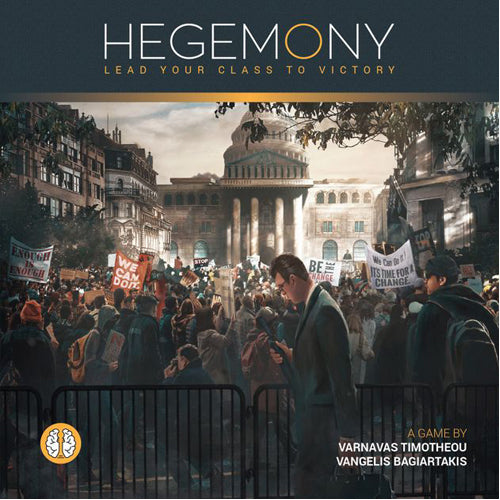
Regole di Hegemony: Lead Your Class to Victory
Riassunto
Hegemony is a card-driven game for 2 to 4 players, where each player takes the role of the Working class, Middle class, Capitalist class, or the State, each pursuing its own agenda. Over five rounds, players play action cards, build and run Companies, and try to change government policies through votes. The player with the most Victory Points at the end wins.
Preparazione
Set up the main board with the starting Capitalist Companies, Public Companies sorted by player count, the starting Business Deals, Export card and Immigration deck, the policy markers, the State's starting money, the Round marker on the first space, and the Tax Multiplier marker on 5. Shuffle the voting cubes into the cloth bag, with six of each color, including the Middle-class cubes even in a 2-player game. Each player then sets up their role: take a player board, starting resources and money, Bill markers, a hand of 8 action cards, and the role's starting Workers and Companies. In 2-player games the roles are Capitalist and Working class; in 3-player games, Capitalist, Working and Middle class; in 4-player games, all four roles, with the State also needing its Legitimacy markers, Event and Political Agenda cards.
Un turno
The game lasts five rounds, each with five phases. Preparation (skipped in round 1): move the Round marker, then each role pays loan interest, refreshes its Workers and draws cards to a hand of 8, and receives new Workers from Immigration. Action phase: each player in turn order (Working, Middle, Capitalist, State) plays one action card for its effect or discards it for a Basic Action, and may perform one Free Action. Six turns are taken in total, leaving 2 cards for the next round. Production phase: the player order is reversed; Companies produce and Wages are paid, Workers' needs are covered with Food, and taxes are paid. Elections phase: if Bills were proposed, each Policy with a Bill is voted on in order, with cubes drawn from the bag and Influence spent to add votes. Scoring phase: players score extra VP for their progress, and the State applies penalties for unresolved Events.
Fine della partita
The game ends after the fifth round. Each player is given a last chance to pay off loans at 55 per loan, and any unpaid amount costs VP. Each role then scores its end-game bonuses based on Policies and its personal board.
Punteggio
Victory Points come from several sources during play: Bills that pass give the proposer 3 VP and supporters who contributed a vote 1 VP each; Prosperity increases give VP equal to the new value (Working and Middle class); Capital and Wealth tables score for the Capitalist class; Trade Unions and Events also grant or cost VP; and the State scores based on its Legitimacy and Political Agenda. At the end, each role adds bonuses for the number of Policies in its section and for remaining resources or money. The highest score wins. In a tie, count the Policies among Policies 1-5 in each tied player's section (Working A, Middle B, Capitalist C, State matching its Political Agenda card); the most wins. If the State is still tied, it wins; otherwise the player with the most Voting cubes wins; if still tied, the tied players share the victory.
Varianti
The rulebook gives no separate solo, team, or short-game variant. It does describe the rules for 2-player and 3-player games, in which some roles are not played and the State is not controlled by a player, with differences in setup, the Public Sector, and election handling.
Modifiche
- Varianti: bozza del regolamento, 22 novembre 2026 (mostrata ora)
- Punteggio: bozza del regolamento, 22 novembre 2026 (mostrata ora)
- Fine della partita: bozza del regolamento, 22 novembre 2026 (mostrata ora)
- Un turno: bozza del regolamento, 22 novembre 2026 (mostrata ora)
- Preparazione: bozza del regolamento, 22 novembre 2026 (mostrata ora)
- Riassunto: bozza del regolamento, 22 novembre 2026 (mostrata ora)