Regole di Hermagor
Riassunto
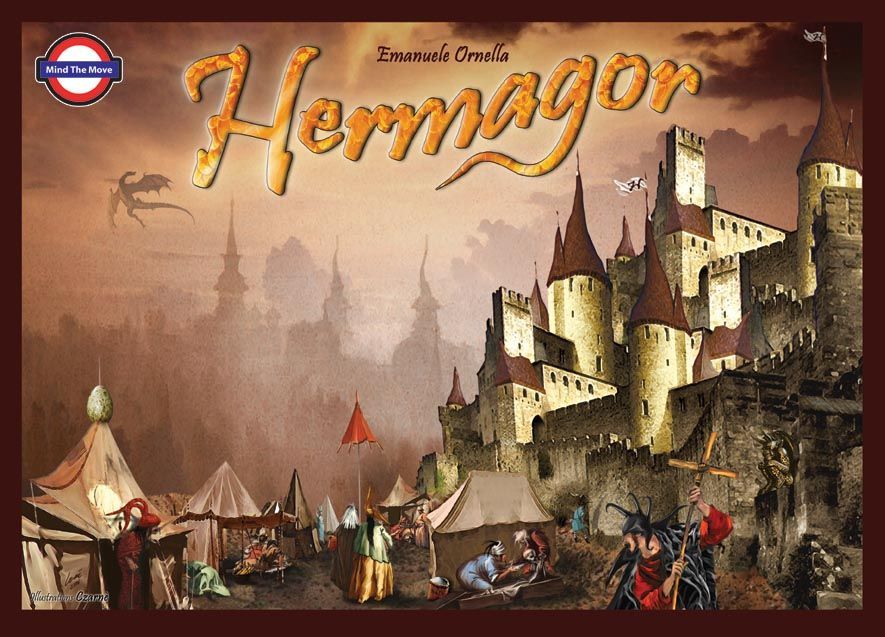
Hermagor is a trading game for 2 to 5 players (ages 12+, about 90 to 120 minutes). Players send Merchants around the map to buy product tiles, sell products in villages, and build trade stations and production buildings. The player with the most money at the end, after final income is counted, is the winner.
Preparazione
Place the board and set the Banknotes next to it as the Bank. Put all the Price Indicators on the value 5 for each product, so the green 0 and 1 numbers are hidden. Put all the trade stations (wooden houses) in a common supply beside the board.
Shuffle the Action Tiles for the player count and place them face down as a stack. With 2 or 3 players use Action Tiles 3, 4, 5 and remove the Product Tiles numbered 17 to 20. With 4 players use 4, 4, 4, 5. With 5 players use 3, 4, 5 and 5. Put the remaining Product Tiles and the Special Tiles into the bag.
Each player picks a colour and places one Merchant on Hermagor city. Each player also takes the other 4 Buyers, all 9 production buildings (discs) and 20 Cash. Choose a Start Player at random and give them the Start Player Tile.
Fill the General Market from the bag. With 5 players, fill all 20 spaces. With 2 or 3 players, leave the top row and the bottom row empty. Fill from upper left to lower right.
Un turno
Each round has three phases.
Phase 1: Buying in the General Market. Starting with the Start Player and going clockwise, each player places one Buyer on an empty market tile or on an empty number in a passageway. Placing a Buyer on a tile costs nothing, but placing one on a passageway number costs the amount shown there, paid to the Bank. Players repeat until all have placed their 4 Buyers. Then Phase 1 moves to tile acquisition: each tile is checked from upper left to lower right. The player with the most Buyers on or around a tile wins it. A tie is settled by a Buyer on top of the tile, then by the most Buyers on the tile's edges (not corners), and if still tied the tile stays in the market. A tile with no Buyers stays too. A won tile goes face up in front of its owner. A single product tile with an arrow lets its owner move that product's price indicator one step to the right immediately. Before the next phase, each player with Buyers in the passageways collects 1 Cash per line with one Buyer, 3 with two, 6 with three, or 10 with four. A player with no product tiles draws one tile from the bag until they get one. The player with the lower tile number becomes the new Start Player. Turn over the next Action Tile, and each player takes that many trade stations from the supply.
Phase 2: Passageway buzz and acquiring products. This is the tile and passageway step described above.
Phase 3: Selling to the villages. Starting with the Start Player and going clockwise, each player takes one action. Play continues until all trade stations are used. The actions are:
- Movement with selling: Move the Merchant to a village where you have no trade station, paying the road cost to the Bank. Then sell one product type shown on that village, which requires a tile for that product. Selling is not allowed before moving.
- Selling without movement: If your Merchant is already in a village where you have no trade station, sell one product.
- Movement without selling: Move to any village where you have no trade station, paying half the road cost rounded down. Return one unused trade station to the supply.
- No action: The Merchant stays put, and you must return one unused trade station to the supply.
When you sell, take the current price from the Bank, place a trade station on the village, and each other player who already has a station there receives 1 Cash from the Bank. Merchants can pass through any village or Hermagor city, but cannot stop in a village where they already have a station. Hermagor city does not allow selling.
When a station completes a region (all surrounding villages have your stations), place a production building on the Production Buildings side of the Price Table, on the highest unoccupied value that matches the building shown in the region. If the price indicator hides a square, that square cannot be used. For a region marked with an H flag, place the disc on the Nobility row on the lowest unoccupied number instead and collect the matching Cash. Completing a region also pays the matching Cash from the Bank.
Use the Black Market tile to stop collecting trade station income from the Bank for the rest of Phase 3. Use the Floating Market tile to raise one product's price once, then discard it. Use the Shortcut tile once in Phase 3 to take a movement-without-selling action at half cost, and discard it. Use the Good Deal tile to collect 5 Cash and discard it.
Fine della partita
The game ends when no Action Tiles are left to turn face up in Phase 1. When Phase 3 ends, all tiles are returned to the bag and shuffled. If Action Tiles are still left, a new round begins with Phase 1.
Punteggio
After the final round, final income is counted and the richest player wins. If players tie for the most money, the tied player with the most discs on the Price Table wins. If a tie remains, the tied player whose disc is furthest to the left on the Nobility row wins.
Varianti
The rulebook mentions a Revenue Officer variant, in which the rule about the lower tile number becoming the Start Player is not used, and a "6" Action Tile used for variants. It does not describe these variants in detail.
Modifiche
- Varianti: bozza del regolamento, 23 novembre 2026 (mostrata ora)
- Punteggio: bozza del regolamento, 23 novembre 2026 (mostrata ora)
- Fine della partita: bozza del regolamento, 23 novembre 2026 (mostrata ora)
- Un turno: bozza del regolamento, 23 novembre 2026 (mostrata ora)
- Preparazione: bozza del regolamento, 23 novembre 2026 (mostrata ora)
- Riassunto: bozza del regolamento, 23 novembre 2026 (mostrata ora)